

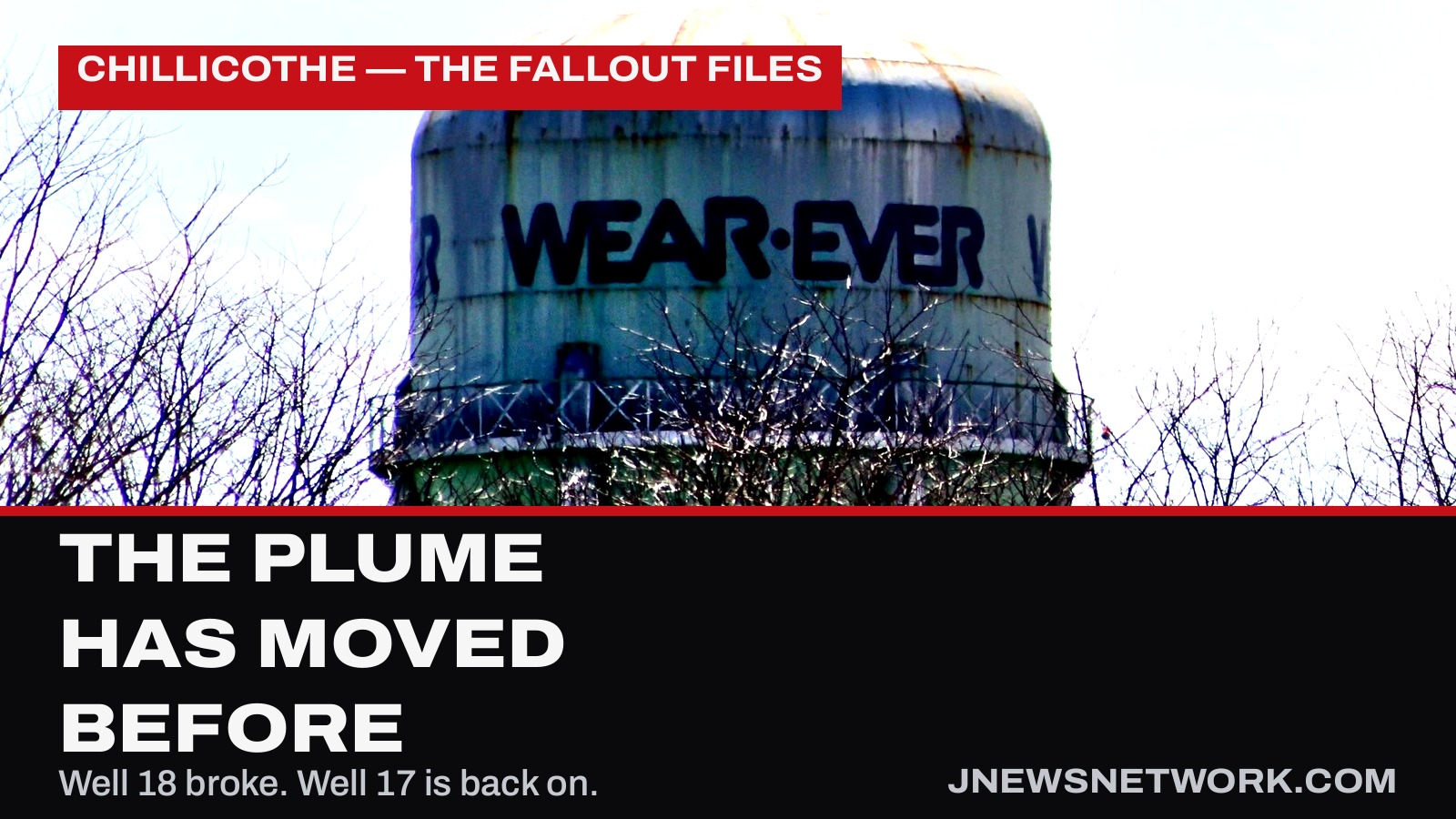
CHILLICOTHE, Ohio — U.S. Paper Mill’s own news release, issued November 16, says the company had to bring Collector Well 17 back online because Well 18 broke down.
Read that against the state’s filings and it is an admission. The release confirms what the company had omitted: it has only been running one pump, on one well, since it took possession of the mill — or at the very least since June, when Howmet Aerospace’s own environmental consultant documented Well 17 shut down and Well 18 running alone. The one well that was running is the one that broke.
What the company says
According to the company’s November 16 release, as reported by the Chillicothe Gazette, a decades-old shaft fractured in Well 18, which had been used to pump water to contain the Wear-Ever toxic plume. Since the shaft could not be repaired quickly, U.S. Paper Mill shifted to using Well 17, which had been dormant. The water table level is being maintained, the company said. When the fracture occurred, U.S. Paper Mill alerted the Ohio Environmental Protection Agency (EPA) and City of Chillicothe about the malfunction.
The release says the company has been pumping water since acquiring the closed Pixelle Specialty Solutions plant last year to ensure the water table does not rise high enough into the plume, as a voluntary service to Ohio EPA and Howmet, and that employees make hourly rounds every shift to check the wells and perform maintenance on pumps that cost at least $1 million per year to operate. The release also lists the company’s commitments to receive and process leachate from the Paint Street Landfill, maintain compliance with state water flow and air quality permits, and eliminate odor through closure of the former pulp mill.
“I am grateful to all our colleagues who prioritized the health and safety of the community we love over the operations of our business,” Utility Superintendent Aaron Anders said in the release, as reported by the Gazette. “We are pleased to see that the well water is being pumped, and we will continue to monitor the situation, as we always have.”
The November 16 release also answers the question the company’s November 12 statement left open. As J News Network reported on November 13, the November 12 statement — which called a fractured pump a “potentially urgent situation” — never named a well. The company now says the fractured shaft was in Well 18, and that it had to bring the dormant well back to replace it.

The June record: one well running
Key Environmental Inc., Howmet Aerospace’s environmental consultant, filed the former Wear-Ever site’s second-quarter 2026 groundwater monitoring report with Ohio EPA this fall. In it, describing the June 2026 monitoring event, Key Environmental states: “Collector Well 17 was not operating during this monitoring event.”

The same report describes which well U.S. Paper Mill has actually been running since it bought the plant: “USPM has continued to operate Collector Well 18 since taking ownership of the property.” Well 18 — not Well 17. The same page records that the June 2026 gauging data show “groundwater is captured by Collector Well 18,” and that Ohio EPA raised the containment issue on July 7, 2025, in a letter to Howmet “regarding groundwater containment concerns and additional monitoring well installation due to the anticipated shutdown of the paper mill.”

So the sequence, on the documents and the company’s own release together, is this: one well running — Well 18. That well’s shaft fractured. The company switched to the well documented as off in June. Containment at the Wear-Ever plume is still one well at a time.
What the EPA records say happened the last time pumping fell
In the COVID years, the starting point was stronger than it is now — and it was not enough. Key Environmental’s second-quarter 2026 report, citing the 2020 Five-Year Review Report, recounts what happened when production at the mill’s collector wells was reduced, with both wells in service:
“as noted in the 2020 Five-Year Review Report it was observed in the second quarter of 2020 that the groundwater flow direction had shifted to the southeast. Pixelle was contacted in 2020 to determine if they had well maintenance issues or had made changes to their pumping operations. Subsequent data provided by Pixelle showed apparent reduced production from their collector wells prior to the second quarter of 2020.”
The shift did not correct itself in a quarter. “Groundwater flow data at the Site through the third quarter of 2021 showed the flow was generally to the southeast and the horizontal hydraulic gradient was less than half of the typical historical values,” the report states. Flow returned east-northeast only after pumping increased again: “the past four years of potentiometric data indicate that the horizontal groundwater flow direction at the Site has shifted back toward the east-northeast as a result of increased pumping at Collector Wells due to maintenance work performed by Pixelle.”

J News Network published the 2020 shift on October 13, in “New WearEver groundwater tests reveal persistent contamination as paper mill pumping raises concerns,” which reported that engineering records describe periods between 2008 and 2013 and again in 2020 when groundwater shifted toward the southeast.
Ohio EPA has seen the same pattern from the other side. As NBC4 Investigates reported in July 2025, Ohio EPA documents show the paper plant paused its well use for maintenance in the 2000s and during the COVID-19 pandemic, and each pause correlated with a spike in trichloroethylene (TCE) concentrations. Ohio EPA documents also show that losing the paper mill shifts the direction of groundwater flow toward local farms and the Scioto River, NBC4 reported — and in 2022, Ohio EPA described the mill closing as a “worst-case scenario” for containing the plume.
And Key Environmental’s report states the low-pumping outcome in plain terms: “Previous groundwater monitoring periods during low pumping or no pumping conditions at Collector Wells 17 and 18 indicate that groundwater beneath the Site will likely flow east-southeast toward the Scioto River and will be characterized by relatively low hydraulic gradients and low groundwater velocity.”
Set that beside now. In 2020, two wells at reduced production could not hold the flow — it turned southeast and stayed turned for more than a year. In 2026, the starting point is not two reduced wells. It is one well, at a plant that no longer makes paper.
A glove plant is not a paper plant
The reason volume matters is in the record. The mill’s key wells used more than 1 billion gallons of water each year, constantly pulling groundwater levels down and keeping the plume from rising to the surface or spreading, according to Ohio EPA documents reported by NBC4. Linda Weavers, codirector of the Ohio Water Resources Center at Ohio State University, told NBC4 the wells flush contaminated water out of the system, and that when pumping stops, contaminants stuck on soil have more time to interact with water and release more contamination.
The operation now in the mill is a glove company — U.S. Paper Mill is an affiliate of U.S. Medical Glove Company — not a paper manufacturer. A glove operation will never pull the amount of water Pixelle pulled during full paper-making operation. As J News Network established on November 13, a replacement pump does not restore paper-manufacturing pumping volume — and neither does switching to the well that sat dormant. The same Q2 2026 report states that U.S. Paper Mill’s “long term plans for use of the paper mill production wells are not well understood.”
The early-warning network meant to catch the plume if it moves still is not in the ground. Ohio EPA ordered additional sentinel monitoring wells, and as J News Network reported on November 12, the property access agreements went out in October 2025 and remain unsigned, and on November 6 Ohio EPA sent Howmet’s installation work plan back with nine technical comments.
The plume did not become a story this week, and a well switch does not settle it. The company’s release and the June record together prove the one-well reality. The EPA records prove what reduced pumping did the last time. And nothing in either record shows the volume that once held this plume coming back.