
CHILLICOTHE — The most important number in Chillicothe’s mill deal is not the sale price.
It is a case number in a federal file in Washington: LA-05177, “In the Matter of CAI Investments, LLC” — a formal Securities and Exchange Commission investigation of the Las Vegas firm whose sponsored trust bought a major portion of the former Pixelle paper mill on Aug. 3, 2026, for $76,525,000, according to Ross County records.
A formal SEC investigation is not a charge, and it is not a finding of wrongdoing. The commission has brought no enforcement action against CAI Investments in any public record J News Network could find. But the file exists, it has existed since 2020, and it was opened years before CAI’s name appeared on a Chillicothe deed — one more fact about the mill transaction that the public record held long before the public was told.

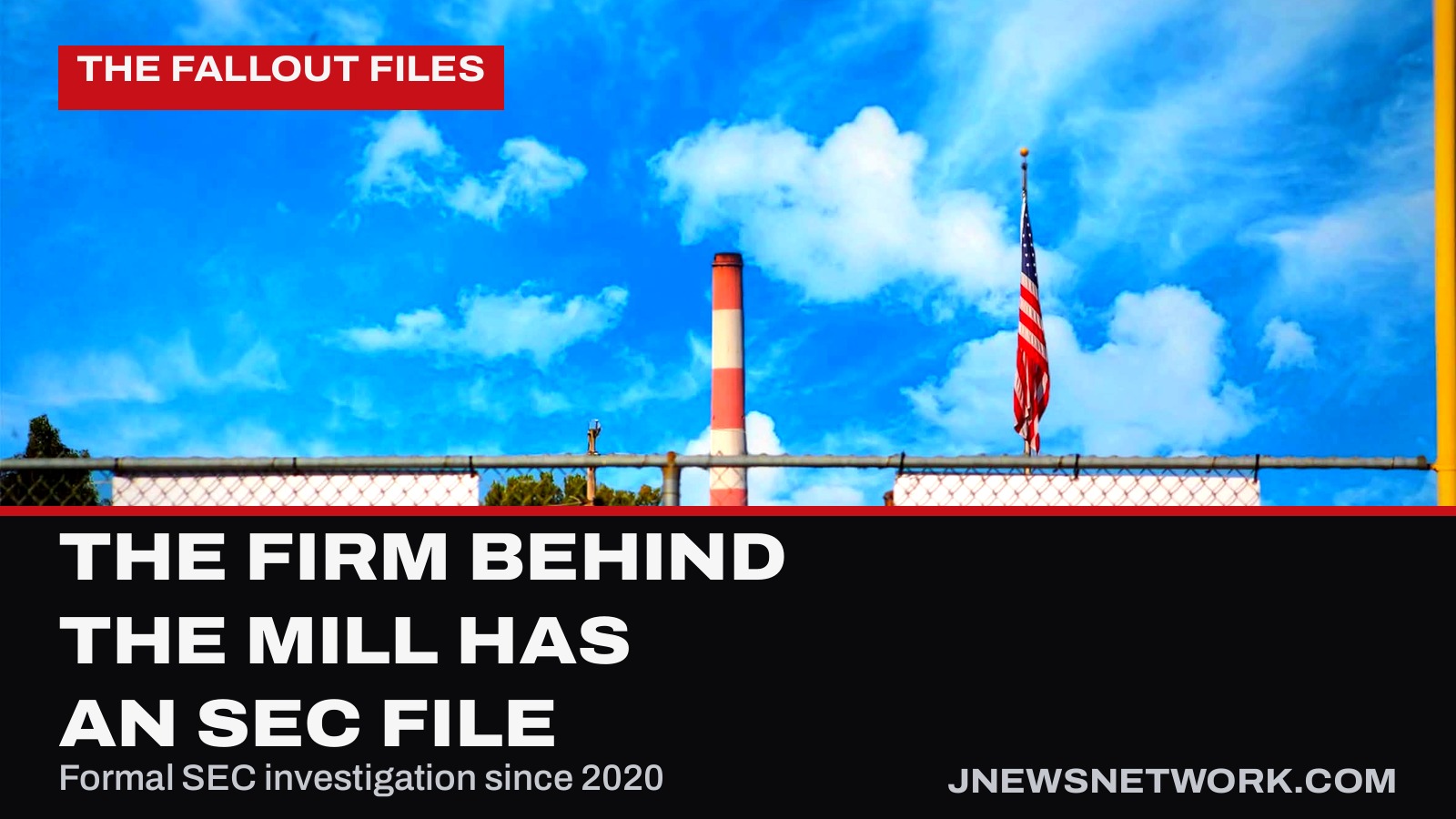
The smokestack of the former Pixelle paper mill in Chillicothe, now held in part by a trust sponsored by CAI Investments. (Photo: Jason Salley / J News Network)
The file in Washington
The investigation became visible only because it collided with a court fight. In 2022, a woman named Ella Asuncion Gutierrez went to federal court to stop the SEC from obtaining her personal bank records. According to her filing in Gutierrez v. SEC, the commission had subpoenaed Navy Federal Credit Union for her personal banking records from Jan. 1, 2018, to the present, in connection with the investigation captioned “In the Matter of CAI Investments, LLC, LA-05177.” Gutierrez stated that CAI never had access to her accounts. Her motion to quash was denied on April 27, 2022.
The commission’s formal order in the matter — the internal document that authorizes SEC staff to issue subpoenas — was entered on Aug. 17, 2020, according to the same court record. The order itself is not public. What it covers is known publicly only because a party on the other side of a CAI affiliate’s bankruptcy quoted it: a Feb. 19, 2025, filing by Reno City Center Owner LLC states that the order directed SEC staff to examine whether CAI and others raised investor money that was used for, among other things, “funding other CAI projects, benefitting CAI’s principals, or making ‘Ponzi-style’ payments to earlier investors,” and whether the firm violated the antifraud and registration provisions of the federal securities laws.
That description is an adversary’s characterization in a bankruptcy fight, quoted from a document the public cannot read. It is not an SEC finding. The current status of the investigation is not public, and J News Network found no SEC enforcement action, no FINRA disciplinary action tied to CAI product sales, and no state regulator action against the firm in the public record.
What is documented is narrower, and it is enough: the firm that now stands behind Chillicothe’s mill has been the subject of a formal federal securities investigation since 2020, and that fact appears nowhere in the marketing materials CAI used to sell the Chillicothe deal to investors.
The deal Chillicothe got
CAI Investments, founded in 2011 by Christopher Beavor and based in Las Vegas, sponsors Delaware statutory trusts — vehicles that let investors place 1031 exchange money into fractional shares of large properties. The firm describes itself as managing about $1.5 billion in assets.
The Chillicothe vehicle is called Critical Infrastructure I, DST. Its asset is a major portion of the former Pixelle mill campus: the Ross County land records show the trust bought the property from US Paper Mill LLC on Aug. 3, 2026, for $76,525,000. The trust’s purchase did not include the portion of the mill where a data hall has been proposed; that portion remains owned by US Paper Mill LLC. US Paper Mill — an affiliate of U.S. Medical Glove Company — stayed on as tenant-operator under a 25-year absolute triple-net lease with 2 percent annual rent increases, and the glove company guarantees the lease, according to CAI’s offering materials. The Food and Drug Administration lists U.S. Medical Glove as the owner/operator of the Chillicothe establishment.
The timeline is the part that still does not sit right. CAI’s offering brochure for the Chillicothe trust is dated December 2025 — roughly eight months before the trust owned the property. The brochure marketed an offering of $91,865,169, a $100,000 minimum purchase, a 25-year lease and 2 percent annual increases, and it carried an aerial photograph of the mill. A June 2026 edition of the brochure was still marketing the offering at about $91.8 million. J News Network located no SEC Form D filing for the Chillicothe trust, and the offering’s funding and closing status could not be verified.

CAI Investments’ December 2025 brochure for Critical Infrastructure I, DST — the trust that bought a major portion of the Chillicothe mill the following August. The brochure lists an offering size of $91,865,169, a 25-year lease and 2 percent annual rent increases. (Document: CAI Investments)
The underlying property had changed hands for a fraction of that figure less than a year earlier. US Paper Mill acquired the former Pixelle portfolio — 31 parcels — on Oct. 17, 2025, for $7.8 million, and glove production began at the mill almost immediately. The company later said the site employed more than 200 full-time workers across 15 nitrile-glove production lines.
Ross County Auditor Jeff Lehner has said his office received the paperwork for the August conveyance several weeks before it was processed, and that the delay was deliberate.
“The size of the transaction and history of this property caused us to want to apply a higher level of scrutiny,” Lehner said.
His office convened a meeting that included the county engineer, Mayor Luke Feeney and an assistant county prosecutor, and the county was advised to process the transfer after legal review, Lehner said. He has also said he intends to value the new parcel at its $76.5 million recorded sale price — a figure that will shape the property’s tax treatment going forward.

Inside the Chillicothe mill: glove production lines beneath a “By Americans For Americans” banner bearing the U.S. Paper Mill Company seal, during a tour of the facility. (Photo: J News Network files)
The letter, the moratorium and the repeal
The mill’s future use was settled on paper months before most of Chillicothe’s elected officials knew a question had been asked. On Feb. 12, 2026, the mill’s owner asked the city to confirm whether a data center could operate at the property. On Feb. 20, Chief Building Official Brandon Gill issued a written determination: a data center was compatible with the property’s General Industrial zoning and required no conditional-use approval.
Mayor Feeney has said such determination letters are routine public records and were not intentionally hidden. But when the February letter surfaced months later, seven city council members said they had not seen it. Council unanimously approved a 60-day moratorium on data centers on Aug. 24, then voted 8–1 on Sept. 14 to repeal it after the February determination became public. The administration attributed the failure to circulate the letter to an administrative and clerical breakdown.
At least one council member has told J News Network he was never informed that the auditor’s scrutiny meeting had occurred, or that a substantial portion of the mill had been transferred into an investor trust.
The tenant’s own paper trail
The trust’s tenant arrives with its own court record, and it is not clean — though every item on it is, at this stage, an allegation or a business dispute, not an adjudicated finding.
On July 30 of this year, Columbia Gas of Ohio sued US Paper Mill, alleging $3,467,662.72 in unpaid gas charges as of April 1. Months earlier, the mill had temporarily lost gas service after US Paper Mill acknowledged it had failed to renegotiate the gas contract it inherited from Pixelle — an episode the company publicly called an “avoidable mistake.” A Chillicothe steel supplier has also sued the company over nearly $20,000 it alleges it is owed.
In August, PNK DC LLC sued the company in federal court, alleging it advanced $3 million for a data-center buildout at the mill and then discovered utility liabilities and mortgages the complaint says were not disclosed before the advance — including, the complaint alleges, roughly $5 million in unpaid utility balances and about $26 million in 2025 mortgages. Those are the plaintiff’s allegations, unproven, and they matter here for one reason: they describe a tenant whose obligations were, on paper, larger and more complicated than the public story of the mill’s rebirth suggested.
Behind the tenant stands a federal contract — and a federal paper trail of its own. On May 27, 2021, the Department of Defense awarded U.S. Medical Glove Company a $63.6 million contract to build domestic nitrile-glove capacity, sized at 24 production lines and 2.31 billion additional gloves a year, at Fort Knox, Kentucky. The General Services Administration’s inspector general opened a case captioned “US Medical Glove Company — Potential COVID-19 PPE Fraud Non-Delivery of Product” (case I22600022) and closed it on Nov. 30, 2022; its findings are not public.
A whistleblower suit goes further, and it is important to be precise about what it is. In United States ex rel. Dylan Ratigan v. U.S. Medical Glove Company LLC, filed in the Eastern District of Kentucky (Case No. 5:23-cv-00149-DCR), the relator alleges that the company, John Todoroki and others used false statements and deceit to obtain at least $36,624,363.94 under the federal glove contract, through false progress reports and unsupported invoices. Those are allegations in an unsealed complaint. They have not been proven, no court has adopted them, and the referral materials that summarize the case state plainly that criminal liability has not been established.
Behind the data hall
The data-center question did not end with the moratorium repeal. On Sept. 8, 2026, Chillicothe learned that a 6.5-acre data hall was planned inside the mill — on the portion of the campus that remains owned by US Paper Mill LLC, not on the parcel the CAI trust bought. The corporate filings behind that announcement describe something larger than the announcement did: an initial phase of up to 154 megawatts, with a pathway to roughly 480 megawatts, under a combined company — SOAR AI, Inc., formerly Volato Group — formed when Alignment Engine merged into Volato in a transaction that closed Sept. 11–14 and was valued at about $500 million, leaving former Alignment holders with about 95 percent of the combined company. Local coverage of the announcement put the initial build at about 89 megawatts.
SOAR AI chief executive Chris Ensey has framed the mill itself as the prize: “We aren’t starting with a greenfield site and a plan to find power,” he said — the campus came with power infrastructure, including a separated on-site power plant now held by an entity called U.S. Power and Cattle.
Here is what the documents do not establish, and what this story does not claim: the data-center portion of the mill was never part of the trust’s purchase — it remains US Paper Mill’s — and no document proves the mill’s owners planned their exit before they arrived. What the record shows is a sequence — a $7.8 million purchase, a $76.5 million transfer into an investor trust, a data hall announced weeks later — that leaves the control question open.
Harvard: the same play, a different ending
Chillicothe is not the first glove town to host this structure. In Harvard, Illinois, a CAI-sponsored trust — Manufacturing Essential Asset, DST — owns the former Motorola headquarters campus at 2001 N. Division St., about 1.5 million square feet, and its sole tenant is U.S. Medical Glove Company. The trust’s SEC Form D lists a total offering amount of $182,117,607, a $100,000 minimum investment, and a signature by Christopher Beavor dated April 11, 2023; Emerson Equity, the broker-dealer that sold the Chillicothe offering, is listed as a recipient of sales compensation. CAI announced the Harvard trust was fully subscribed in March 2026, and a second Harvard-linked vehicle, MEA II, completed a $22.28 million raise in February 2025 for a facility in Honea Path, South Carolina.
Manufacturing Essential Asset, DST — SEC Form D filing (EDGAR)
The Form D for Manufacturing Essential Asset, DST (SEC filing, signed by Christopher Beavor, April 11, 2023): a total offering of $182,117,607 for the trust that owns the Harvard, Illinois, plant tenanted by U.S. Medical Glove Company.
The Harvard plant is now closed. The Harvard Fire Protection District’s minutes of April 14, 2026, confirm the facility’s closure, and Shaw Local reported in September that the property is the subject of lawsuits, a $127 million foreclosure claim and the building’s shutdown. J News Network could not independently verify the foreclosure case’s plaintiff, court or case number, and does not name them here.
What the court record does show, in full, is the utility judgment. In McHenry County Case No. 2026LA000046, Commonwealth Edison sued USMC 2023 LLC and U.S. Medical Glove Company LLC on Feb. 4, 2026, and on Sept. 8, 2026, judgments totaling $2,479,961.95 were entered against both defendants. The docket lists those judgments as unsatisfied. CBRE’s Chicago industrial report for the third quarter of 2026 lists the Harvard plant among the market’s largest available sublease blocks — 1.5 million square feet of glove plant, offered back to the market.

The former Motorola campus at 2001 N. Division St. in Harvard, Illinois — owned by CAI’s Manufacturing Essential Asset, DST and tenanted by U.S. Medical Glove Company until its closure. (Aerial image: Google Earth, as published in The Fallout Files)

The McHenry County docket in Commonwealth Edison v. USMC 2023 LLC (Case No. 2026LA000046), showing judgments of $2,479,961.95 entered Sept. 8, 2026, and listed as unsatisfied. (Court record: McHenry County Circuit Court)
Reno: two projects, two collapses
The Harvard and Chillicothe trusts are CAI’s industrial deals. Its hospitality deals produced the court record that exposed the SEC file.
In Reno, Nevada, CAI’s Reno City Center project — the conversion of the former Harrah’s casino towers — collapsed into Chapter 11 (Case No. 24-50152-hlb). The project’s lender, Delphi CRE Funding LLC, had declared a default in April 2023 asserting a $59,474,502 funding shortfall, and filed a proof of claim for $106,404,600.05. The debtor alleged that Beavor and CAI’s management affiliate misappropriated loan funds; those assertions were never adjudicated. The bankruptcy court dismissed the case on Feb. 26, 2025, and on Dec. 12, 2025, the Ninth Circuit Bankruptcy Appellate Panel affirmed the dismissal, rejecting an appeal brought by appellants including Christopher Beavor, CAI Investments LLC and CAI Reno Hotel Partners LLC. A $42 million loan from Madison Capital funded a $47.5 million settlement with Delphi, and Madison is now the project’s majority owner.
Read the opinion (PDF): U.S. Bankruptcy Appellate Panel of the Ninth Circuit, BAP No. NV-25-1050
Opinion of the U.S. Bankruptcy Appellate Panel of the Ninth Circuit, BAP No. NV-25-1050 (filed Dec. 12, 2025), affirming dismissal of the Reno City Center Owner LLC Chapter 11 case. Also available from the Ninth Circuit.
A second Reno project, the Kimpton hotel development, is a separate matter and should not be confused with the first. Its lender foreclosed, the parcels were sold at a trustee’s sale on May 16, 2025, for $1 million, and CAI Reno Hotel Partners, LLC went through Chapter 7 (Case No. 2:24-bk-15652). On Dec. 9, 2025, CAI bought the land back for $14 million through an affiliate, according to the Reno Gazette Journal.
In Tempe, Arizona, the firm’s Westin hotel took an $86.5 million construction loan from Hall Structured Finance, missed its November 2023 maturity, and was noticed for a trustee’s sale in January 2024 that was postponed seven times before a two-year extension closed in May 2024. The hotel is operating; the loan’s status since the extension could not be verified.
The record is not one-directional. In Ohio, a different CAI trust — Healthcare Products I, DST — won a judgment of more than $32 million in Hamilton County against a defaulting tenant, St. Bernard Soap, in a case filed Nov. 27, 2024. Sponsors sue tenants; tenants fail; that is the ordinary friction of commercial real estate. The pattern that matters for Chillicothe is not that CAI’s deals have produced litigation. It is that the two deals built on U.S. Medical Glove as the tenant — Harvard and Chillicothe — were sold to investors on the strength of the same operator, and one of them has already closed.
The lawyers are circling the brokers, not the sponsor
The investor-law firms now advertising CAI cases are aimed, notably, at the firms that sold CAI’s products rather than at CAI itself. The law firm SSEK states it is investigating brokers for “potentially unsuitable recommendations and due diligence failures related to the $182M CAI Investments Manufacturing Essential Asset DST,” and says it has filed a FINRA arbitration for a Michigan retiree against Capulent and two of its brokers, seeking up to $500,000. The White Law Group says it filed a FINRA claim against Arkadios Capital on Oct. 14, 2026, for a Florida retiree seeking $500,000 to $1,000,000 over unsuitable DST purchases including the Harvard trust. On its own Reno page, White Law cautions that “none of these allegations have been proven.”
SSEK’s page also cites reports of suspended dividends and additional capital calls on CAI investors. J News Network could not independently corroborate either claim, and neither FINRA filing mentions a dividend suspension; they are reported here as what they are — assertions on a law firm’s solicitation page, not findings.
For completeness: the SEC sanctioned Emerson Equity, the broker-dealer on CAI’s offerings, on Aug. 11, 2025 — over GWG L Bonds, a different product entirely, not CAI. It is part of the selling chain’s record, not part of CAI’s.
“By Americans, for Americans” — and the Philippines
U.S. Medical Glove’s public identity is built on domestic manufacturing. At a May announcement covered by the U.S. Chamber of Commerce, the company declared its model “Made by Americans for America,” and its chief financial officer, Lucas Muriello, said “the best products in the world are made by American workers.”
In March, the office of Philippine President Ferdinand Marcos Jr. announced that the same company planned a glove plant in the Philippines — an initial investment of up to $200 million and more than 2,000 Filipino workers, according to the Philippine Information Agency. As of Sept. 20, 2026, no commercial production from the Philippine venture had been verified, and the company’s local partner has not been named.
None of that is illegal, and none of it is hidden, exactly. It is simply not in the brochure.
The question the documents leave open
J News Network asked CAI Investments and its founder, Christopher Beavor, for comment on the SEC investigation, the Harvard and Reno records and the Chillicothe valuation before publication of this story.
What remains, after the documents, is the question this investigation started with. A mill that sold for $7.8 million in October 2025 was transferred into an investor trust at a $76.5 million valuation ten months later, marketed to investors before the transfer happened, by a firm under a formal SEC investigation since 2020, with a tenant whose sister plant in Illinois stands closed under a utility judgment of nearly $2.5 million. Weeks after the transfer, a data hall was announced inside the mill under a half-billion-dollar corporate merger. Whether that sequence is the architecture of an exit — a structure in which the original owners convert a distressed industrial asset into investor money and walk away with the gain while the trust, the tenant and the town hold the risk — is not something any single document proves.
It is, however, the question the documents ask. And in Chillicothe, where the February letter stayed in a drawer, the August deed sat in a drawer, and the December brochure was in investors’ hands before either one surfaced, it is a question the public record has been asking longer than the public has been allowed to hear it.
This story is part of The Fallout Files, J News Network’s continuing investigation of the Chillicothe mill, the WearEver plume and the public records behind both. Documents cited in this story — the Ninth Circuit Bankruptcy Appellate Panel opinion, the Manufacturing Essential Asset Form D, the Gutierrez v. SEC docket and the Reno City Center bankruptcy filings — are published with this article.
Correction (Nov. 16, 2026): An earlier version of this story did not state clearly that the portion of the mill campus where a data hall has been proposed was not part of Critical Infrastructure I, DST’s Aug. 3 purchase. That portion remains owned by US Paper Mill LLC. The story has been updated to make that ownership clear.