

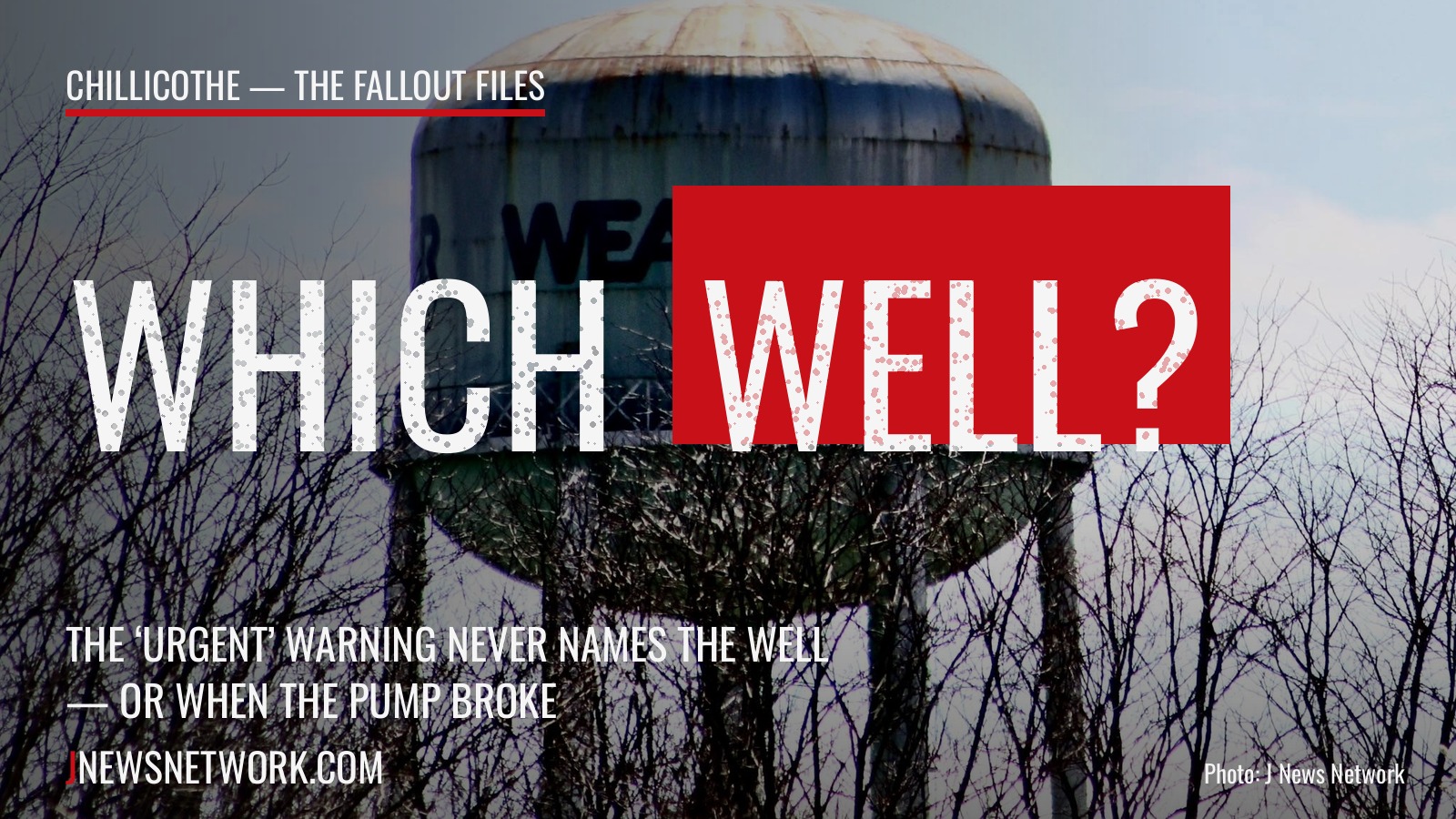
CHILLICOTHE, Ohio — U.S. Paper Mill Company LLC put out a statement on November 12 warning that a fractured pump on a well holding back the Wear-Ever toxic plume is a “potentially urgent situation” that could, over time, let contaminated groundwater reach farmland, residences and the Scioto River. The statement never names the well. It never says when the pump broke.
Those omissions are the story. The documented record — filed with the Ohio EPA by Howmet Aerospace’s own environmental consultant — shows the mill’s two containment wells are in very different shape, and the statement’s account fits neither of them cleanly. Collector Well 17 was not operating during the June 2026 monitoring event; the consultant put that in writing, and J News Network reported Well 17’s status on October 13. The well U.S. Paper Mill has actually been pumping since taking ownership of the plant — the well the June gauging shows capturing the groundwater — is Collector Well 18. So the fractured pump is either on a well that has been off for months, which makes the emergency months old, or on the one working capture well, which the company has not said. The statement does not distinguish between the two.
What the company said
The statement, sent out through Werth, a Columbus public relations firm, says U.S. Paper Mill “has alerted the Ohio Environmental Protection Agency (EPA) about the fracture of a pump serving a water well that has been containing a toxic plume of underground chemicals,” and that the “decades-old, 90-foot pump will require a replacement costing hundreds of thousands of dollars.”
It says that “[s]ince acquiring the closed Pixelle Specialty Solutions plant last year, U.S. Paper Mill has been pumping water in the well at its own expense,” and that by doing so it “has been able to protect nearby residents from the plume of chemicals, which was spilled decades ago by a cookware manufacturing plant that closed in the 1990s.”
“As we work closely with Ohio EPA and the City of Chillicothe, the residents of this community need to understand this is a potentially urgent situation,” U.S. Paper Mill Utility Superintendent Aaron Andrews says in the statement. “Without replacement of the pump, the water table could potentially rise high enough to release containments from the plume. We are doing all we can to protect the community that we love.”

What the filings say
The groundwater beneath the former Wear-Ever plant is monitored under Ohio EPA orders running back to 1999, and the reports are not secret. Key Environmental Inc., Howmet’s consultant, filed the site’s second-quarter 2026 groundwater monitoring report with the state this fall. In it, describing the June 2026 monitoring event, Key Environmental states:
“Collector Well 17 was not operating during this monitoring event.”

The same report describes which of the mill’s two containment wells U.S. Paper Mill has actually been running since it bought the plant: “USPM has continued to operate Collector Well 18 since taking ownership of the property.” Well 18 — not Well 17. The same report states that the June 2026 gauging data “show that groundwater is captured by Collector Well 18.” That leaves the statement’s broken pump in one of two places: on Well 18, the well U.S. Paper Mill is documented as actually running — or on Well 17, which has not run since at least June. The statement does not say which, and nothing in it identifies the well.
And on the same page, the report records that Ohio EPA raised this exact issue on July 7, 2025, in a letter to Howmet “regarding groundwater containment concerns and additional monitoring well installation due to the anticipated shutdown of the paper mill.” The state flagged the risk sixteen months ago.

J News Network published these findings on October 13, in “New WearEver groundwater tests reveal persistent contamination as paper mill pumping raises concerns.” What the November 12 statement adds is the framing — and it withholds the two facts that would let anyone test it: which well, and when.
The part a new pump doesn’t fix
There is a second problem with the statement, and it is also in the filings. The plume was never held back by one pump on one well. It was held back by the paper mill’s industrial pumping — the enormous volumes of groundwater a working paper plant pulled every day. The same monitoring report states that during past periods of low pumping or no pumping at Collector Wells 17 and 18, groundwater beneath the site flowed east-southeast, toward the Scioto River.
A replacement pump does not restore paper-manufacturing draw. Unless the mill pulls water the way a paper plant pulled water — billions of gallons — the plume’s movement changes regardless of whether one pump on one well is new or broken. That is not opinion. It is the hydrology in Howmet’s own reports.
The watchdog that still isn’t there
Ohio EPA understood this in 2025, which is why the agency ordered additional sentinel monitoring wells — an early-warning network to catch the plume if it starts to move. As J News Network reported on November 12, in “Thirteen months, zero signatures,” those wells still are not in the ground: the property access agreements went out in October 2025 and remain unsigned, and on November 6 Ohio EPA sent Howmet’s installation work plan back with nine technical comments and no deadline to fix them.
So at the moment the mill’s owner warns the plume could move, the state-ordered network built to detect that movement does not exist — and the owner will not say which of its two containment wells it is warning about, while one of them has been off, on paper, for months.
The plume did not become a story this week. What changed on November 12 is that a public relations firm put out a statement.
CORRECTION — NOV. 13, 2026
An earlier version of this story identified the fractured pump in U.S. Paper Mill Company LLC’s November 12 statement as the pump on Collector Well 17. The statement did not specify which pump was broken, or which well it serves. What is confirmed is that Collector Well 17 was down in June: Key Environmental Inc.’s second-quarter 2026 groundwater monitoring report states, “Collector Well 17 was not operating during this monitoring event.”