

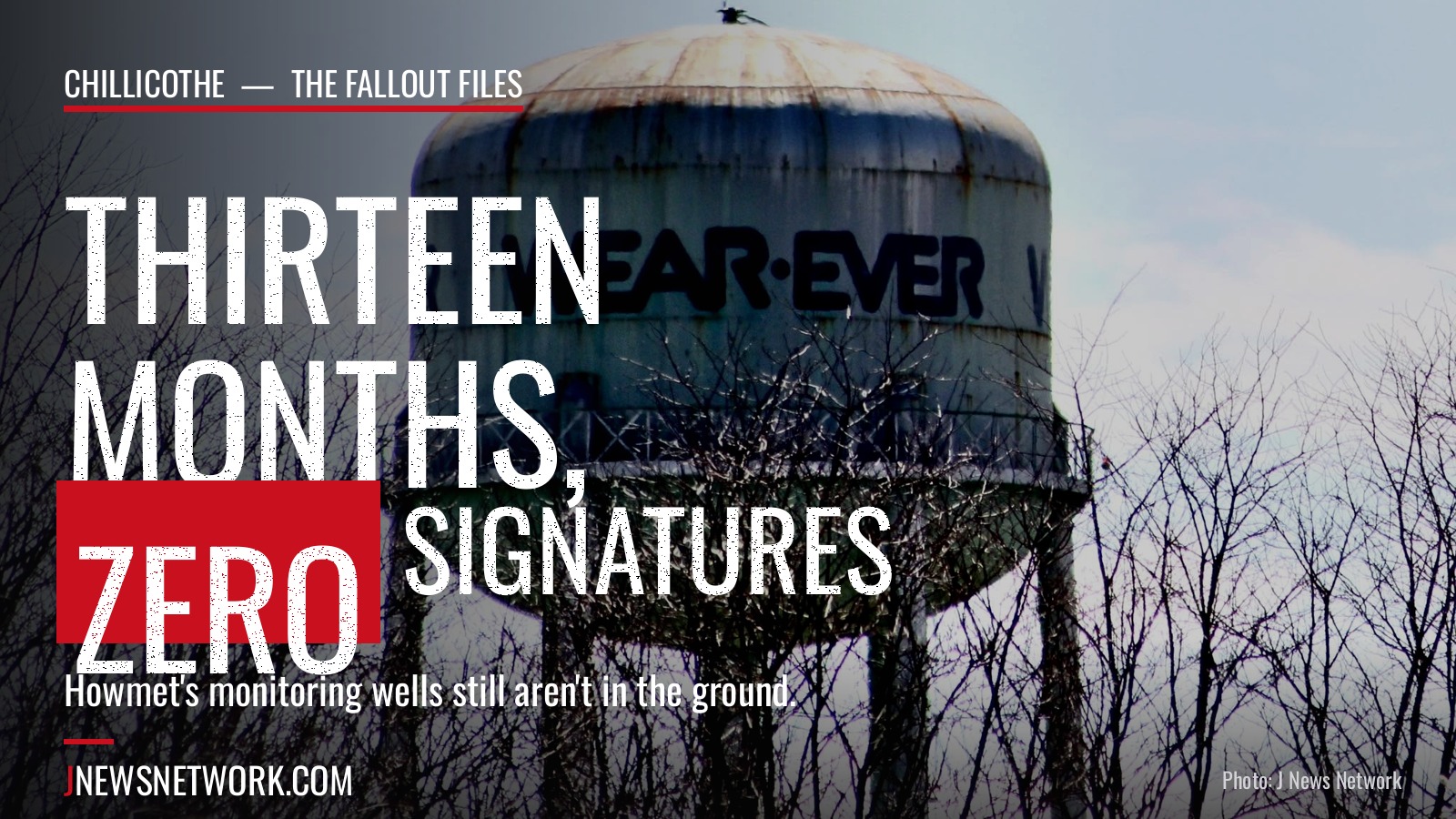
CHILLICOTHE, Ohio — The access agreements went out in October 2025. The plan to drill didn’t reach the Ohio EPA until September 2026. The state sent that plan back last week with nine required fixes.
And the six monitoring wells — the wells that are supposed to track where the toxic plume beneath the former WearEver aluminum plant is moving — still aren’t in the ground.
Howmet Aerospace owns the former Wear-Ever facility on Eastern Avenue, where decades of aluminum production left groundwater contaminated with trichloroethylene, vinyl chloride and other industrial solvents at levels many times above federal drinking-water limits. Ohio EPA and Howmet agreed on locations for six new monitoring wells: four shallow wells, designated H-S, OS-2-S, OS-4-S and OS-5-S, screened at about 32 feet, and two intermediate wells, OS-4-I and OS-5-I, at about 60 feet.

Most of those wells are off-site, on neighboring private property. That means Howmet needs the neighbors’ signatures before a drill rig can roll. According to Howmet’s own consultant, those signatures have been missing for more than a year.
“Howmet provided access agreements to the property owners in October 2025 but has not yet received the signed agreements from those owners,” Key Environmental Inc. wrote in Howmet’s third-quarter 2026 progress report, filed with Ohio EPA on October 10.

The same report describes Howmet as “diligently working with Ohio EPA and nearby property owners to install additional monitoring wells.” Thirteen months of diligence has produced zero signatures. The report does not say why the property owners haven’t signed, and nothing in the state record explains it.
The access agreements aren’t the only stall. They aren’t even the newest one.
Howmet’s Monitoring Well Installation Work Plan was submitted to Ohio EPA on September 11, 2026 — eleven months after the access agreements went out. Ohio EPA’s Division of Environmental Response and Revitalization took eight weeks to review it. On November 6, site coordinator Austin Tweedy sent the plan back with nine comments Howmet must address before the plan can be approved.
The state’s objections aren’t minor. Ohio EPA found that the plan never specified the auger size or borehole diameter for the drilling. It set a filter pack only two feet above the well screens where state guidance calls for at least three, without the sieve analysis to justify the design. It placed the shallow screens at 22 to 32 feet without explaining how those depths account for seasonal swings in the water table — the very fluctuations that determine what a monitoring well actually measures. It proposed developing the wells “as soon as practicable” where state guidance calls for waiting roughly 48 hours for the seals to cure, and it never said how the drill cuttings and development water — waste pulled from contaminated ground — would be tested to determine whether it must be handled as hazardous waste.
“Please revise the Work Plan to address the comments above and resubmit the revised Work Plan to Ohio EPA for review and approval,” Tweedy wrote. The letter sets no deadline for Howmet to resubmit. As of this week, no revised plan appears in the site record, and no drilling has been scheduled.

The installation itself was never the hard part. Howmet’s own work plan estimated that once access is secured, drilling, installing, developing and surveying all six wells would take approximately two weeks.
What’s at stake in the delay is not paperwork. The paper mill next door to the WearEver site closed in August 2025, and the mill’s high-volume production wells had for years incidentally helped hold the WearEver plume in check. The mill was sold to U.S. Paper Mill, and what the new owner intends to do with those production wells is, in the words of Howmet’s own quarterly report, “not yet well understood.”
Howmet says it began enhanced quarterly monitoring in the third quarter of 2025, to continue “until groundwater conditions are better understood.” The six wells are a central part of understanding those conditions. The existing network still finds contamination well above federal drinking-water limits: in the second quarter of 2026, monitoring well MW-C-I returned 1,1-dichloroethylene at 2,300 micrograms per liter, trichloroethylene at 260 and vinyl chloride at 230 — all above their maximum contaminant levels.
In its third-quarter report, Howmet lists the difficulties it encountered during the reporting period in a single entry: “N/A.” Its explanation of deviations from milestones reads the same: “N/A.”

The company’s stated plan for the next quarter is to “continue pursuit of access agreements with nearby property owners” and to install the wells “once access agreements are executed.” Sampling results from August are expected in the forthcoming third-quarter Groundwater Monitoring Report, and a state Five-Year Review of the site remedy is under way.
The wells were agreed to because nobody can say with confidence where the plume goes next. Thirteen months after the agreements went out, that is still true — and on the record Ohio EPA holds, nothing about the timeline is being treated as a difficulty at all.
Watch: “Wear-Ever: The Hidden Cost of American Made” — J News Network’s documentary on the site:



One thought on “Thirteen months, zero signatures: Howmet’s WearEver monitoring wells still aren’t in the ground”