

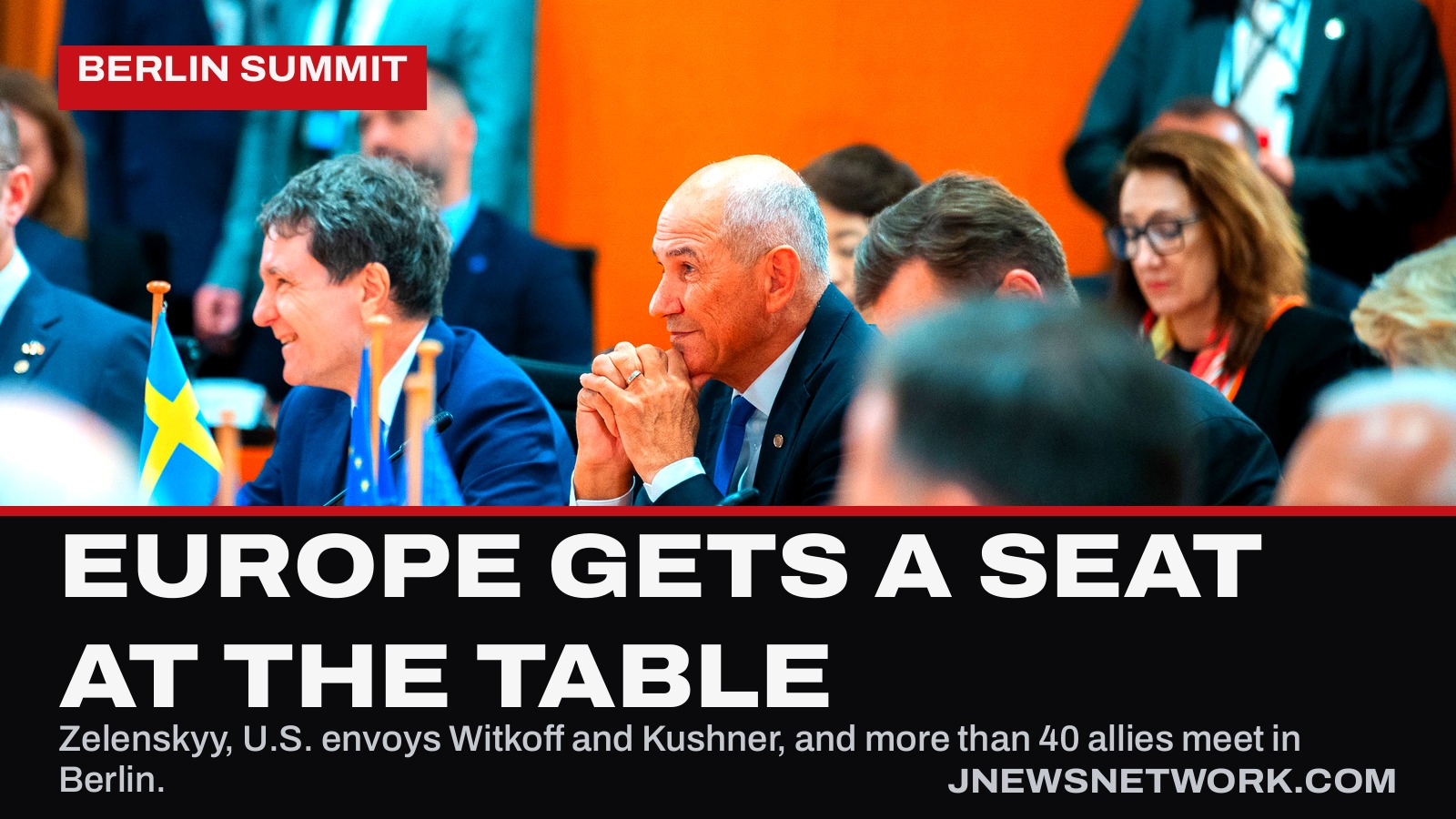
BERLIN — Ukrainian President Volodymyr Zelenskyy sat down Thursday in Berlin with U.S. envoys Steve Witkoff and Jared Kushner and more than 40 allied governments, and announced afterward that the group had settled a point Kyiv has pressed for months: Europe will take part in the next round of negotiations with Russia, in what he said must now be a four-party format.
The envoys joined a meeting of the Coalition of the Willing, the group of countries backing Ukraine, hosted by German Chancellor Friedrich Merz and co-chaired by France and the United Kingdom. NATO said more than 30 heads of state and government attended, including Zelenskyy; the Ukrainian president put total participation at more than 40.

In a statement published by his office after a joint press conference with Merz, French President Emmanuel Macron and British Prime Minister Andy Burnham — a statement in which he addressed the two American envoys by their first names — Zelenskyy said, “There is a decision that Europeans will participate in the negotiation formats with the Russians,” with Europe represented by five countries plus the European Union and NATO. The statement did not name the five countries.
“Later today, we will speak separately with the American envoys about when the next meeting will take place and what its agenda will be,” Zelenskyy said. “It must now be a four-party meeting – Ukraine, Europe, America, and Russia.” He said the agenda must be jointly developed and approved by Ukraine, Europe and America, and warned against delay: “We do not want Russia to drag all of this out into the winter.”
Kushner, announcing the Berlin consultations in a post on X, said the envoys’ priorities were to further strengthen coordination with Ukraine and Europe, to work toward a common position on the key elements of a lasting peace, and to jointly prepare the agenda and proposed format for the next round of multilateral negotiations.
Ahead of the coalition session, Zelenskyy met separately with Merz, Macron and Burnham. His office said the leaders focused on countering Russian “shahed” drones and missiles, protecting Ukraine’s energy sector and infrastructure, winter support packages, security guarantees and diplomacy.
Zelenskyy laid out five priorities for the day: air defense; more F-16s and other combat aircraft; stronger defense capabilities of Europe’s own, including the FREYJA anti-ballistic program and satellite communications; the diplomatic track; and security guarantees, which he argued rest on Ukraine’s membership in NATO and the European Union.
On support, he said the European Union had recently decided to provide an additional €45 billion for next year, that a 22nd package of EU sanctions is in preparation, and that this week’s meeting of the Ramstein-format Ukraine Defense Contact Group had strengthened Ukraine’s defense. On air defense, he said the partners agreed Ukraine’s defenses must be strengthened and that support packages would follow: “We reached the relevant agreements today.”
NATO Secretary General Mark Rutte, who attended the meeting, stressed the importance of continuing support to Ukraine and praised allies for their contributions at the Contact Group meeting in Brussels this week, NATO said.
Zelenskyy said Russia has rejected every de-escalation proposal put to it — covering energy infrastructure, the Black Sea and other ceasefire formats — and that Russian strikes on Thursday injured dozens of people and killed civilians. A Russian “shahed,” he said, damaged St. Volodymyr’s Cathedral in Kyiv and the buildings of the Austrian and Dutch embassies.