

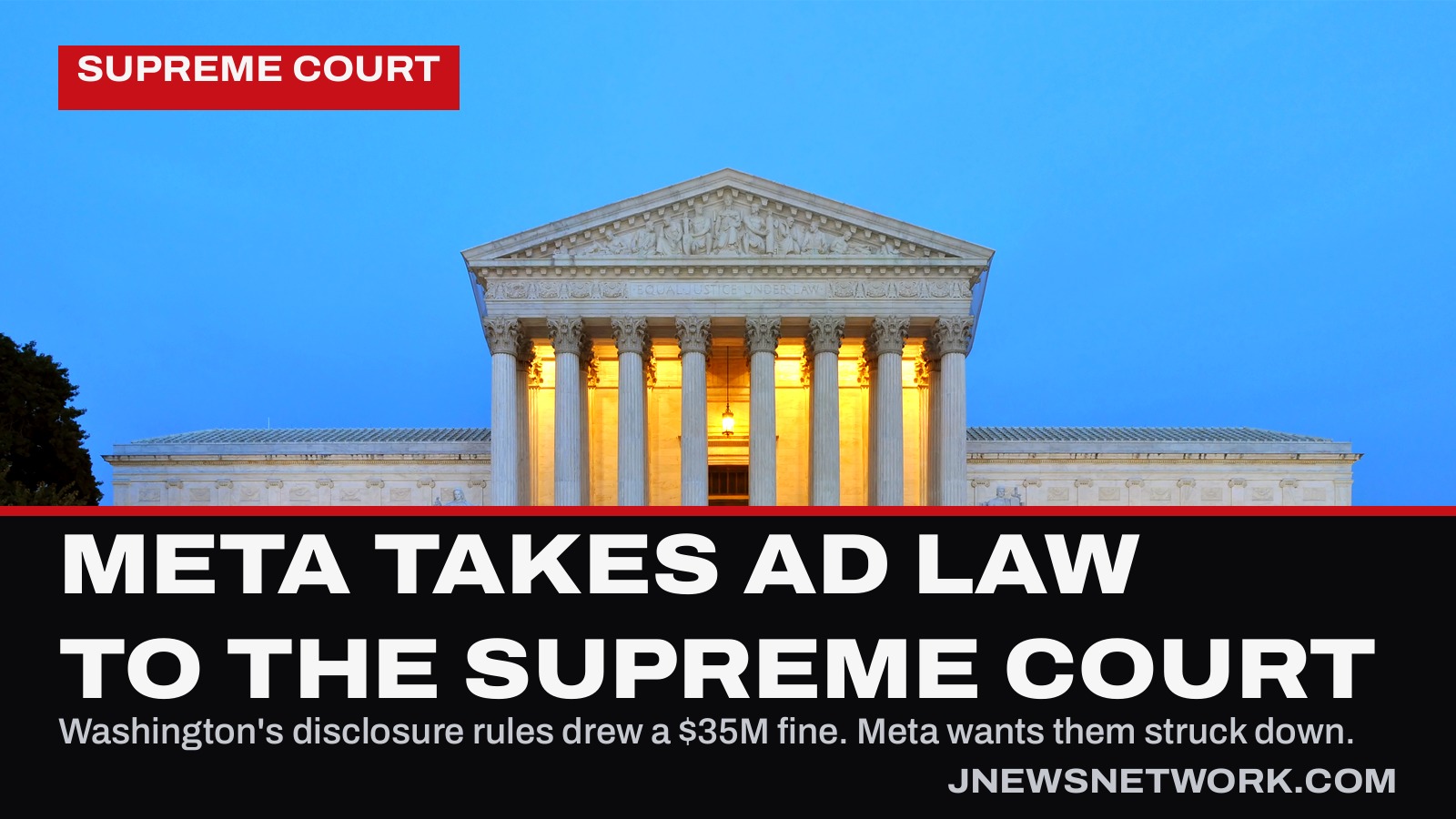
WASHINGTON — Meta Platforms, the parent company of Facebook and Instagram, has asked the U.S. Supreme Court to hear its challenge to Washington state’s campaign advertising disclosure law, carrying a fight over political ad transparency to the justices after the company lost at every level of the Washington courts.

In a petition for a writ of certiorari filed Nov. 13, 2026, Meta asks the Court to decide a single question: “Whether the First Amendment permits a state to impose onerous content- and speaker-based disclosure requirements on third-party platforms that make it financially irrational for those platforms to disseminate political speech.”
Washington’s response is due Dec. 18, 2026, according to the docket in Meta Platforms, Inc. v. Washington, No. 26-649. The Court has not said whether it will take the case; four of the nine justices must vote to grant review.
The case centers on Washington’s Fair Campaign Practices Act, a law first approved by voters in 1972. It requires “commercial advertisers” — businesses that sell political advertising — to maintain detailed records on the political ads they carry, including who bought each ad, what it cost, when it ran and what audience it targeted, and to keep those records open for public inspection for five years. Regulations adopted by the state Public Disclosure Commission require the records to be updated within 24 hours and made available to anyone who asks within 48 hours. The Act’s provisions, formerly chapter 42.17A of the Revised Code of Washington, were recodified as Title 29B RCW effective Jan. 1, 2026.
The dispute began with 12 records requests filed by three Washington residents — Eli Sanders, Tallman Trask and Zach Wurtz — seeking information about political advertisements on Meta’s platforms. Meta has never disputed that its responses to those requests violated the law. The state attorney general sued in King County Superior Court in April 2020, and in 2022 the trial court ruled for the state: it counted 822 violations, imposed the maximum penalty of $10,000 for each, found the violations intentional and trebled the award — $24.66 million in civil penalties plus $10.52 million in attorney fees and costs, $35.18 million in total — and barred Meta from further violations.
The Washington Court of Appeals affirmed that judgment in December 2024. On June 18, 2026, the Washington Supreme Court affirmed as well, in a fractured decision. A majority of the justices held that the disclosure law, as applied to Meta, does not violate the First Amendment. But the court split three ways on the penalty, so no majority existed to change it and the $35 million judgment stood; a majority separately held that the penalty does not violate the Eighth Amendment’s ban on excessive fines.
Meta has since paid the judgment. With post-judgment interest running at 12 percent a year, state officials say the amount collected grew to more than $51 million, and the Public Disclosure Commission has cautioned state budget writers not to spend the money while the Supreme Court appeal could force Washington to give it back.
In its petition, Meta argues the Washington regime is so burdensome that it has driven political advertising off the major platforms altogether: Meta and Google stopped disseminating political advertisements in Washington rather than comply. The petition also points to a split among the courts — the Washington justices expressly disagreed with a Fourth Circuit decision that struck down a similar Maryland disclosure law — of the kind the Supreme Court often steps in to resolve. The petition calls the $35 million judgment the largest campaign finance penalty in U.S. history.
Meta first signaled the appeal in August, when it asked Justice Elena Kagan, who handles applications arising from the Ninth Circuit, for more time to file. Kagan granted the extension on Sept. 3, 2026, moving Meta’s deadline to Nov. 15; the company filed two days before it. Meta is represented by Paul D. Clement, a former U.S. solicitor general. The law is defended by Washington Attorney General Nick Brown’s office, which has said the Court will likely decide whether to review the case before the end of June.