


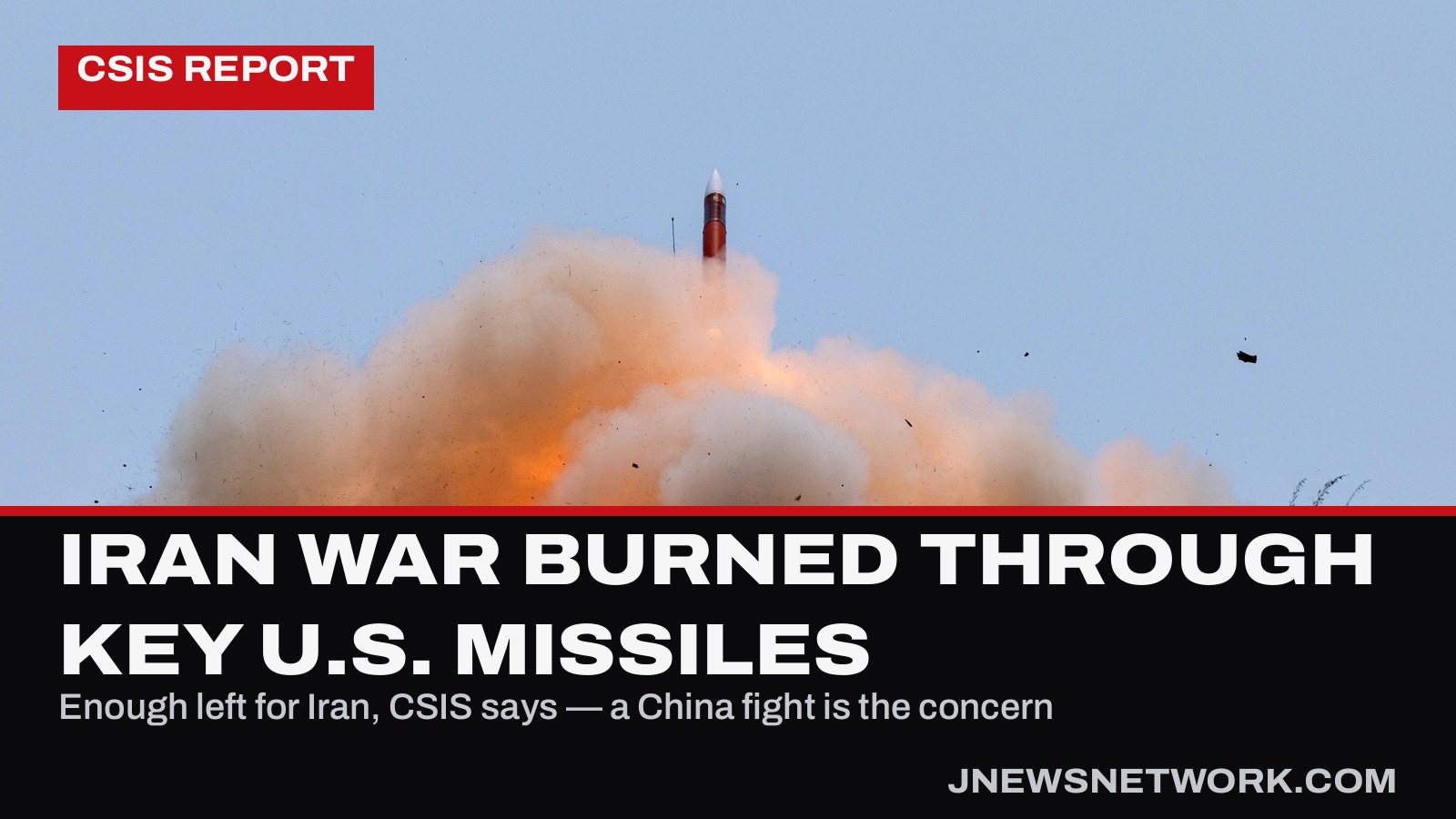
The United States burned through between a third and two-thirds of key munition inventories in the 39-day campaign against Iran and the operations that followed, leaving enough missiles to renew that fight but raising “great concern” about a war with China, according to a report from the Center for Strategic and International Studies.
The report, “Munition Inventories: An Update Amid Renewed War Risk,” was written by Mark F. Cancian and Chris H. Park and published Nov. 10, 2026, by CSIS’s Defense 360 program. It updates the pair’s earlier inventory estimates and, for the first time in the series, situates the munitions expended in the Iran war among the full spectrum of U.S. munitions, grouping most conventional munitions into nine categories and judging each against the demands of a war with China.
“Does the United States have enough munitions to renew the fight? The short answer is yes—against Iran. Against China, there is great concern,” the report says. “Rebuilding inventories will require a multiyear commitment extending beyond the current crisis.”
Missile defense interceptors are in the worst shape, the report found. Patriot, THAAD and Standard Missiles are the three principal U.S. missile defense programs, and CSIS said there are no substitutes for them. An estimated two-thirds of the prewar Patriot interceptor inventory has been expended against Iranian ballistic missiles in the past nine months, and around half of the prewar THAAD inventory has been used. The prewar inventory of missile defense interceptors was already considered inadequate for a war against China, according to the report.
Long-range strike weapons were also heavily used in the early stages of Operation Epic Fury. U.S. destroyers and submarines fired an estimated third of the prewar Tomahawk inventory; the Tomahawk strikes ground targets from the sea at a range of around 1,000 miles. Bombers and fighters expended around a third of the prewar inventory of JASSM cruise missiles. The Precision Strike Missile saw its first combat use in the campaign; its prewar inventory was low because procurement only began in fiscal 2023, but CSIS said large Army orders—964 missiles between fiscal 2024 and 2026—will quickly replenish stocks.

The drawdown has created what amounts to a range problem. The United States has large numbers of munitions with the same explosive yield and accuracy as its long-range systems, the report said, but with ranges under 300 miles. Using them extensively requires air superiority, because the shorter ranges put launch platforms in danger—and that, CSIS warned, may not be achievable against a great power like China, whose extensive air defenses would take much longer to reduce.
The cost gap is wide. A JASSM and a general-purpose bomb fitted with a JDAM guidance kit both accurately deliver 1,000-pound payloads, the report noted, but the JDAM has a maximum range of 15 miles and costs about $100,000, while the JASSM has a range of 600 miles and costs $2.4 million. Gen. Dan Caine, the chairman of the Joint Chiefs of Staff, said U.S. forces reached a “point of munitions transition” from standoff to stand-in strikes by the fifth day of the campaign, once Iranian air defenses were reduced; by day 14, less than 1 percent of munitions fired by U.S. forces were long-range.
Ship-based missile inventories face a separate constraint: missiles aboard destroyers and cruisers can only be reloaded in a port with specialized facilities, the report said, which limited how much ship-based interceptors could be used in theater.
Recovery will be slow. Most munitions take two to four years after Congress appropriates the funds to be delivered, and although production rates are increasing, demand—from the United States and from allies—exceeds supply, so timelines have lengthened. “The problem is not money, assuming Congress continues its support, but time,” the report says. Patriot production is running around 600 missiles a year, up from around 300 before the war in Ukraine, with a goal of 2,000 per year by 2030 under a January 2026 framework agreement between Lockheed Martin and the Trump administration. Eighteen other countries operate the Patriot, an estimated 1,600 interceptors were already in the allied backlog before the war, and in October the administration approved a sale of 500 interceptors to Ukraine.
CSIS said the Defense Department cannot afford to build adequate inventories relying solely on highly capable and expensive munitions and needs a mix of munitions across ranges and costs, backed by a long-term funding commitment in fiscal 2027 and beyond. The report’s estimates rest on unclassified data; actual munition inventories are classified.
The CSIS assessment is separate from a Government Accountability Office report released Thursday, covered here, which found the Pentagon has no overarching plan linking munitions production and funding to requirements.
Cover photo: A Patriot missile is launched during Exercise Balikatan 2023 in the Philippines. (U.S. Marine Corps photo by Cpl. Tyler Andrews via Wikimedia Commons, public domain)