

The FBI’s investigation into “ghost students” — fake college enrollments built on stolen American identities to drain federal student aid — is still growing, nearly three weeks after federal prosecutors announced their first charges.
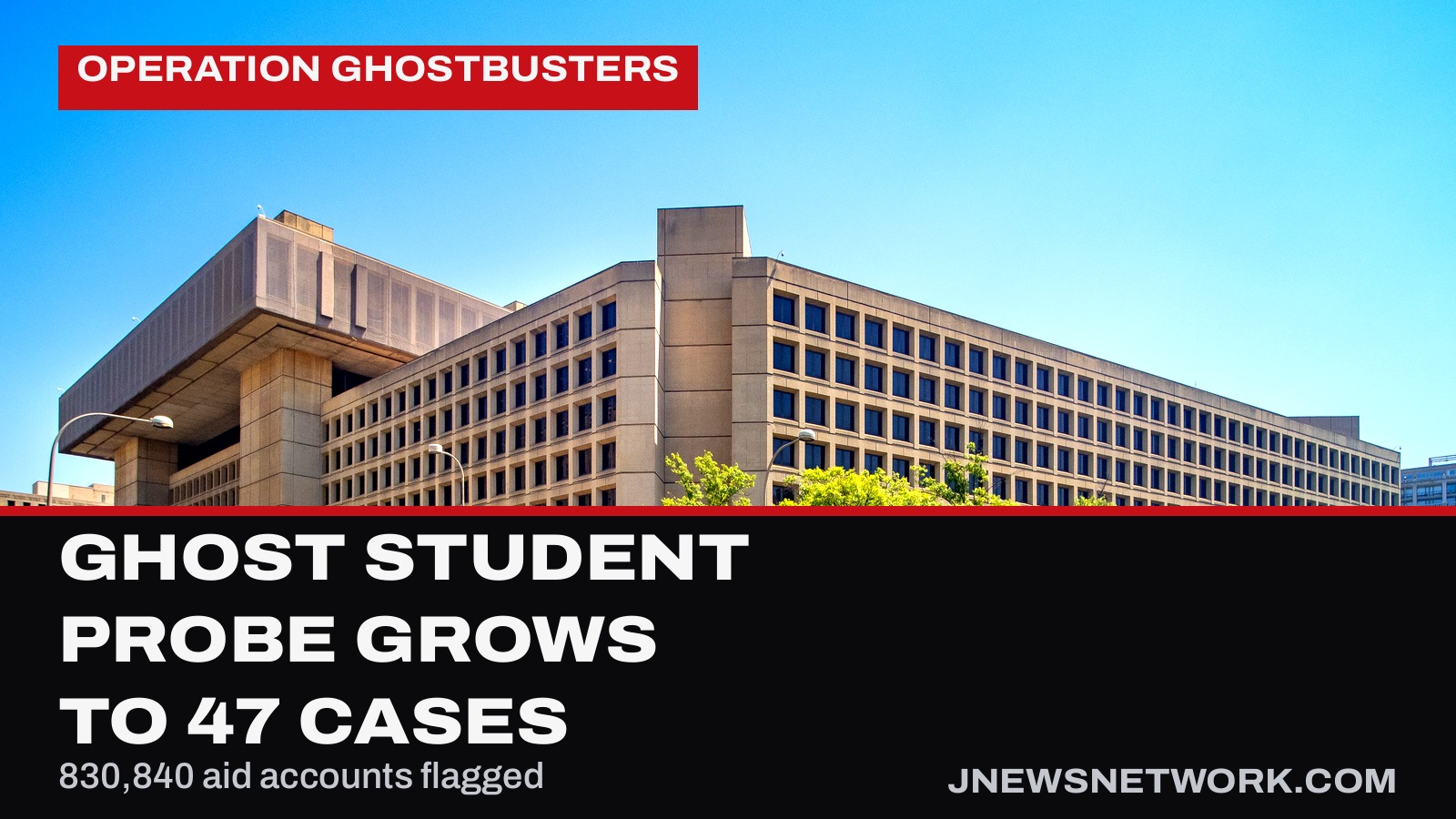
Heith Janke, the assistant director of the FBI’s Criminal Division, told ABC News that the bureau has launched 47 separate investigations tied to the scam and that almost half of the FBI’s 55 field offices are now actively pursuing ghost-student cases.
“We are just getting started when it comes to ghost students,” Janke said. “While we’ve had the success in getting those initial cases, we are not stopping … we will trace the money, we will find it, and we will seek accountability from them.”
The scale investigators describe is industrial. In September and October of this year, investigators identified 830,840 potentially fraudulent Federal Student Aid IDs relating to nearly $130 million and recommended that the Department of Education disable those IDs, according to the Justice Department. The IDs are flagged as potentially fraudulent — the department does not say the full $130 million was stolen. What the FBI says it has confirmed so far is smaller and still large: “To date, the FBI has identified more than $32 million in losses, with millions more suspected, in similar ghost student schemes,” Janke said when the first charges were announced.
Prosecutors estimate the fraud, which investigators believe has been running since at least 2021, at well over $200 million in total.
How the scheme worked
The Justice Department calls the nationwide investigation Operation Ghostbusters. According to the department, criminal actors created fraudulent Federal Student Aid accounts using stolen U.S. citizen identities and enrolled “ghost students” in educational institutions. After loan and grant money was disbursed, the refunds were diverted to bank accounts controlled by foreign actors, facilitated by U.S.-based money mules, including Kenyan nationals.
The ghost students never actually attend the classes the money pays for. Instead, the department says, fraudsters keep fake students placed in classrooms to keep the aid flowing — and even complete the required coursework for them to maintain the scam. The victims investigators have identified are often Americans who have never been to college — many hold only high school diplomas, and learn what happened when they discover a college enrollment, and a loan, in their name.
One of them is Tony Rice, a 33-year-old cybersecurity professional in Beloit, Wisconsin, who told ABC News he learned late in 2025 that criminals had stolen his identity and enrolled him in college. Rice said a fraudster had applied for about $10,000 in student loans in his name, leaving him to get the loans removed from his credit or pay money he never borrowed.

Five charged, money seized in Kenya
The Justice Department announced the first results of Operation Ghostbusters on Oct. 29, charging five defendants and announcing the seizure of more than $750,000 in cryptocurrency tied to the scheme through a network associated with Kenyan nationals — the first international seizure of its kind in Kenya.
“Today, we are announcing the first results of Operation Ghostbusters — a nationwide effort to stop a major fraud scheme targeting federal student aid, low-income Americans, and the American taxpayer,” said Assistant Attorney General Colin M. McDonald of the Justice Department’s National Fraud Enforcement Division. “If you steal American identities, if you steal taxpayer dollars, if you exploit programs meant to help students build a future — we will find you. Whether you are in Nebraska, New Jersey, Virginia, or Nairobi, we will pursue you.”
In the District of New Jersey, a criminal complaint charges Mabed Patricia Utate-Alberto, Patricia Arisleydi Perez and George Arturo Alfau Mendez with conspiring with persons in Kenya, beginning in about March 2021 and continuing through at least January 2026, to obtain more than $1 million in student aid funds. Prosecutors say the three acted as money mules, receiving aid money obtained through fraudulent applications in U.S. bank accounts and transferring it — after taking a cut — overseas to co-conspirators in Kenya associated with a purported Kenyan safari company. All three were arrested. Two co-conspirators in Kenya remain to be charged, the department said.
In the Eastern District of Virginia, a grand jury indictment returned Oct. 21 — still under seal — charges a Kenyan national with conspiracy to commit wire fraud and student aid fraud. Prosecutors say the defendant received more than 700 fraudulently obtained student aid refund deposits totaling approximately $1,439,548, and moved at least $1.3 million to accounts in the United States and Kenya.
In Nebraska, Francis Mogambi, a 23-year-old Kenyan citizen living in Lincoln, was indicted Oct. 19 on five counts of theft of government money and five counts of aggravated identity theft. Prosecutors allege that between November 2025 and May 2026, Mogambi used stolen identities to enroll American victims in educational institutions and redirect their federal financial aid checks to himself, keeping 30 percent of the proceeds and sending the rest to conspirators in Kenya. ABC News reported that his alleged victims were in Wisconsin, Ohio, Virginia and New York, and that he has pleaded not guilty. He was arrested and detained pending trial.
First Assistant U.S. Attorney Theophani K. Stamos, whose Eastern District of Virginia office is one of the three prosecuting the first cases, said the FBI’s Richmond cyber squad and the Education Department’s Office of Inspector General “has already uncovered hundreds of participants and hundreds of millions of dollars in stolen funds, sending approximately 50 referrals to 26 FBI field offices across the country, and we are just getting started.”
When the charges were announced, the department said there were more than 40 open cases across 26 FBI field offices and more than 20 U.S. Attorneys’ Offices. The investigation was opened by the FBI’s Richmond Field Office following a referral from the Education Department’s inspector general.
What victims should do
The FBI has sent letters to many identified victims, and the Justice Department directs anyone who believes they are a victim of this fraud to file a report through the Department of Education inspector general’s hotline complaint form.
Under Secretary Nicholas Kent of the Department of Education said the department “has saved taxpayers more than $2 billion in attempted student aid theft.” “Every dollar that falls into the hands of a fraudster is a dollar that will not go to a student in need,” Kent said.
An indictment, information, or complaint is merely an allegation. All defendants are presumed innocent until proven guilty beyond a reasonable doubt in a court of law.