

WASHINGTON — A House select committee report released Thursday says Honeywell Aerospace, GE Aerospace and Collins Aerospace repeatedly obtained U.S. government licenses for controlled technology transfers involving Chinese military end users, part of a broader pattern in which legal commercial deals moved American and Western aerospace technology, know-how and industrial capacity into China’s military-linked aerospace industry.
Chairman John Moolenaar of the Select Committee on China released the report, titled “China’s Wingmen: How Western Government Policy Enabled China’s Rise in the Skies,” on Nov. 19, 2026. The committee said it spent the past year investigating Western aerospace ties to China’s military industrial base, reviewing information from GE Aerospace, Honeywell Aerospace and Collins Aerospace about their operations in China and their relationships with Chinese defense entities including the Aviation Industry Corporation of China (AVIC) and the Commercial Aircraft Corporation of China (COMAC), according to the report.
“American and European companies transferred technology to China that could be used against our brave men and women in uniform. With the CCP’s military-civil fusion there are no private companies in China. The PLA will exploit civilian technology and use it to advance its military ambitions and that is what happened here,” Moolenaar said in the committee’s release. “The U.S. and its allies should strengthen export controls and tighten investment restrictions on the aerospace sector to stop the transfer of vital technology that will empower our foremost adversary.”

What the report found
Through joint ventures, co-development agreements and other commercial relationships, the report says, American and other Western companies transferred technology, know-how and industrial capacity to China — many of the transfers licensed as commercial, and others requiring no license at all. Because commercial and military aerospace technology overlap heavily — the report notes the U.S. Navy’s P-8 Poseidon shares 86 percent parts commonality with Boeing’s Next-Generation 737 airliner — technology transferred for civilian programs could simultaneously advance military development, the committee found.
The report’s five findings, as summarized by the committee, are:
- Western aerospace companies entered lawful commercial arrangements that transferred advanced technology, technical know-how and Western expertise to Chinese aerospace firms.
- Honeywell, GE Aerospace and Collins repeatedly sought and obtained licenses for controlled technology transfers involving PRC military end users and other military-linked entities as part of Chinese commercial aerospace platforms.
- Export controls relied on company due diligence even where commercial incentives favored continuity and past enforcement actions revealed compliance weaknesses.
- PRC-based joint ventures created a structural gap in U.S. national security review by allowing sensitive capabilities to move offshore outside the principal Committee on Foreign Investment in the United States (CFIUS) framework.
- Unilateral U.S. restrictions would disadvantage American aerospace companies without denying China access to many Western technologies when allied firms backfill the resulting business.
Reviewing the licenses the three companies produced, the committee said most involved COMAC’s C919 airliner or the ARJ21 regional jet, while Collins Aerospace licenses involved other AVIC programs. The report says the expanded military-end-user controls adopted in 2020 often converted existing commercial aerospace work into licensed activity rather than ending it. Honeywell’s China work includes contracts for four systems on the C919 and a joint venture established in 2012 — 51 percent owned by Honeywell, 49 percent by Boyun — to produce the C919’s wheel-and-brake system, according to the report.
The committee was explicit that it was not alleging crimes. “The Select Committee does not investigate in the first instance to find potential violations of law; it seeks to illuminate areas where policymakers should consider change and generate policy recommendations,” the report states. It described the problem as systemic: “The broader system allowed commercial aerospace engagement that could strengthen firms connected to the PRC’s military industrial base without triggering the safeguards designed to protect sensitive technology.”
Airbus and the ‘backfill problem’
The report also singles out Europe’s Airbus, which it says “systemically furthered China’s aerospace industrial base spanning decades” — including a helicopter co-development with the Harbin Aircraft Industry Group that began in 2006 and a second final assembly line in Tianjin, China, announced in October 2025. Because allied firms can step into business American companies give up, the committee calls unilateral U.S. restrictions self-defeating — the “Backfill Problem.”
What the committee wants done
The report makes seven recommendations, per the report and the committee’s release:
- The United States should not allocate taxpayer dollars to companies that build adversary military capabilities that can be turned against the United States and its allies — in the report’s words, defense contractors must “pick a side.”
- The Treasury Department should restrict outbound investment into China’s aerospace sector under its Outbound Investment Security Program, and Congress should codify the prohibition in the Comprehensive Outbound Investment National Security Act of 2025 (COINS Act).
- The Federal Aviation Administration should not certify aircraft manufactured in China. The report cites China’s refusal to release its report on the 2022 crash of a China Eastern Airlines Boeing aircraft on national security grounds, and the subsidies China has given COMAC and AVIC.
- Congress should pass H.R. 11047, the Aerospace Transparency Act, requiring aerospace contractors doing business with the Department of War to disclose their relationships with U.S.-designated Chinese military companies.
- The State and Commerce Departments should fundamentally reapproach aerospace licensing — reducing exports to adversaries, requiring full beneficial ownership transparency, denying dual-use exports accessible by Chinese military companies, and enforcing violations with genuinely deterrent penalties.
- Congress should pass H.R. 11048, the Geospatial Intelligence Transparency and Security Act, directing the National Geospatial-Intelligence Agency to assess commercial geospatial AI capabilities of national security concern.
- Acquisitions of American aerospace companies by French companies should face heightened scrutiny and a presumption of denial until they unwind ties to China’s civil-military ecosystem.
Company responses
Honeywell said all of the projects were “fully licensed and approved by the US government” and that Honeywell Aerospace “has and will continue to follow all U.S. export laws and procedures, as is acknowledged in the report,” according to Reuters. GE Aerospace told Reuters it takes national security, compliance and the protection of its intellectual property seriously and works closely with the U.S. government. Collins Aerospace, a unit of RTX, the FAA and Airbus did not immediately comment, Reuters reported.
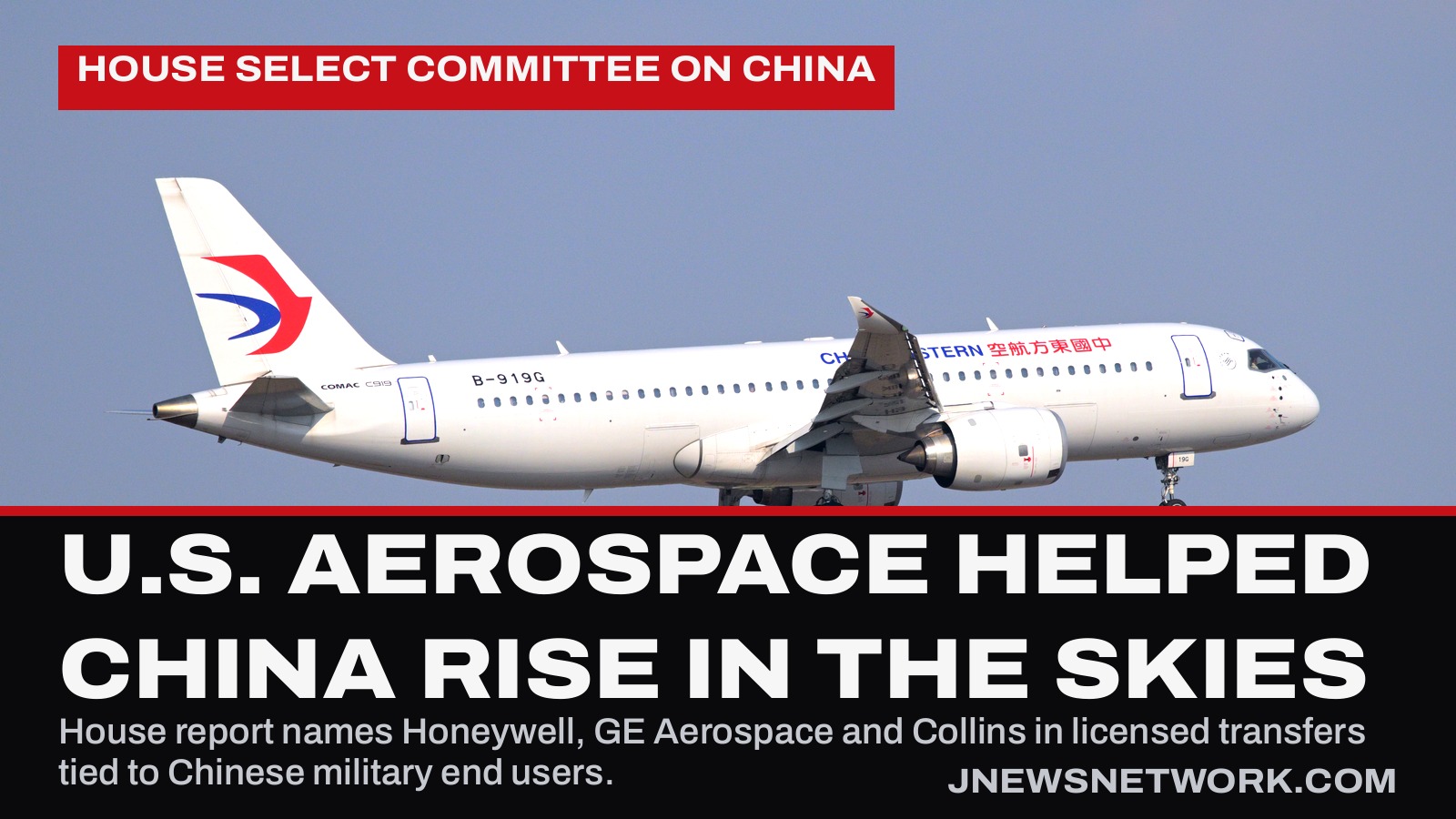
Photo: A COMAC C919 operated by China Eastern Airlines on final approach to Shanghai Hongqiao International Airport in May 2026. The C919 is the commercial platform at the center of the committee’s licensing findings. (4300streetcar / Wikimedia Commons, CC BY 4.0)