


The change was treated as the equivalent of a Class 2 permit modification, which meant the public got a say. The comment period ran from September 23 through October 26, 2026. Ohio EPA’s approval letter records the result: “Ohio EPA did not receive any comments during the public comment period.”
Not one.
The approval, signed by the director and entered in the Director’s Journal on November 2, comes with one reservation: it “does not release Parker Hannifin from any responsibilities regarding corrective action for all releases of hazardous waste or constituents from any waste management unit, regardless of the time at which waste was placed in the unit.”
The plan itself was extended this year. The original 30-year post-closure period, which began around June 1995, ended in June 2025; on April 27, 2026, Ohio EPA approved ten more years of post-closure care, through June 30, 2035.

Read the full approval letter (PDF)
The question no document asks: the air inside the stores
There is a word that appears in none of these documents. Not in the inspection report. Not in the request to remove the well. Not in the approval.
The word is vapor.
TCE and the other solvents in this plume are volatile — they evaporate. When contaminated groundwater sits beneath a building, those chemicals can rise as vapor through the soil, slip through cracks and utility openings in a foundation, and collect in the air inside. It is called vapor intrusion, and it is the reason contaminated-groundwater sites with buildings on top of them get their indoor air tested: the people inside a store over a plume — the cashiers and stockers who work full shifts there, the shoppers who pass through — breathe that air.
The Walmart has stood over this plume for years. The Aldi opened on the property on July 30, 2026 — a new grocery store, built on the same ground, while the treatment system sat off.
JNN raised vapor intrusion at this site a year ago, in December 2025. For this story, JNN reviewed the governing documents of the site’s Ohio EPA file — the 765-page post-closure and corrective action monitoring plan, the 404-page 2025 annual groundwater monitoring report, the 2026 inspection, the shutdown approval, the post-closure extension and the well-removal approval. Across all of them, the word “vapor” appears only as soil vapor extraction — a cleanup technology that pulled vapors out of the soil at the source area, itself shut down in 2018 with Ohio EPA’s approval. No document in that record evaluates vapor intrusion into the buildings on the property. None describes indoor-air testing inside the Walmart. None describes testing inside the Aldi. None explains why it isn’t needed.
So the record now stands like this: the treatment system is off — turned off with the state’s permission, as a trial, with the decision on making that permanent now due. Monitoring continues, and the company’s own 2025 report still records the plume’s main chemical above the state’s groundwater standard in wells on the property. The last discharge violations the system committed were never reported by the company that committed them. A monitoring well is coming out of the ground to make room for redevelopment, and the public comment file is empty. And over a plume of cancer-causing solvents, under two grocery stores full of people, the question of what is in the air inside has not been asked — at least not anywhere in writing, by anyone whose job it is to ask it.
The Fallout Files is JNN’s investigative desk. The documents cited in this story — Ohio EPA’s inspection report, AECOM’s amendment request and Ohio EPA’s approval — are embedded above in full.
🎧 LISTEN: THE FALLOUT FILES PODCAST

Read the December 2023 shutdown approval (PDF)
Parker Hannifin notified the agency on January 24, 2024, and shut the system down on January 29, 2024. By then it had been running, in interim and full-scale form, since 1995: according to the company’s 2025 annual monitoring report, it treated approximately 2,031,900,000 gallons of groundwater and removed approximately 1,824 pounds of volatile organic compounds.
No reactivation triggers were hit in the trial’s first year, and Ohio EPA approved a second year. The monitoring — which never stopped — is the trial’s evidence, and the 2025 annual report, filed by AECOM in March 2026, cuts both ways. It concludes that concentrations are broadly stable or decreasing, that no volatile compounds were detected in Pee Pee Creek surface water in the third and fourth quarters of 2025, and that the treatment system “is not necessary to prevent off-site migration.” It also records that, with the pumps off, TCE still exceeded the state’s groundwater protection standard — 5 micrograms per liter — in recovery wells RW-4 and RW-5 in every sample collected during the reporting period, and in monitoring well MW-15I in September 2025. The report recommends continuing the pilot shutdown for one more year, at Ohio EPA’s request.
Count the trial clock: approved in December 2023, extendable to a maximum of three years. The decision the 2023 approval demands — whether the shutdown becomes permanent — is now due.
Read the 2025 Annual Groundwater Monitoring Report (Ohio EPA public record, 404 pages)
Now a monitoring well is coming out — for redevelopment
On November 2, 2026, Ohio EPA Director John Logue approved an amendment to the site’s Post-Closure Plan — the plan, first approved October 4, 2001, that governs how this closed hazardous-waste facility is watched over. The amendment does one thing: it allows Parker Hannifin to decommission monitoring well MW-12R.
The reason is in the request filed by AECOM, Parker Hannifin’s consultant: “The current property owner, Mr. Randy Roe (Roe Properties LLC), is redeveloping the property and, given the location of MW-12R, this well will likely be damaged or destroyed during redevelopment work.”

Read AECOM’s full amendment request (PDF)
MW-12R is one of only seven wells designated to monitor the source area under the site’s Corrective Action Monitoring Plan. AECOM’s case for removing it: the well sits side-gradient or upgradient of the assumed source area, and site chemicals have not been detected above groundwater standards there since May 2009 — 17 years and 47 sampling events. AECOM filed the well’s full testing history with the request: a quarter-century of results for the 15 chemicals the monitoring program tracks.
The change was treated as the equivalent of a Class 2 permit modification, which meant the public got a say. The comment period ran from September 23 through October 26, 2026. Ohio EPA’s approval letter records the result: “Ohio EPA did not receive any comments during the public comment period.”
Not one.
The approval, signed by the director and entered in the Director’s Journal on November 2, comes with one reservation: it “does not release Parker Hannifin from any responsibilities regarding corrective action for all releases of hazardous waste or constituents from any waste management unit, regardless of the time at which waste was placed in the unit.”
The plan itself was extended this year. The original 30-year post-closure period, which began around June 1995, ended in June 2025; on April 27, 2026, Ohio EPA approved ten more years of post-closure care, through June 30, 2035.
Read the full approval letter (PDF)
The question no document asks: the air inside the stores
There is a word that appears in none of these documents. Not in the inspection report. Not in the request to remove the well. Not in the approval.
The word is vapor.
TCE and the other solvents in this plume are volatile — they evaporate. When contaminated groundwater sits beneath a building, those chemicals can rise as vapor through the soil, slip through cracks and utility openings in a foundation, and collect in the air inside. It is called vapor intrusion, and it is the reason contaminated-groundwater sites with buildings on top of them get their indoor air tested: the people inside a store over a plume — the cashiers and stockers who work full shifts there, the shoppers who pass through — breathe that air.
The Walmart has stood over this plume for years. The Aldi opened on the property on July 30, 2026 — a new grocery store, built on the same ground, while the treatment system sat off.
JNN raised vapor intrusion at this site a year ago, in December 2025. For this story, JNN reviewed the governing documents of the site’s Ohio EPA file — the 765-page post-closure and corrective action monitoring plan, the 404-page 2025 annual groundwater monitoring report, the 2026 inspection, the shutdown approval, the post-closure extension and the well-removal approval. Across all of them, the word “vapor” appears only as soil vapor extraction — a cleanup technology that pulled vapors out of the soil at the source area, itself shut down in 2018 with Ohio EPA’s approval. No document in that record evaluates vapor intrusion into the buildings on the property. None describes indoor-air testing inside the Walmart. None describes testing inside the Aldi. None explains why it isn’t needed.
So the record now stands like this: the treatment system is off — turned off with the state’s permission, as a trial, with the decision on making that permanent now due. Monitoring continues, and the company’s own 2025 report still records the plume’s main chemical above the state’s groundwater standard in wells on the property. The last discharge violations the system committed were never reported by the company that committed them. A monitoring well is coming out of the ground to make room for redevelopment, and the public comment file is empty. And over a plume of cancer-causing solvents, under two grocery stores full of people, the question of what is in the air inside has not been asked — at least not anywhere in writing, by anyone whose job it is to ask it.
The Fallout Files is JNN’s investigative desk. The documents cited in this story — Ohio EPA’s inspection report, AECOM’s amendment request and Ohio EPA’s approval — are embedded above in full.
🎧 LISTEN: THE FALLOUT FILES PODCAST

The shutdown was approved — as a trial. The trial is almost up.
The inspection report — written by Ohio EPA’s surface-water division, which runs the discharge permit — does not explain the shutdown. The explanation sits in the site’s cleanup file, in a different arm of the agency, and JNN pulled it for this story.
On December 20, 2023, Ohio EPA approved a temporary addendum to the post-closure plan: Parker Hannifin could shut off the groundwater extraction and treatment system for a trial period, to test a mixing-zone analysis indicating that turning the system off would not push TCE in Pee Pee Creek above the established limits. The approval set criteria that would force the system back on, and it increased the monitoring frequency while the trial ran. The trial’s initial term was one year. Ohio EPA could extend it to three — “after which a decision must be made about the permanent deactivation of the system.”
Read the December 2023 shutdown approval (PDF)
Parker Hannifin notified the agency on January 24, 2024, and shut the system down on January 29, 2024. By then it had been running, in interim and full-scale form, since 1995: according to the company’s 2025 annual monitoring report, it treated approximately 2,031,900,000 gallons of groundwater and removed approximately 1,824 pounds of volatile organic compounds.
No reactivation triggers were hit in the trial’s first year, and Ohio EPA approved a second year. The monitoring — which never stopped — is the trial’s evidence, and the 2025 annual report, filed by AECOM in March 2026, cuts both ways. It concludes that concentrations are broadly stable or decreasing, that no volatile compounds were detected in Pee Pee Creek surface water in the third and fourth quarters of 2025, and that the treatment system “is not necessary to prevent off-site migration.” It also records that, with the pumps off, TCE still exceeded the state’s groundwater protection standard — 5 micrograms per liter — in recovery wells RW-4 and RW-5 in every sample collected during the reporting period, and in monitoring well MW-15I in September 2025. The report recommends continuing the pilot shutdown for one more year, at Ohio EPA’s request.
Count the trial clock: approved in December 2023, extendable to a maximum of three years. The decision the 2023 approval demands — whether the shutdown becomes permanent — is now due.
Read the 2025 Annual Groundwater Monitoring Report (Ohio EPA public record, 404 pages)
Now a monitoring well is coming out — for redevelopment
On November 2, 2026, Ohio EPA Director John Logue approved an amendment to the site’s Post-Closure Plan — the plan, first approved October 4, 2001, that governs how this closed hazardous-waste facility is watched over. The amendment does one thing: it allows Parker Hannifin to decommission monitoring well MW-12R.
The reason is in the request filed by AECOM, Parker Hannifin’s consultant: “The current property owner, Mr. Randy Roe (Roe Properties LLC), is redeveloping the property and, given the location of MW-12R, this well will likely be damaged or destroyed during redevelopment work.”
Read AECOM’s full amendment request (PDF)
MW-12R is one of only seven wells designated to monitor the source area under the site’s Corrective Action Monitoring Plan. AECOM’s case for removing it: the well sits side-gradient or upgradient of the assumed source area, and site chemicals have not been detected above groundwater standards there since May 2009 — 17 years and 47 sampling events. AECOM filed the well’s full testing history with the request: a quarter-century of results for the 15 chemicals the monitoring program tracks.
The change was treated as the equivalent of a Class 2 permit modification, which meant the public got a say. The comment period ran from September 23 through October 26, 2026. Ohio EPA’s approval letter records the result: “Ohio EPA did not receive any comments during the public comment period.”
Not one.
The approval, signed by the director and entered in the Director’s Journal on November 2, comes with one reservation: it “does not release Parker Hannifin from any responsibilities regarding corrective action for all releases of hazardous waste or constituents from any waste management unit, regardless of the time at which waste was placed in the unit.”
The plan itself was extended this year. The original 30-year post-closure period, which began around June 1995, ended in June 2025; on April 27, 2026, Ohio EPA approved ten more years of post-closure care, through June 30, 2035.
Read the full approval letter (PDF)
The question no document asks: the air inside the stores
There is a word that appears in none of these documents. Not in the inspection report. Not in the request to remove the well. Not in the approval.
The word is vapor.
TCE and the other solvents in this plume are volatile — they evaporate. When contaminated groundwater sits beneath a building, those chemicals can rise as vapor through the soil, slip through cracks and utility openings in a foundation, and collect in the air inside. It is called vapor intrusion, and it is the reason contaminated-groundwater sites with buildings on top of them get their indoor air tested: the people inside a store over a plume — the cashiers and stockers who work full shifts there, the shoppers who pass through — breathe that air.
The Walmart has stood over this plume for years. The Aldi opened on the property on July 30, 2026 — a new grocery store, built on the same ground, while the treatment system sat off.
JNN raised vapor intrusion at this site a year ago, in December 2025. For this story, JNN reviewed the governing documents of the site’s Ohio EPA file — the 765-page post-closure and corrective action monitoring plan, the 404-page 2025 annual groundwater monitoring report, the 2026 inspection, the shutdown approval, the post-closure extension and the well-removal approval. Across all of them, the word “vapor” appears only as soil vapor extraction — a cleanup technology that pulled vapors out of the soil at the source area, itself shut down in 2018 with Ohio EPA’s approval. No document in that record evaluates vapor intrusion into the buildings on the property. None describes indoor-air testing inside the Walmart. None describes testing inside the Aldi. None explains why it isn’t needed.
So the record now stands like this: the treatment system is off — turned off with the state’s permission, as a trial, with the decision on making that permanent now due. Monitoring continues, and the company’s own 2025 report still records the plume’s main chemical above the state’s groundwater standard in wells on the property. The last discharge violations the system committed were never reported by the company that committed them. A monitoring well is coming out of the ground to make room for redevelopment, and the public comment file is empty. And over a plume of cancer-causing solvents, under two grocery stores full of people, the question of what is in the air inside has not been asked — at least not anywhere in writing, by anyone whose job it is to ask it.
The Fallout Files is JNN’s investigative desk. The documents cited in this story — Ohio EPA’s inspection report, AECOM’s amendment request and Ohio EPA’s approval — are embedded above in full.
🎧 LISTEN: THE FALLOUT FILES PODCAST

JNN has reported on this site before: the Walmart was built on top of the plume, and the plume never left. What is new is that the system built to control it is off — and that the paper trail around the shutdown raises more questions than it answers.
The violations nobody reported
While the treatment system was still running, it broke its permit three times. The inspection report lists three effluent limit violations between September 2021 and April 2026, all for trichloroethylene in the treated water discharged from Outfall 001:
- April 2022: TCE at 8.4 micrograms per liter against a permit limit of 5.0 — plus a separate violation for the total quantity discharged.
- July 2022: TCE at 7.6 micrograms per liter against the same 5.0 limit.
And then, the report finds, Parker Hannifin simply never told the state. “Noncompliance reports were not received for trichloroethylene (TCE) violations that occurred in April and July 2022,” the inspector wrote — a separate finding in the report, because reporting a violation is itself a permit requirement.
The company’s permit renewal application was also filed late: it was due no later than July 4, 2024, and was not received until July 5, 2024.
Ohio EPA’s response to all of it, in full, is one recommendation — the report stresses it “is not an Order”: “Ohio EPA recommends continuing to operate within the terms and conditions of the NPDES permit.” The permit itself (Ohio permit OH0104132) runs through December 31, 2029.
The shutdown was approved — as a trial. The trial is almost up.
The inspection report — written by Ohio EPA’s surface-water division, which runs the discharge permit — does not explain the shutdown. The explanation sits in the site’s cleanup file, in a different arm of the agency, and JNN pulled it for this story.
On December 20, 2023, Ohio EPA approved a temporary addendum to the post-closure plan: Parker Hannifin could shut off the groundwater extraction and treatment system for a trial period, to test a mixing-zone analysis indicating that turning the system off would not push TCE in Pee Pee Creek above the established limits. The approval set criteria that would force the system back on, and it increased the monitoring frequency while the trial ran. The trial’s initial term was one year. Ohio EPA could extend it to three — “after which a decision must be made about the permanent deactivation of the system.”
Read the December 2023 shutdown approval (PDF)
Parker Hannifin notified the agency on January 24, 2024, and shut the system down on January 29, 2024. By then it had been running, in interim and full-scale form, since 1995: according to the company’s 2025 annual monitoring report, it treated approximately 2,031,900,000 gallons of groundwater and removed approximately 1,824 pounds of volatile organic compounds.
No reactivation triggers were hit in the trial’s first year, and Ohio EPA approved a second year. The monitoring — which never stopped — is the trial’s evidence, and the 2025 annual report, filed by AECOM in March 2026, cuts both ways. It concludes that concentrations are broadly stable or decreasing, that no volatile compounds were detected in Pee Pee Creek surface water in the third and fourth quarters of 2025, and that the treatment system “is not necessary to prevent off-site migration.” It also records that, with the pumps off, TCE still exceeded the state’s groundwater protection standard — 5 micrograms per liter — in recovery wells RW-4 and RW-5 in every sample collected during the reporting period, and in monitoring well MW-15I in September 2025. The report recommends continuing the pilot shutdown for one more year, at Ohio EPA’s request.
Count the trial clock: approved in December 2023, extendable to a maximum of three years. The decision the 2023 approval demands — whether the shutdown becomes permanent — is now due.
Read the 2025 Annual Groundwater Monitoring Report (Ohio EPA public record, 404 pages)
Now a monitoring well is coming out — for redevelopment
On November 2, 2026, Ohio EPA Director John Logue approved an amendment to the site’s Post-Closure Plan — the plan, first approved October 4, 2001, that governs how this closed hazardous-waste facility is watched over. The amendment does one thing: it allows Parker Hannifin to decommission monitoring well MW-12R.
The reason is in the request filed by AECOM, Parker Hannifin’s consultant: “The current property owner, Mr. Randy Roe (Roe Properties LLC), is redeveloping the property and, given the location of MW-12R, this well will likely be damaged or destroyed during redevelopment work.”
Read AECOM’s full amendment request (PDF)
MW-12R is one of only seven wells designated to monitor the source area under the site’s Corrective Action Monitoring Plan. AECOM’s case for removing it: the well sits side-gradient or upgradient of the assumed source area, and site chemicals have not been detected above groundwater standards there since May 2009 — 17 years and 47 sampling events. AECOM filed the well’s full testing history with the request: a quarter-century of results for the 15 chemicals the monitoring program tracks.
The change was treated as the equivalent of a Class 2 permit modification, which meant the public got a say. The comment period ran from September 23 through October 26, 2026. Ohio EPA’s approval letter records the result: “Ohio EPA did not receive any comments during the public comment period.”
Not one.
The approval, signed by the director and entered in the Director’s Journal on November 2, comes with one reservation: it “does not release Parker Hannifin from any responsibilities regarding corrective action for all releases of hazardous waste or constituents from any waste management unit, regardless of the time at which waste was placed in the unit.”
The plan itself was extended this year. The original 30-year post-closure period, which began around June 1995, ended in June 2025; on April 27, 2026, Ohio EPA approved ten more years of post-closure care, through June 30, 2035.
Read the full approval letter (PDF)
The question no document asks: the air inside the stores
There is a word that appears in none of these documents. Not in the inspection report. Not in the request to remove the well. Not in the approval.
The word is vapor.
TCE and the other solvents in this plume are volatile — they evaporate. When contaminated groundwater sits beneath a building, those chemicals can rise as vapor through the soil, slip through cracks and utility openings in a foundation, and collect in the air inside. It is called vapor intrusion, and it is the reason contaminated-groundwater sites with buildings on top of them get their indoor air tested: the people inside a store over a plume — the cashiers and stockers who work full shifts there, the shoppers who pass through — breathe that air.
The Walmart has stood over this plume for years. The Aldi opened on the property on July 30, 2026 — a new grocery store, built on the same ground, while the treatment system sat off.
JNN raised vapor intrusion at this site a year ago, in December 2025. For this story, JNN reviewed the governing documents of the site’s Ohio EPA file — the 765-page post-closure and corrective action monitoring plan, the 404-page 2025 annual groundwater monitoring report, the 2026 inspection, the shutdown approval, the post-closure extension and the well-removal approval. Across all of them, the word “vapor” appears only as soil vapor extraction — a cleanup technology that pulled vapors out of the soil at the source area, itself shut down in 2018 with Ohio EPA’s approval. No document in that record evaluates vapor intrusion into the buildings on the property. None describes indoor-air testing inside the Walmart. None describes testing inside the Aldi. None explains why it isn’t needed.
So the record now stands like this: the treatment system is off — turned off with the state’s permission, as a trial, with the decision on making that permanent now due. Monitoring continues, and the company’s own 2025 report still records the plume’s main chemical above the state’s groundwater standard in wells on the property. The last discharge violations the system committed were never reported by the company that committed them. A monitoring well is coming out of the ground to make room for redevelopment, and the public comment file is empty. And over a plume of cancer-causing solvents, under two grocery stores full of people, the question of what is in the air inside has not been asked — at least not anywhere in writing, by anyone whose job it is to ask it.
The Fallout Files is JNN’s investigative desk. The documents cited in this story — Ohio EPA’s inspection report, AECOM’s amendment request and Ohio EPA’s approval — are embedded above in full.
🎧 LISTEN: THE FALLOUT FILES PODCAST

Read the full inspection report (PDF)
What was turned off
The system was the site’s groundwater remediation plant: contaminated groundwater was pumped out of the ground, run through an oil-and-water separator and an air stripper to strip out the chemicals, and discharged — under a state pollution permit — into Crooked Creek. It was designed to treat an average of 0.36 million gallons a day.
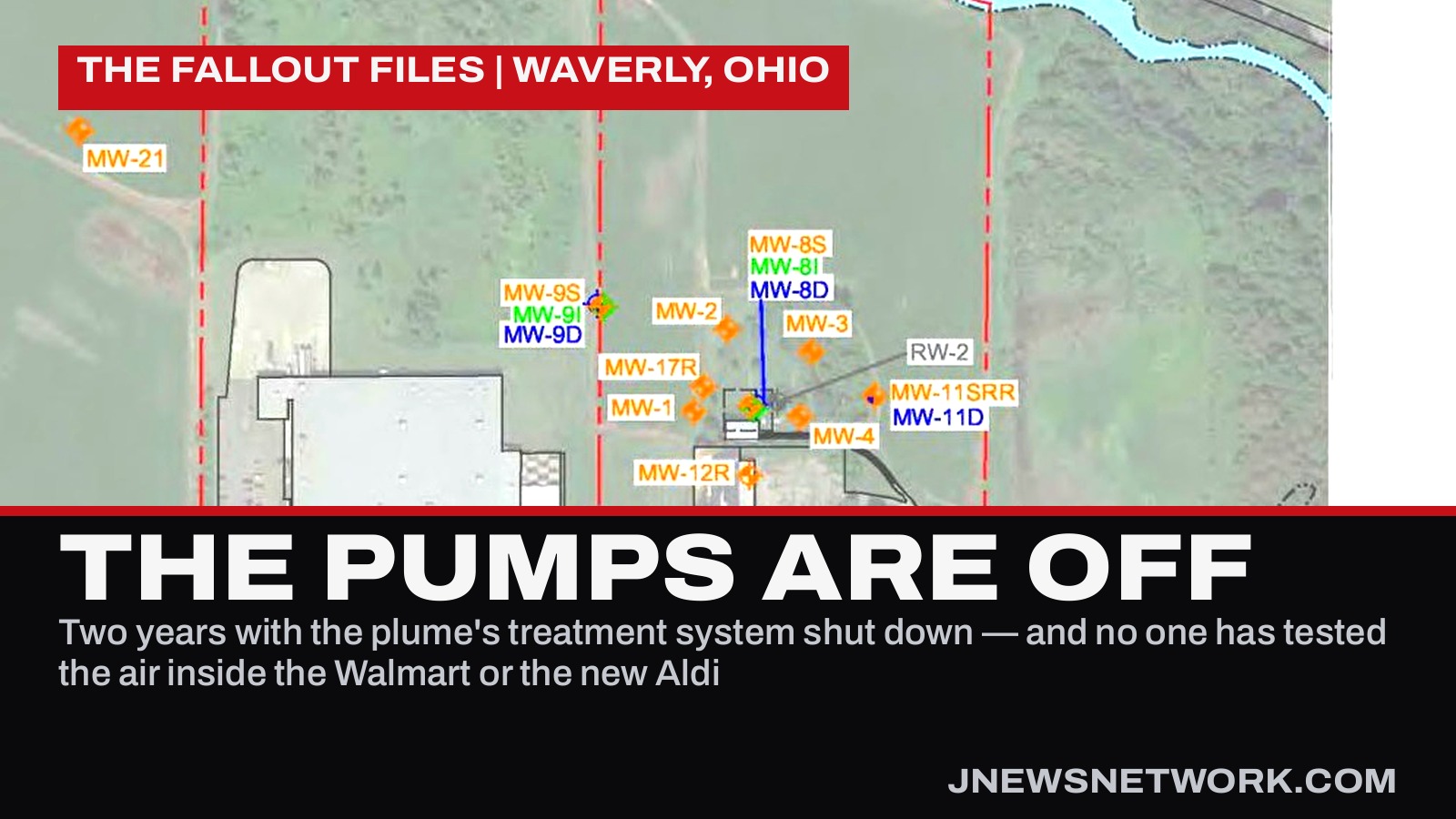
The plume it was built to hold back is mapped in Parker Hannifin’s own filings: a network of recovery wells, piezometers and monitoring wells spread across the property between Crooked Creek and Pee Pee Creek, tracking a plume of volatile organic compounds — the family of industrial solvents that includes trichloroethylene (TCE), tetrachloroethene, dichloroethene and vinyl chloride.
JNN has reported on this site before: the Walmart was built on top of the plume, and the plume never left. What is new is that the system built to control it is off — and that the paper trail around the shutdown raises more questions than it answers.
The violations nobody reported
While the treatment system was still running, it broke its permit three times. The inspection report lists three effluent limit violations between September 2021 and April 2026, all for trichloroethylene in the treated water discharged from Outfall 001:
- April 2022: TCE at 8.4 micrograms per liter against a permit limit of 5.0 — plus a separate violation for the total quantity discharged.
- July 2022: TCE at 7.6 micrograms per liter against the same 5.0 limit.
And then, the report finds, Parker Hannifin simply never told the state. “Noncompliance reports were not received for trichloroethylene (TCE) violations that occurred in April and July 2022,” the inspector wrote — a separate finding in the report, because reporting a violation is itself a permit requirement.
The company’s permit renewal application was also filed late: it was due no later than July 4, 2024, and was not received until July 5, 2024.
Ohio EPA’s response to all of it, in full, is one recommendation — the report stresses it “is not an Order”: “Ohio EPA recommends continuing to operate within the terms and conditions of the NPDES permit.” The permit itself (Ohio permit OH0104132) runs through December 31, 2029.
The shutdown was approved — as a trial. The trial is almost up.
The inspection report — written by Ohio EPA’s surface-water division, which runs the discharge permit — does not explain the shutdown. The explanation sits in the site’s cleanup file, in a different arm of the agency, and JNN pulled it for this story.
On December 20, 2023, Ohio EPA approved a temporary addendum to the post-closure plan: Parker Hannifin could shut off the groundwater extraction and treatment system for a trial period, to test a mixing-zone analysis indicating that turning the system off would not push TCE in Pee Pee Creek above the established limits. The approval set criteria that would force the system back on, and it increased the monitoring frequency while the trial ran. The trial’s initial term was one year. Ohio EPA could extend it to three — “after which a decision must be made about the permanent deactivation of the system.”
Read the December 2023 shutdown approval (PDF)
Parker Hannifin notified the agency on January 24, 2024, and shut the system down on January 29, 2024. By then it had been running, in interim and full-scale form, since 1995: according to the company’s 2025 annual monitoring report, it treated approximately 2,031,900,000 gallons of groundwater and removed approximately 1,824 pounds of volatile organic compounds.
No reactivation triggers were hit in the trial’s first year, and Ohio EPA approved a second year. The monitoring — which never stopped — is the trial’s evidence, and the 2025 annual report, filed by AECOM in March 2026, cuts both ways. It concludes that concentrations are broadly stable or decreasing, that no volatile compounds were detected in Pee Pee Creek surface water in the third and fourth quarters of 2025, and that the treatment system “is not necessary to prevent off-site migration.” It also records that, with the pumps off, TCE still exceeded the state’s groundwater protection standard — 5 micrograms per liter — in recovery wells RW-4 and RW-5 in every sample collected during the reporting period, and in monitoring well MW-15I in September 2025. The report recommends continuing the pilot shutdown for one more year, at Ohio EPA’s request.
Count the trial clock: approved in December 2023, extendable to a maximum of three years. The decision the 2023 approval demands — whether the shutdown becomes permanent — is now due.
Read the 2025 Annual Groundwater Monitoring Report (Ohio EPA public record, 404 pages)
Now a monitoring well is coming out — for redevelopment
On November 2, 2026, Ohio EPA Director John Logue approved an amendment to the site’s Post-Closure Plan — the plan, first approved October 4, 2001, that governs how this closed hazardous-waste facility is watched over. The amendment does one thing: it allows Parker Hannifin to decommission monitoring well MW-12R.
The reason is in the request filed by AECOM, Parker Hannifin’s consultant: “The current property owner, Mr. Randy Roe (Roe Properties LLC), is redeveloping the property and, given the location of MW-12R, this well will likely be damaged or destroyed during redevelopment work.”
Read AECOM’s full amendment request (PDF)
MW-12R is one of only seven wells designated to monitor the source area under the site’s Corrective Action Monitoring Plan. AECOM’s case for removing it: the well sits side-gradient or upgradient of the assumed source area, and site chemicals have not been detected above groundwater standards there since May 2009 — 17 years and 47 sampling events. AECOM filed the well’s full testing history with the request: a quarter-century of results for the 15 chemicals the monitoring program tracks.
The change was treated as the equivalent of a Class 2 permit modification, which meant the public got a say. The comment period ran from September 23 through October 26, 2026. Ohio EPA’s approval letter records the result: “Ohio EPA did not receive any comments during the public comment period.”
Not one.
The approval, signed by the director and entered in the Director’s Journal on November 2, comes with one reservation: it “does not release Parker Hannifin from any responsibilities regarding corrective action for all releases of hazardous waste or constituents from any waste management unit, regardless of the time at which waste was placed in the unit.”
The plan itself was extended this year. The original 30-year post-closure period, which began around June 1995, ended in June 2025; on April 27, 2026, Ohio EPA approved ten more years of post-closure care, through June 30, 2035.
Read the full approval letter (PDF)
The question no document asks: the air inside the stores
There is a word that appears in none of these documents. Not in the inspection report. Not in the request to remove the well. Not in the approval.
The word is vapor.
TCE and the other solvents in this plume are volatile — they evaporate. When contaminated groundwater sits beneath a building, those chemicals can rise as vapor through the soil, slip through cracks and utility openings in a foundation, and collect in the air inside. It is called vapor intrusion, and it is the reason contaminated-groundwater sites with buildings on top of them get their indoor air tested: the people inside a store over a plume — the cashiers and stockers who work full shifts there, the shoppers who pass through — breathe that air.
The Walmart has stood over this plume for years. The Aldi opened on the property on July 30, 2026 — a new grocery store, built on the same ground, while the treatment system sat off.
JNN raised vapor intrusion at this site a year ago, in December 2025. For this story, JNN reviewed the governing documents of the site’s Ohio EPA file — the 765-page post-closure and corrective action monitoring plan, the 404-page 2025 annual groundwater monitoring report, the 2026 inspection, the shutdown approval, the post-closure extension and the well-removal approval. Across all of them, the word “vapor” appears only as soil vapor extraction — a cleanup technology that pulled vapors out of the soil at the source area, itself shut down in 2018 with Ohio EPA’s approval. No document in that record evaluates vapor intrusion into the buildings on the property. None describes indoor-air testing inside the Walmart. None describes testing inside the Aldi. None explains why it isn’t needed.
So the record now stands like this: the treatment system is off — turned off with the state’s permission, as a trial, with the decision on making that permanent now due. Monitoring continues, and the company’s own 2025 report still records the plume’s main chemical above the state’s groundwater standard in wells on the property. The last discharge violations the system committed were never reported by the company that committed them. A monitoring well is coming out of the ground to make room for redevelopment, and the public comment file is empty. And over a plume of cancer-causing solvents, under two grocery stores full of people, the question of what is in the air inside has not been asked — at least not anywhere in writing, by anyone whose job it is to ask it.
The Fallout Files is JNN’s investigative desk. The documents cited in this story — Ohio EPA’s inspection report, AECOM’s amendment request and Ohio EPA’s approval — are embedded above in full.
🎧 LISTEN: THE FALLOUT FILES PODCAST
WAVERLY, Ohio — The machines that spent decades pulling contaminated groundwater out from under the Waverly Walmart and treating it have been shut off for two years.
That is not an allegation. It is a finding in Ohio EPA’s own inspection report.
On April 22, 2026, an inspector from the Ohio EPA’s Division of Surface Water walked the former Parker Hannifin facility at 11197 U.S. Route 23 in Waverly — the plant whose chemical plume spread through the groundwater beneath what is now the Walmart, and beneath the Aldi grocery store that opened on the property this summer. In the findings section of the report, between a late permit filing and a set of pollution violations the company never reported, the inspector wrote it in one sentence:
“The groundwater pump and treat system has been shut down for two years.”
The sentence appears twice in the report. There was no discharge at all on the day of the inspection.
Read the full inspection report (PDF)
What was turned off
The system was the site’s groundwater remediation plant: contaminated groundwater was pumped out of the ground, run through an oil-and-water separator and an air stripper to strip out the chemicals, and discharged — under a state pollution permit — into Crooked Creek. It was designed to treat an average of 0.36 million gallons a day.
The plume it was built to hold back is mapped in Parker Hannifin’s own filings: a network of recovery wells, piezometers and monitoring wells spread across the property between Crooked Creek and Pee Pee Creek, tracking a plume of volatile organic compounds — the family of industrial solvents that includes trichloroethylene (TCE), tetrachloroethene, dichloroethene and vinyl chloride.
JNN has reported on this site before: the Walmart was built on top of the plume, and the plume never left. What is new is that the system built to control it is off — and that the paper trail around the shutdown raises more questions than it answers.
The violations nobody reported
While the treatment system was still running, it broke its permit three times. The inspection report lists three effluent limit violations between September 2021 and April 2026, all for trichloroethylene in the treated water discharged from Outfall 001:
- April 2022: TCE at 8.4 micrograms per liter against a permit limit of 5.0 — plus a separate violation for the total quantity discharged.
- July 2022: TCE at 7.6 micrograms per liter against the same 5.0 limit.
And then, the report finds, Parker Hannifin simply never told the state. “Noncompliance reports were not received for trichloroethylene (TCE) violations that occurred in April and July 2022,” the inspector wrote — a separate finding in the report, because reporting a violation is itself a permit requirement.
The company’s permit renewal application was also filed late: it was due no later than July 4, 2024, and was not received until July 5, 2024.
Ohio EPA’s response to all of it, in full, is one recommendation — the report stresses it “is not an Order”: “Ohio EPA recommends continuing to operate within the terms and conditions of the NPDES permit.” The permit itself (Ohio permit OH0104132) runs through December 31, 2029.
The shutdown was approved — as a trial. The trial is almost up.
The inspection report — written by Ohio EPA’s surface-water division, which runs the discharge permit — does not explain the shutdown. The explanation sits in the site’s cleanup file, in a different arm of the agency, and JNN pulled it for this story.
On December 20, 2023, Ohio EPA approved a temporary addendum to the post-closure plan: Parker Hannifin could shut off the groundwater extraction and treatment system for a trial period, to test a mixing-zone analysis indicating that turning the system off would not push TCE in Pee Pee Creek above the established limits. The approval set criteria that would force the system back on, and it increased the monitoring frequency while the trial ran. The trial’s initial term was one year. Ohio EPA could extend it to three — “after which a decision must be made about the permanent deactivation of the system.”
Read the December 2023 shutdown approval (PDF)
Parker Hannifin notified the agency on January 24, 2024, and shut the system down on January 29, 2024. By then it had been running, in interim and full-scale form, since 1995: according to the company’s 2025 annual monitoring report, it treated approximately 2,031,900,000 gallons of groundwater and removed approximately 1,824 pounds of volatile organic compounds.
No reactivation triggers were hit in the trial’s first year, and Ohio EPA approved a second year. The monitoring — which never stopped — is the trial’s evidence, and the 2025 annual report, filed by AECOM in March 2026, cuts both ways. It concludes that concentrations are broadly stable or decreasing, that no volatile compounds were detected in Pee Pee Creek surface water in the third and fourth quarters of 2025, and that the treatment system “is not necessary to prevent off-site migration.” It also records that, with the pumps off, TCE still exceeded the state’s groundwater protection standard — 5 micrograms per liter — in recovery wells RW-4 and RW-5 in every sample collected during the reporting period, and in monitoring well MW-15I in September 2025. The report recommends continuing the pilot shutdown for one more year, at Ohio EPA’s request.
Count the trial clock: approved in December 2023, extendable to a maximum of three years. The decision the 2023 approval demands — whether the shutdown becomes permanent — is now due.
Read the 2025 Annual Groundwater Monitoring Report (Ohio EPA public record, 404 pages)
Now a monitoring well is coming out — for redevelopment
On November 2, 2026, Ohio EPA Director John Logue approved an amendment to the site’s Post-Closure Plan — the plan, first approved October 4, 2001, that governs how this closed hazardous-waste facility is watched over. The amendment does one thing: it allows Parker Hannifin to decommission monitoring well MW-12R.
The reason is in the request filed by AECOM, Parker Hannifin’s consultant: “The current property owner, Mr. Randy Roe (Roe Properties LLC), is redeveloping the property and, given the location of MW-12R, this well will likely be damaged or destroyed during redevelopment work.”
Read AECOM’s full amendment request (PDF)
MW-12R is one of only seven wells designated to monitor the source area under the site’s Corrective Action Monitoring Plan. AECOM’s case for removing it: the well sits side-gradient or upgradient of the assumed source area, and site chemicals have not been detected above groundwater standards there since May 2009 — 17 years and 47 sampling events. AECOM filed the well’s full testing history with the request: a quarter-century of results for the 15 chemicals the monitoring program tracks.
The change was treated as the equivalent of a Class 2 permit modification, which meant the public got a say. The comment period ran from September 23 through October 26, 2026. Ohio EPA’s approval letter records the result: “Ohio EPA did not receive any comments during the public comment period.”
Not one.
The approval, signed by the director and entered in the Director’s Journal on November 2, comes with one reservation: it “does not release Parker Hannifin from any responsibilities regarding corrective action for all releases of hazardous waste or constituents from any waste management unit, regardless of the time at which waste was placed in the unit.”
The plan itself was extended this year. The original 30-year post-closure period, which began around June 1995, ended in June 2025; on April 27, 2026, Ohio EPA approved ten more years of post-closure care, through June 30, 2035.
Read the full approval letter (PDF)
The question no document asks: the air inside the stores
There is a word that appears in none of these documents. Not in the inspection report. Not in the request to remove the well. Not in the approval.
The word is vapor.
TCE and the other solvents in this plume are volatile — they evaporate. When contaminated groundwater sits beneath a building, those chemicals can rise as vapor through the soil, slip through cracks and utility openings in a foundation, and collect in the air inside. It is called vapor intrusion, and it is the reason contaminated-groundwater sites with buildings on top of them get their indoor air tested: the people inside a store over a plume — the cashiers and stockers who work full shifts there, the shoppers who pass through — breathe that air.
The Walmart has stood over this plume for years. The Aldi opened on the property on July 30, 2026 — a new grocery store, built on the same ground, while the treatment system sat off.
JNN raised vapor intrusion at this site a year ago, in December 2025. For this story, JNN reviewed the governing documents of the site’s Ohio EPA file — the 765-page post-closure and corrective action monitoring plan, the 404-page 2025 annual groundwater monitoring report, the 2026 inspection, the shutdown approval, the post-closure extension and the well-removal approval. Across all of them, the word “vapor” appears only as soil vapor extraction — a cleanup technology that pulled vapors out of the soil at the source area, itself shut down in 2018 with Ohio EPA’s approval. No document in that record evaluates vapor intrusion into the buildings on the property. None describes indoor-air testing inside the Walmart. None describes testing inside the Aldi. None explains why it isn’t needed.
So the record now stands like this: the treatment system is off — turned off with the state’s permission, as a trial, with the decision on making that permanent now due. Monitoring continues, and the company’s own 2025 report still records the plume’s main chemical above the state’s groundwater standard in wells on the property. The last discharge violations the system committed were never reported by the company that committed them. A monitoring well is coming out of the ground to make room for redevelopment, and the public comment file is empty. And over a plume of cancer-causing solvents, under two grocery stores full of people, the question of what is in the air inside has not been asked — at least not anywhere in writing, by anyone whose job it is to ask it.
The Fallout Files is JNN’s investigative desk. The documents cited in this story — Ohio EPA’s inspection report, AECOM’s amendment request and Ohio EPA’s approval — are embedded above in full.