



Read the full groundwater report (PDF, 94 pages)
Who is watching it
The monitoring is not being run by the plant’s operator. Verdantas prepared the sampling work plan in February 2026 on behalf of Legacy Refining Operations, a series of Evergreen Resources Group, LLC — the former owner’s side of the site. ALTIVIA Petrochemicals, which operates the plant today (the facility was formerly Haverhill Chemicals), is the named facility on the report. Ohio EPA reviewed the plan, sent comments in May 2026, and a revised plan followed in June.
The sampling itself had to be done twice. The first event, June 15–17, 2026, was thrown out: the samples reached the laboratory several days late and warmer than the acceptable range, and were “no longer considered acceptable for analysis.” The crews went back on July 6 and 7 and re-sampled. The July results are the ones in the report.
The plant’s fall paperwork
The groundwater report is one of four ALTIVIA filings to land in Ohio EPA’s public file this fall:
- October 16, 2026 — Ohio EPA issued the plant’s renewed Title V air permit, the facility’s license to operate its air emissions sources. Read it at Ohio EPA
- November 13, 2026 — ALTIVIA filed the 2026 engineering assessments for storage tanks 2105-F, 2104-F and 2003-F; the assessor certified tank 2003-F as “adequately designed, has sufficient structural strength and is compatible for its intended service.” Read it at Ohio EPA
- November 20, 2026 — ALTIVIA asked approval to update the plant’s RCRA closure cost estimate for inflation: $1,132,871 for 2026 — the financial assurance figure for closing those tank units, up from $970,833 in the 2022 base year. Read it at Ohio EPA
So the fall record for Haverhill reads like this: the air permit is renewed, the tanks are certified, the closure fund is updated — and underneath the plant, in the groundwater, five industrial solvents are sitting above the limits the federal government sets for the water people drink. The monitoring continues. What happens about the plume itself is not in any of these documents.
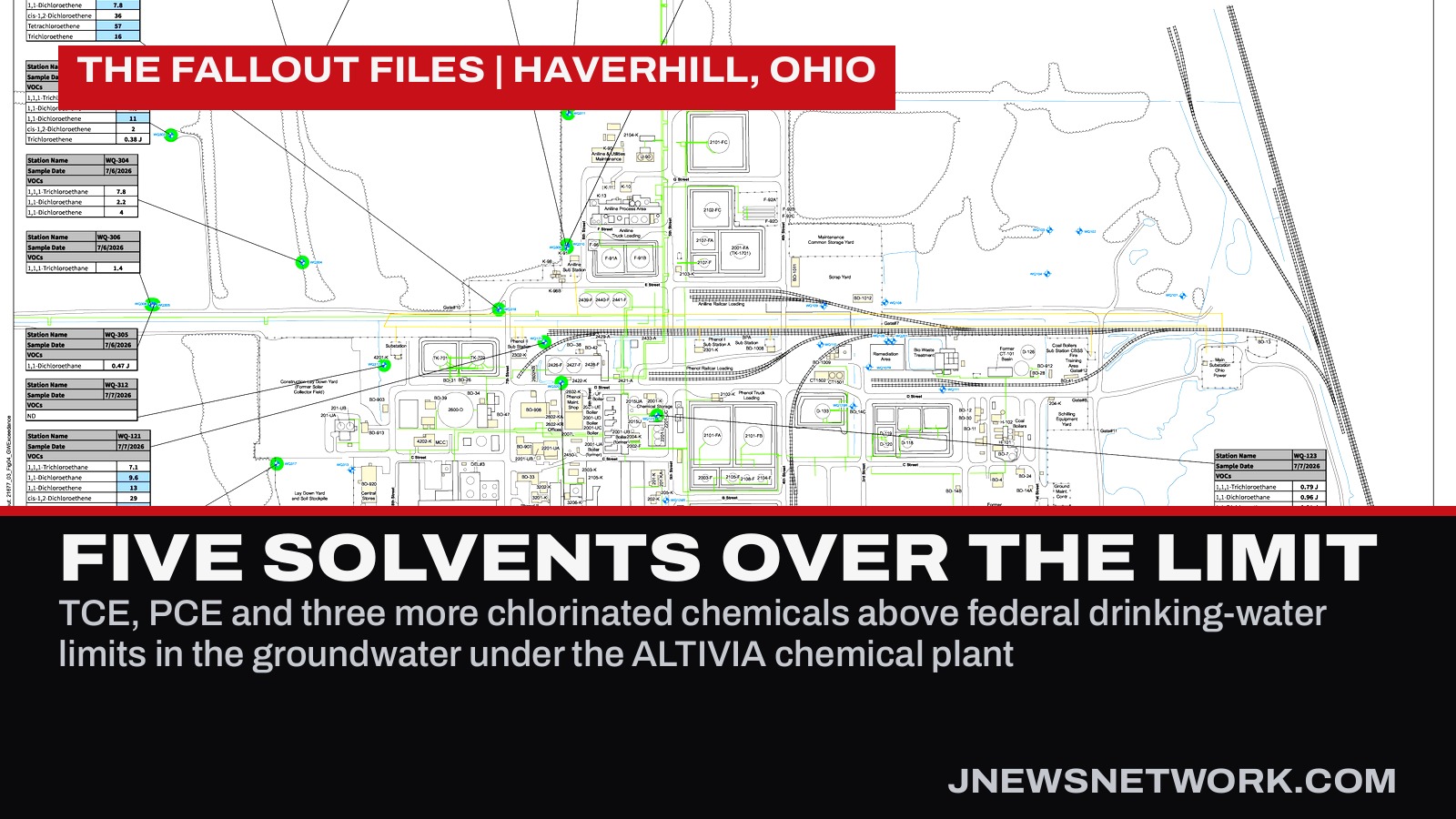
Five chlorinated solvents are sitting in the groundwater under the ALTIVIA chemical plant at Haverhill at levels above the federal limits for drinking water — one of them at 44 times its limit — according to the plant’s own 2026 groundwater monitoring report, filed with Ohio EPA in October.
The report, prepared by the environmental firm Verdantas and submitted to the Ohio EPA’s Division of Environmental Response and Revitalization on October 7, 2026, covers sampling conducted July 6 and 7, 2026 at the plant at 1019 Haverhill–Ohio Furnace Road in Scioto County, on the Ohio River. Its conclusion is one sentence long: “A dissolved-phase groundwater plume containing relatively low concentrations of five chlorinated compounds underlies a portion of the operating Facility.”
The numbers
The laboratory results were compared against the U.S. EPA’s drinking-water standards (maximum contaminant levels, or MCLs). Five compounds came back above them:
- Tetrachloroethene (PCE) — the dry-cleaning and degreasing solvent: 4 samples above its limit of 5 micrograms per liter, running as high as 220 — 44 times the limit.
- Trichloroethene (TCE) — 3 samples above its limit of 5, running as high as 90 — 18 times the limit.
- cis-1,2-Dichloroethene — one sample at 460, against a limit of 70.
- 1,1-Dichloroethene — 4 samples above its limit of 7, running 7.8 to 51.
- 1,1-Dichloroethane — 3 samples above the federal tapwater screening level, running 5.4 to 16. (No drinking-water MCL exists for this compound; the report screened it against U.S. EPA’s tapwater level of 2.8.)
Five monitoring wells — WQ-121, WQ-303, WQ-318, WQ-319 and WQ-320 — carried at least one chemical over its limit. The highest concentrations were found at WQ-320, on the plant’s north side, where a single well carried the 460 reading for cis-1,2-dichloroethene, the 220 for PCE and the 90 for TCE at once.

Where the plume sits — and where it doesn’t
The report states that groundwater under the plant flows to the west and northwest. It also records the boundary of the problem as the consultants found it: monitoring wells located beyond the operating plant, in the agricultural fields down- and side-gradient of the facility, “continue to show no VOC concentrations exceeding MCLs” — with one exception, well WQ-303, where 1,1-dichloroethane was detected at 11 micrograms per liter, above its screening level.
The report is a monitoring summary. It records concentrations, maps them, and concludes the plume underlies part of the plant. It does not order a cleanup, set a remediation schedule, or describe one — nothing in the documents filed this fall does.
Read the full groundwater report (PDF, 94 pages)
Who is watching it
The monitoring is not being run by the plant’s operator. Verdantas prepared the sampling work plan in February 2026 on behalf of Legacy Refining Operations, a series of Evergreen Resources Group, LLC — the former owner’s side of the site. ALTIVIA Petrochemicals, which operates the plant today (the facility was formerly Haverhill Chemicals), is the named facility on the report. Ohio EPA reviewed the plan, sent comments in May 2026, and a revised plan followed in June.
The sampling itself had to be done twice. The first event, June 15–17, 2026, was thrown out: the samples reached the laboratory several days late and warmer than the acceptable range, and were “no longer considered acceptable for analysis.” The crews went back on July 6 and 7 and re-sampled. The July results are the ones in the report.
The plant’s fall paperwork
The groundwater report is one of four ALTIVIA filings to land in Ohio EPA’s public file this fall:
- October 16, 2026 — Ohio EPA issued the plant’s renewed Title V air permit, the facility’s license to operate its air emissions sources. Read it at Ohio EPA
- November 13, 2026 — ALTIVIA filed the 2026 engineering assessments for storage tanks 2105-F, 2104-F and 2003-F; the assessor certified tank 2003-F as “adequately designed, has sufficient structural strength and is compatible for its intended service.” Read it at Ohio EPA
- November 20, 2026 — ALTIVIA asked approval to update the plant’s RCRA closure cost estimate for inflation: $1,132,871 for 2026 — the financial assurance figure for closing those tank units, up from $970,833 in the 2022 base year. Read it at Ohio EPA
So the fall record for Haverhill reads like this: the air permit is renewed, the tanks are certified, the closure fund is updated — and underneath the plant, in the groundwater, five industrial solvents are sitting above the limits the federal government sets for the water people drink. The monitoring continues. What happens about the plume itself is not in any of these documents.
Five chlorinated solvents are sitting in the groundwater under the ALTIVIA chemical plant at Haverhill at levels above the federal limits for drinking water — one of them at 44 times its limit — according to the plant’s own 2026 groundwater monitoring report, filed with Ohio EPA in October.
The report, prepared by the environmental firm Verdantas and submitted to the Ohio EPA’s Division of Environmental Response and Revitalization on October 7, 2026, covers sampling conducted July 6 and 7, 2026 at the plant at 1019 Haverhill–Ohio Furnace Road in Scioto County, on the Ohio River. Its conclusion is one sentence long: “A dissolved-phase groundwater plume containing relatively low concentrations of five chlorinated compounds underlies a portion of the operating Facility.”
The numbers
The laboratory results were compared against the U.S. EPA’s drinking-water standards (maximum contaminant levels, or MCLs). Five compounds came back above them:
- Tetrachloroethene (PCE) — the dry-cleaning and degreasing solvent: 4 samples above its limit of 5 micrograms per liter, running as high as 220 — 44 times the limit.
- Trichloroethene (TCE) — 3 samples above its limit of 5, running as high as 90 — 18 times the limit.
- cis-1,2-Dichloroethene — one sample at 460, against a limit of 70.
- 1,1-Dichloroethene — 4 samples above its limit of 7, running 7.8 to 51.
- 1,1-Dichloroethane — 3 samples above the federal tapwater screening level, running 5.4 to 16. (No drinking-water MCL exists for this compound; the report screened it against U.S. EPA’s tapwater level of 2.8.)
Five monitoring wells — WQ-121, WQ-303, WQ-318, WQ-319 and WQ-320 — carried at least one chemical over its limit. The highest concentrations were found at WQ-320, on the plant’s north side, where a single well carried the 460 reading for cis-1,2-dichloroethene, the 220 for PCE and the 90 for TCE at once.
Where the plume sits — and where it doesn’t
The report states that groundwater under the plant flows to the west and northwest. It also records the boundary of the problem as the consultants found it: monitoring wells located beyond the operating plant, in the agricultural fields down- and side-gradient of the facility, “continue to show no VOC concentrations exceeding MCLs” — with one exception, well WQ-303, where 1,1-dichloroethane was detected at 11 micrograms per liter, above its screening level.
The report is a monitoring summary. It records concentrations, maps them, and concludes the plume underlies part of the plant. It does not order a cleanup, set a remediation schedule, or describe one — nothing in the documents filed this fall does.
Read the full groundwater report (PDF, 94 pages)
Who is watching it
The monitoring is not being run by the plant’s operator. Verdantas prepared the sampling work plan in February 2026 on behalf of Legacy Refining Operations, a series of Evergreen Resources Group, LLC — the former owner’s side of the site. ALTIVIA Petrochemicals, which operates the plant today (the facility was formerly Haverhill Chemicals), is the named facility on the report. Ohio EPA reviewed the plan, sent comments in May 2026, and a revised plan followed in June.
The sampling itself had to be done twice. The first event, June 15–17, 2026, was thrown out: the samples reached the laboratory several days late and warmer than the acceptable range, and were “no longer considered acceptable for analysis.” The crews went back on July 6 and 7 and re-sampled. The July results are the ones in the report.
The plant’s fall paperwork
The groundwater report is one of four ALTIVIA filings to land in Ohio EPA’s public file this fall:
- October 16, 2026 — Ohio EPA issued the plant’s renewed Title V air permit, the facility’s license to operate its air emissions sources. Read it at Ohio EPA
- November 13, 2026 — ALTIVIA filed the 2026 engineering assessments for storage tanks 2105-F, 2104-F and 2003-F; the assessor certified tank 2003-F as “adequately designed, has sufficient structural strength and is compatible for its intended service.” Read it at Ohio EPA
- November 20, 2026 — ALTIVIA asked approval to update the plant’s RCRA closure cost estimate for inflation: $1,132,871 for 2026 — the financial assurance figure for closing those tank units, up from $970,833 in the 2022 base year. Read it at Ohio EPA
So the fall record for Haverhill reads like this: the air permit is renewed, the tanks are certified, the closure fund is updated — and underneath the plant, in the groundwater, five industrial solvents are sitting above the limits the federal government sets for the water people drink. The monitoring continues. What happens about the plume itself is not in any of these documents.