

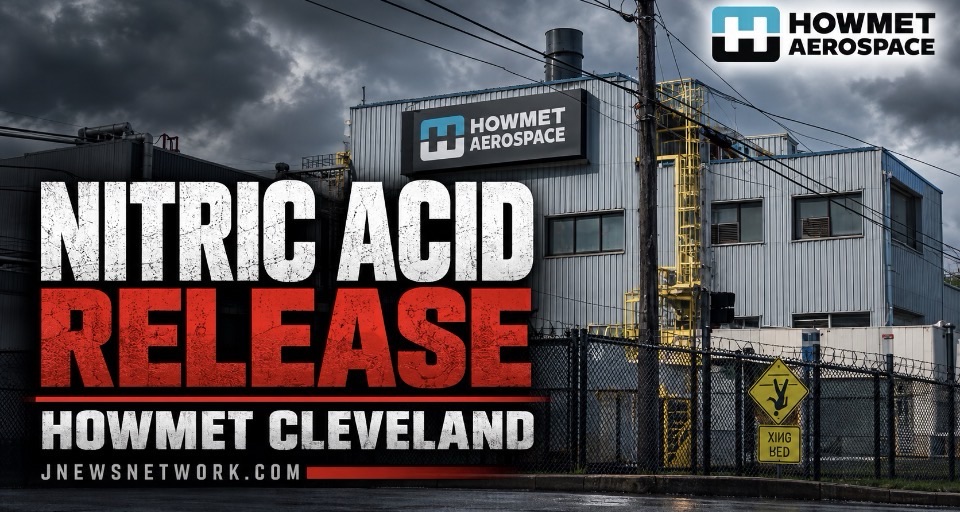
CUYAHOGA HEIGHTS, Ohio — People were exposed to nitric-acid fumes after gas escaped during a waste-acid collection operation at Howmet Aerospace’s Cleveland plant Wednesday morning. A few received on-site medical attention, putting the company’s environmental record at two Ohio sites back in focus.
At about 11 a.m. Oct. 21, a contractor collecting waste nitric acid in a tanker truck accidentally released gas at the facility at 1600 Harvard Avenue, Howmet spokesperson Rob Morrison told News 5 Cleveland. A dispatch message reviewed by JNN described a large orange cloud. Howmet said the affected area was evacuated and that a few people received medical attention on site because of inhalation concerns.
Nitric acid is used at the plant for metal etching. The company said crews were checking for residual effects. The public account did not identify the amount released, explain how the collection operation failed or describe the plume’s path beyond the facility.
EPA history at the Cleveland plant
The Cleveland operation has a record of environmental enforcement. EPA air records list violation notices in 2018 and 2021 and a 2022 administrative order carrying a $17,000 penalty.
Same company owns the former Wear-Ever site
Howmet also owns the former Wear-Ever cookware property in Chillicothe, where decades of manufacturing left chlorinated-solvent and heavy-metal contamination.
Recent groundwater results at Wear-Ever remain stark. In June 2026 sampling reported by JNN, an on-site well contained vinyl chloride at 230 micrograms per liter and trichloroethylene at 260 micrograms per liter—115 times and 52 times their respective federal drinking-water limits. An off-site monitoring well also exceeded federal limits for several solvents.
Ohio EPA and Howmet have agreed to add six monitoring wells to the Chillicothe site, but JNN reported in September that installation still depended on access agreements. More wells would expand monitoring; they do not by themselves remove contamination. Environmental scientists have stated that under the current remedial action plan it would take over 100 years before the groundwater under the old Chillicothe site is remotely safe.
JNN has tracked the Chillicothe site’s continuing contamination in its reports on recent groundwater results and the proposed monitoring wells. At the Cleveland plant, the immediate questions are how the release happened, how much material escaped and what steps will prevent another one. At Wear-Ever, the long-running questions concern containment, monitoring and whether the remedy is keeping contamination from spreading.