

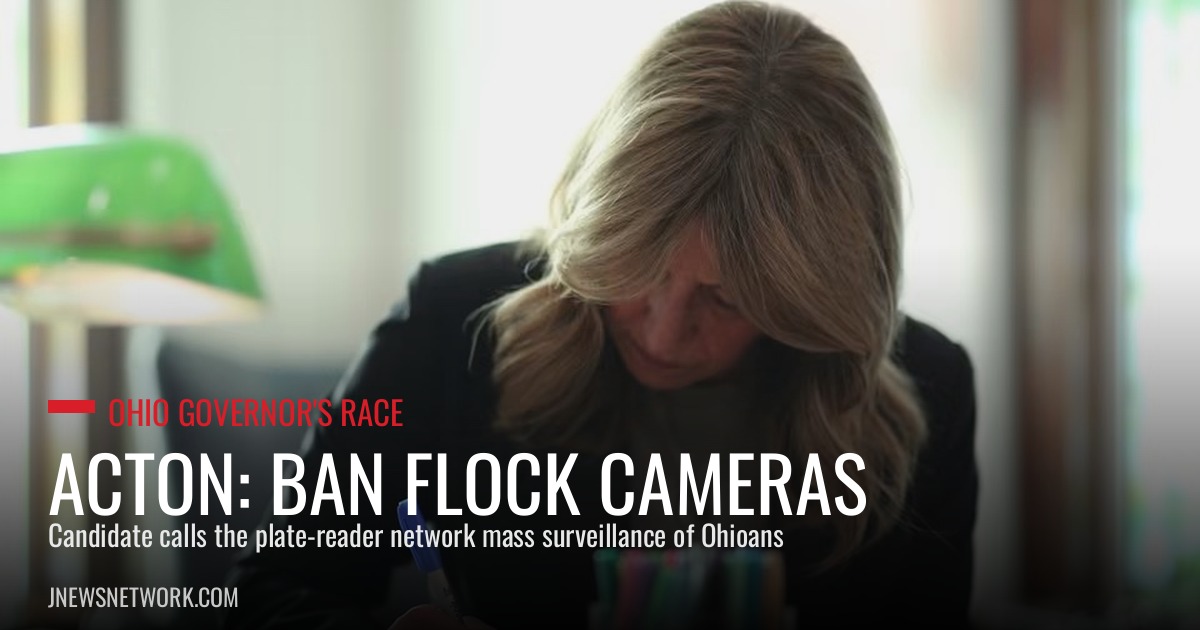
COLUMBUS, Ohio — Democratic gubernatorial candidate Amy Acton said Saturday she will support legislation to ban Flock Safety license plate reader cameras in Ohio, arguing the network amounts to mass surveillance of people who have broken no law.
“Ohioans shouldn’t have to sacrifice their rights to keep our state safe,” Acton said in a statement. “As governor, I will support legislation to ban Flock cameras. I will always support law enforcement and keep our communities safe without allowing mass surveillance of everyday Ohioans.”
The statement hardens a position Acton first signaled in September, when her campaign said she would back bipartisan ban legislation after she had initially called for a comprehensive review of law enforcement technology.
What the cameras do
Flock Safety, an Atlanta-based company, sells solar-powered cameras that mount on poles along roads and photograph every vehicle that passes. Software reads each license plate and records the vehicle’s make, model, color and distinguishing details — a combination the company calls a “vehicle fingerprint.” The images are uploaded to a searchable database, and departments that use Flock can search cameras operated by other agencies through a national network spanning thousands of law enforcement agencies.
Police credit the system with real results. It alerts officers in real time when a camera spots a stolen vehicle, a car tied to a warrant or a vehicle connected to a missing person, and detectives use it to retrace a suspect’s movements. Columbus police told City Council in August that Flock had helped solve 54 percent of the city’s homicides this year.
Why the cameras are controversial
Critics, including the American Civil Liberties Union and the Electronic Frontier Foundation, argue the cameras log the movements of every driver who passes — not just people suspected of crimes — and that those records can be searched without a warrant. U.S. Senate Minority Leader Chuck Schumer has called Flock “a private, nationwide surveillance tool” and questioned the company’s security after researchers who obtained a camera found its stored data could be extracted.
The backlash has reached Ohio. Since August, at least a dozen Ohio communities and agencies have ended, paused or turned down Flock programs. Columbus and Dayton paused their networks, the Hamilton County Sheriff’s Office shut down its 75 cameras on Oct. 2, and Oxford, Ironton, Monroe and Reynoldsburg are among the communities that have ended or rejected programs. Columbus paused after a police officer was found to have searched the same license plate hundreds of times for personal reasons. Nationally, more than 200 cities and counties have ended Flock contracts since 2021, according to counts compiled by opponents of the technology, and Florida’s Department of Transportation revoked approvals for Flock cameras on state road rights-of-way in September.
Ohio has no law limiting how long plate-reader data is kept, who it may be shared with or whether searches require a warrant; the only statute on the books exempts the data from public records requests. Five bills are pending at the Statehouse. House Bill 1010, the bipartisan Ohio Freedom from Mass Surveillance Act backed by Rep. Levi Dean, a Xenia Republican, and Rep. Tristan Rader, a Lakewood Democrat, would generally prohibit agencies from operating the cameras while allowing use with a search warrant. Senate Bill 469, from Sen. Al Cutrona, a Canfield Republican, would instead keep the cameras with new guardrails, including a 10-day data deletion rule, a felony penalty for selling the data and annual reporting. Bills not passed by the end of the year expire with the legislative session.
Flock says its cameras help officers find missing children, recover stolen vehicles and identify murder suspects, and the company has added audit tools, required case numbers for searches and shortened its default data retention period. Law enforcement supporters also note the cameras photograph vehicles traveling on public roads, where courts have long held drivers have a limited expectation of privacy.