

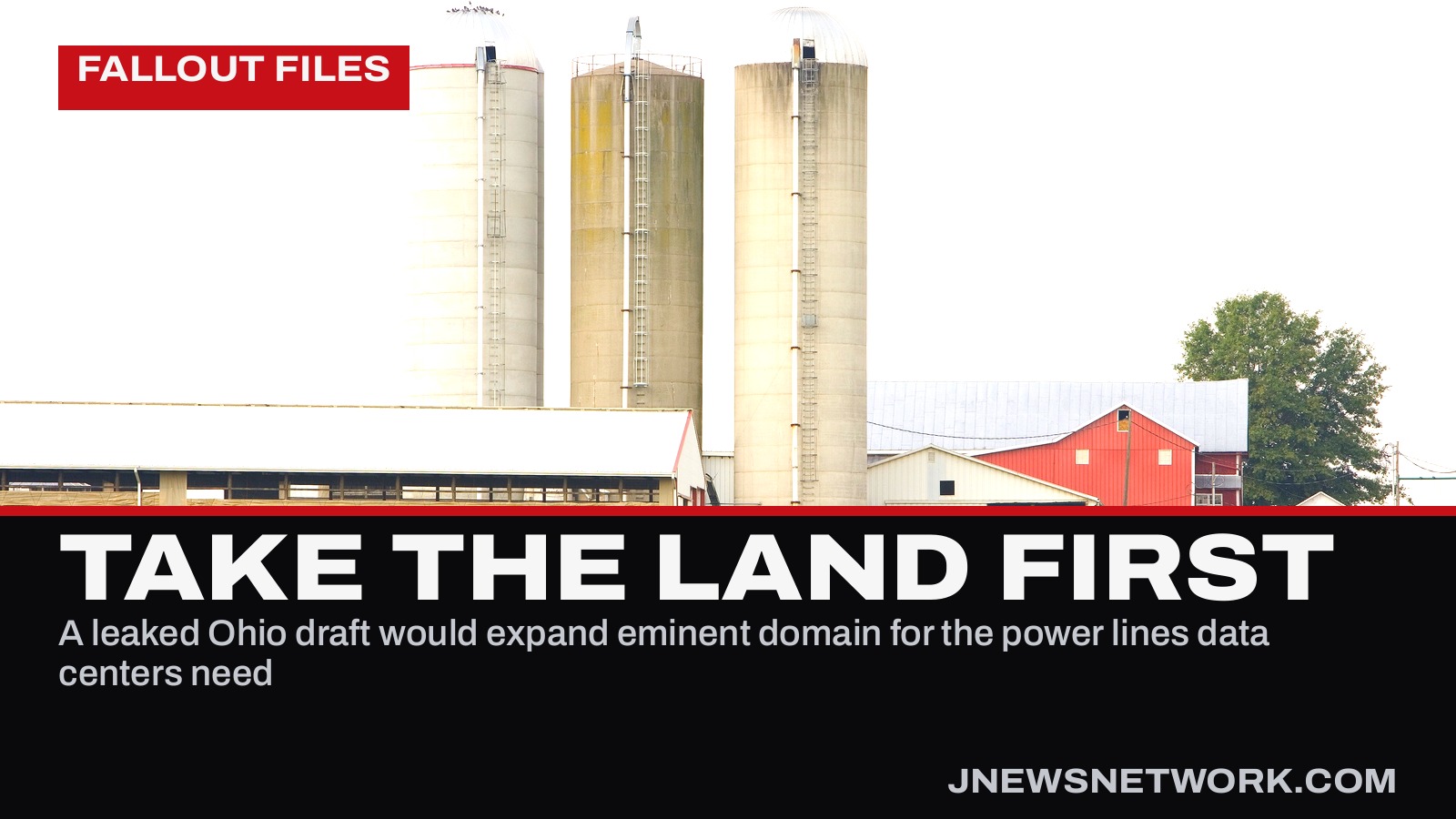
A draft bill circulating at the Ohio Statehouse would rewrite the state’s eminent domain law in two ways: it would expand who counts as a “public utility” with the power to take private land, and it would change the appraisal process so land can be seized sooner — before the fight over its price is finished.
The draft has not been introduced in the General Assembly. It has no bill number, and its full text has not been publicly released. What is known about it comes from the document itself as quoted by the reporters who obtained it: News 5 Cleveland reporter Morgan Trau, who first reported the draft on Nov. 16 (the story also ran in the Ohio Capital Journal), and WDTN 2 News in Dayton, which reported obtaining its own copy on Nov. 17.
The receipts: what the draft’s own words would change
Ohio’s eminent domain statute, Section 163.01 of the Revised Code, defines “public utility” this way today:
“‘Public utility’ has the same meaning as in section 4905.02 of the Revised Code and also includes a public utility owned or operated by one or more municipal corporations, an electric cooperative, and an agency holding a certificate of public convenience and necessity granted by the federal energy regulatory commission.”
The draft would add this category, in the draft’s own words as quoted by Trau:
“and an agency holding a certificate of environmental compatibility and public need from the power siting board for constructing an electric transmission line and associated facilities or gas pipeline and its associated facilities.”
That certificate — issued by the Ohio Power Siting Board — is the state permit required to build major electric transmission lines and gas pipelines. The draft does not name data centers anywhere, according to News 5. But legal experts cited in the reporting say the added language could let a transmission developer seize land to power, or to make room for, a data center. A data center operator itself would not receive eminent domain authority directly; the power would sit with the companies holding the siting certificates for the lines and pipelines the facilities need.
The definition matters because of what the same statute says one section later. Under Section 163.01(H)(1), a taking does not count as a “public use” if it conveys property to a private commercial enterprise or for economic development — unless the property is conveyed to a public utility, a municipal power agency or a common carrier. And under Section 163.01(H)(2), “projects by an agency that is a public utility” are presumed to be public uses. Who fits inside the definition of “public utility” decides which private projects can take land at all.

The second change: take first, settle later
The draft also changes the appraisal process in a way that, in Trau’s reporting, makes it “easier to seize land immediately.” Under the process Ohio landowners face today, a utility that cannot buy land takes the owner to court; a court determines whether the taking is necessary; the appraised value is deposited; the owner can appeal — and construction is not allowed to begin while the case is being fought.
The possession change matches a recommendation the Ohio Business Roundtable, a Statehouse lobbying group, made in June: extend possession authority to energy infrastructure projects once public use and necessity have been established. The Roundtable calls the program “deposit and build,” and says it is modeled on systems used in 45 other states. Ohio’s existing deposit-and-possession statute, Section 163.06, is written for public agencies — and for roads and rail projects — not as a general tool for utility companies.
The denials, and the document
State Sen. Bill Reineke, R-Tiffin, the incoming Senate president who is working on the bill, said in a statement:
“We keep talking about lowering costs, and one way we can do that is expanding infrastructure for public utilities to keep rates down. That’s what this is about. It’s important to me that landowners keep their rights, and this would not extend eminent domain to anyone who doesn’t already have that privilege; rather, it is a framework to simplify our existing process that would put us in line with 45 other states.”
The Ohio Business Roundtable’s Alexandra Denney told Trau the recommendation “is about making sure that Ohio’s grid is reliable and affordable for Ohioans and that economic development can continue in the state.” She categorically denied any changes to eminent domain. After Trau read the draft’s definition change aloud to her, Denney said she would need to “look at” the changes in the definition of public utilities. She also said the intent is not “to expand the ability to use eminent domain to anybody that doesn’t already have that ability,” and that Ohioans voting to restrict or ban data centers in 21 communities had nothing to do with the proposal’s timing.
The record stands where it stands: the draft’s quoted words add a category of certificate holders to the statutory definition of “public utility,” and the two officials closest to the proposal say it extends eminent domain to no one. Both of those things are in the record, and they are not the same thing.
The farm community’s answer
The Ohio Farm Bureau has been preparing for this fight since the Roundtable’s recommendation surfaced in June. In a Nov. 16 action alert, the Bureau told its members: “Ohio lawmakers are currently considering giving public utilities the authority to take private property and begin construction before determining how much the landowner should be paid.”
“Ohio farmers and landowners should not have to fight to protect their property while a utility company is already building on it,” Farm Bureau President Bill Patterson said in a statement. “Eminent domain is already a difficult process for families in Ohio. Giving these companies even more authority to take property without a full and fair process is simply unacceptable.”
“We are aware of efforts to further erode the limited protections that landowners have, allowing for quick take of property without first paying for the property and determining a landowners rights and compensation through a court of law,” the Bureau’s Evan Callicoat said. The Bureau says it is not opposed to data centers; it is opposed to a violation of property rights, and it warns farmers could lose their land and wait months or years to be paid. Leah Curtis, the Bureau’s associate general counsel, put the objection plainly to Brownfield Ag News: “The day in court that you get to argue if this is actually necessary and then going to the compensation stage, that goes away.”
Gretchan Francis, whose multigenerational family farm has been cut from 160 acres to 60 by past highway takings, told Trau: “That would be devastating. I think anybody would feel the same way if their personal land was taken for a data center. That sounds like it’s a corporate, private, for-profit type of need, not for a public need.”
Where it stands
The proposal is a leaked draft — not a filed bill, not a committee item, not law. It surfaced during the lame-duck session, two weeks after Ohio voters approved data center restrictions or bans in 21 local ballot issues across 18 communities. WDTN reported the draft could be introduced in the General Assembly at any time. Until it is, the only public evidence of what it would do is the language quoted above — and the fight over that language has already begun.