

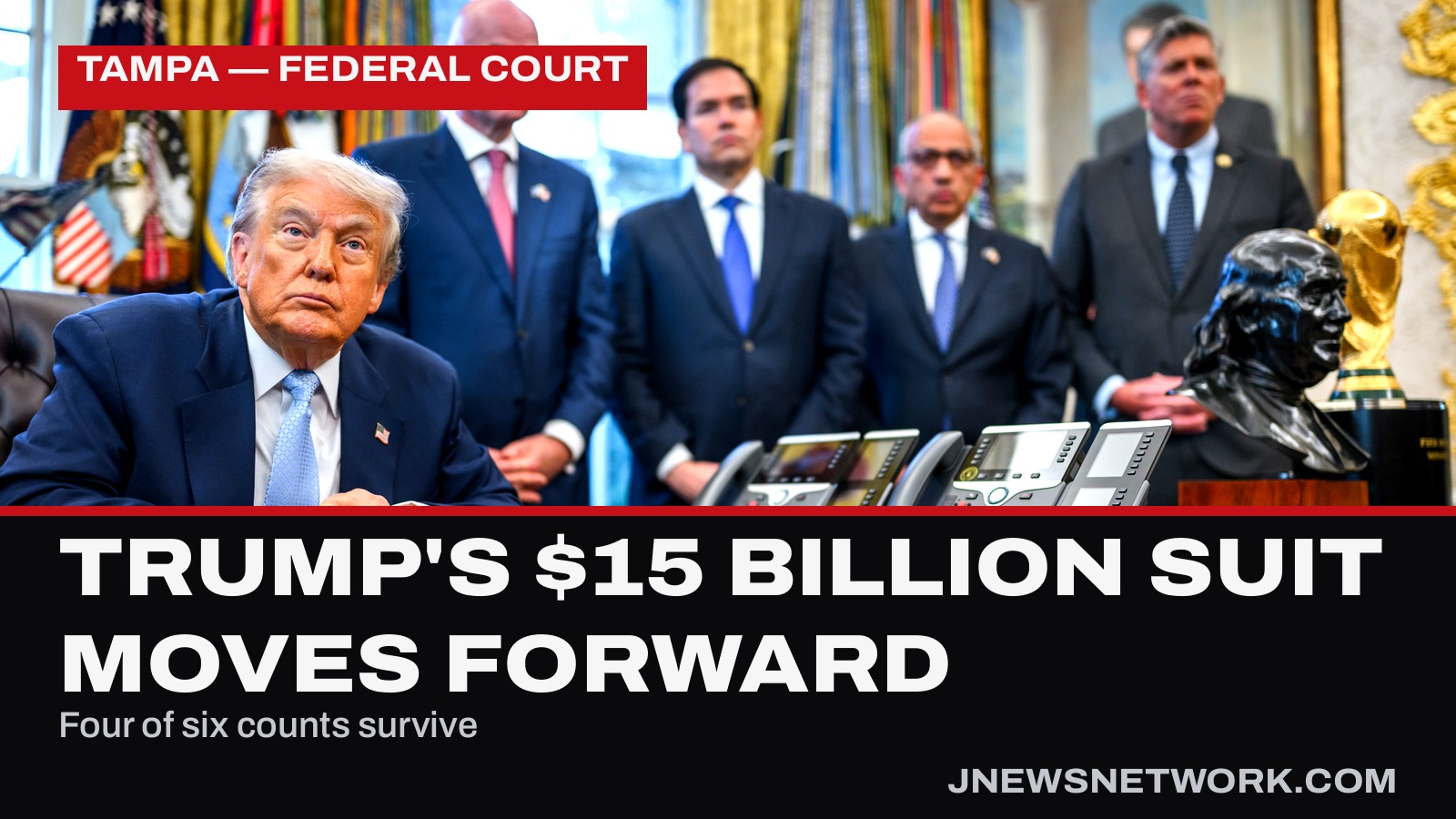
A federal judge in Tampa on Thursday refused to dismiss the core of President Donald Trump’s $15 billion defamation lawsuit against The New York Times and Penguin Random House, ruling that four of the suit’s six counts plausibly allege the “actual malice” a public official must prove to recover for a defamatory falsehood.
In a 12-page order signed Thursday, U.S. District Judge Steven D. Merryday granted the defendants’ motion to dismiss Counts III and IV of the second amended complaint but denied the motion as to Counts I, II, V and VI. The surviving counts rest on seven statements — six in the 2024 book Lucky Loser: How Donald Trump Squandered His Father’s Fortune and Created the Illusion of Success, by Times reporters Susanne Craig and Russ Buettner, and one in an Oct. 20, 2024 Times article by Peter Baker — that accuse Trump of tax fraud and other financial crimes.

The two dismissed counts were based on Craig and Buettner’s Sept. 14, 2024 article about Trump’s years on “The Apprentice” and the construction of his public image. Merryday also ruled that 27 other statements Trump challenged “are not actionable” as defamation and will not proceed further in the case.
Among the statements that survived are the book’s claim that “Donald Trump had received the equivalent of more than $400 million from his father, much of it through fraudulent tax evasion schemes” and its description of “taxable gifts masquerading as loans, a likely tax fraud that went unnoticed.” The seventh surviving statement, from Baker’s article, said federal, state and local authorities “looked into his ties with the Mafia, found violations of money laundering rules and penalized him for skirting stock trade rules.”
Merryday wrote that the complaint plausibly alleges the authors and publishers knew those crime accusations were “based on incomplete, minimal information,” and that a responsible assessment of the Trump family’s compliance with the tax laws “would have required forensic auditing, expert tax and legal advice, and other expensive investigatory tools” that they knowingly failed to obtain. The complaint notes that neither Donald Trump nor his father, Fred Trump, was investigated for, charged with, or convicted of tax fraud. Failing to procure a qualified opinion before publishing accusations of complex crimes, the judge wrote, is “a fine example of the purposeful avoidance of the truth.”
The judge was unpersuaded by the defense’s reliance on experts cited in the reporting, writing that characterizations such as a transaction being “highly suspicious” or having the “smell” of crime are “far from a formal legal opinion” sufficient to remove serious doubt about accusing a specific person of fraud or tax evasion.
The ruling is a pleading-stage decision under New York Times Co. v. Sullivan, the 1964 Supreme Court decision requiring a public official to prove a statement was published with knowledge of its falsity or with reckless disregard for the truth. It does not find any statement false; Trump must still prove falsity and actual malice as the case proceeds. Merryday, an appointee of President George H.W. Bush, also denied Trump’s request to amend the complaint again, finding further amendment would be futile, and ordered the defendants to answer the surviving counts within 28 days.
Trump filed the suit on Sept. 15, 2025, seeking compensatory damages of not less than $15 billion, plus punitive damages. Merryday struck the original 85-page complaint four days later for failing to satisfy the federal rule requiring a short and plain statement of the claim; Thursday’s ruling addresses the second amended complaint, filed Aug. 27, 2026.
A Times spokesman, Charlie Stadtlander, said the Times was “encouraged to see Judge Merryday’s dismissal of almost all claims against us” and that “the remaining claim in the filing has no legal merit,” according to Barron’s. A spokesperson for Trump’s legal team told Barron’s that the Times “has a long pattern of defaming President Trump in service of its leftist political agenda” and called the ruling “a victory for honesty in America.”
The ruling came a week after another federal judge allowed Trump’s defamation lawsuit against the BBC to proceed, Reuters reported.
The case is Trump v. New York Times Company, No. 8:25-cv-02487-SDM-NHA, in the U.S. District Court for the Middle District of Florida. The full docket is available through CourtListener.