

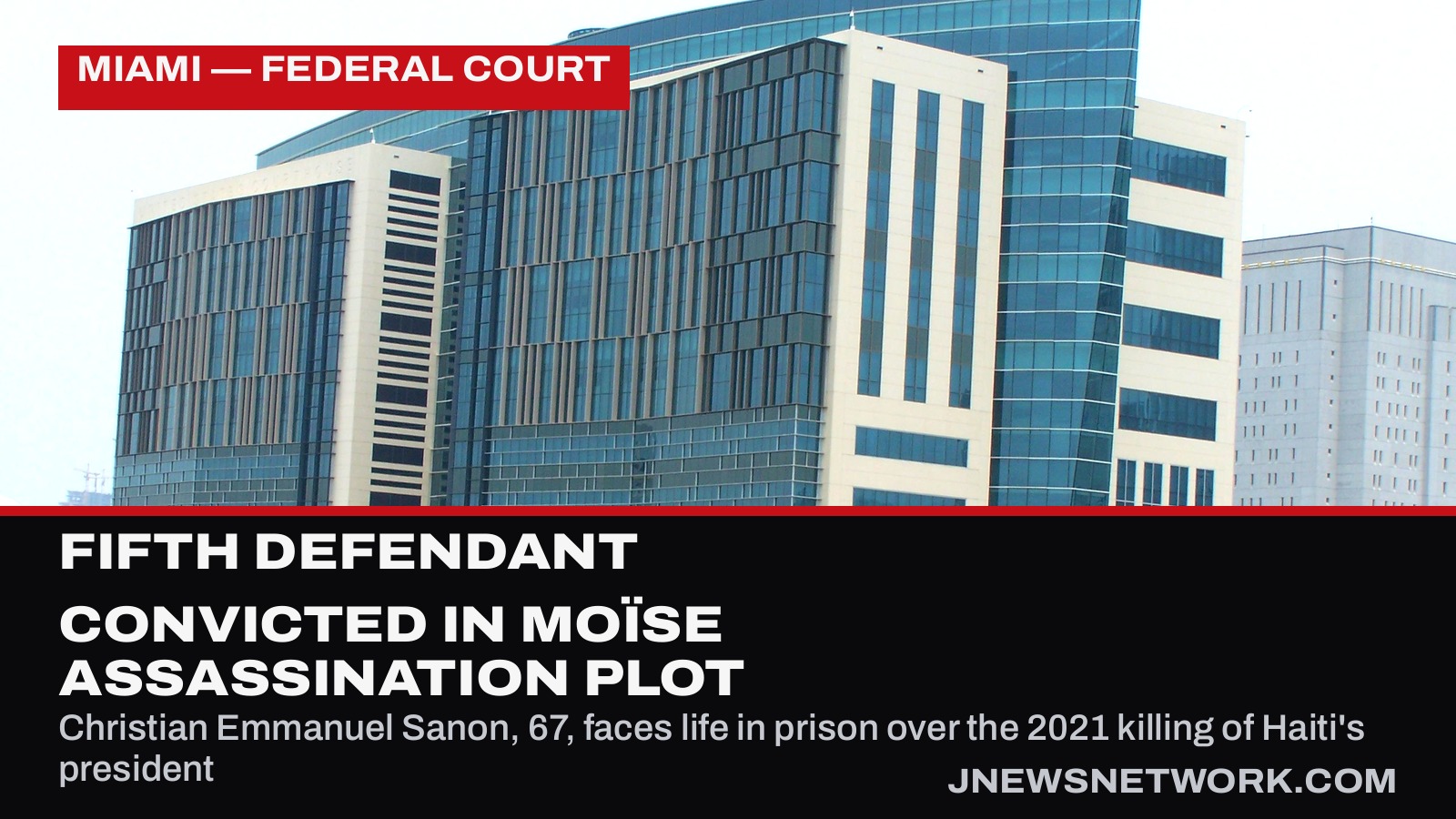
A federal jury in Miami on Wednesday convicted Christian Emmanuel Sanon, 67, for his role in the July 7, 2021, assassination of Haitian President Jovenel Moïse — the fifth defendant convicted at trial in the plot, the Justice Department announced.
Sanon was convicted of conspiracy to provide material support or resources resulting in death; providing material support and resources resulting in death; conspiracy to kill and kidnap a person outside the United States; two counts of conspiracy to commit offenses against the United States; expedition against a friendly nation; smuggling goods from the United States; and submitting false or misleading export information. He faces a maximum penalty of life in federal prison. A federal district court judge will determine his sentence after considering the U.S. Sentencing Guidelines and other statutory factors.
The plot, as laid out at trial
According to court records and evidence presented at trial, Sanon kickstarted a conspiracy in early 2021 to violently overthrow Moïse and install himself as Haiti’s next president. Working with Arcangel Pretel Ortiz, Antonio Intriago, Walter Veintemilla, James Solages and others in the United States and Haiti, he promised lucrative future government infrastructure contracts in exchange for their financial, logistical and operational support in kidnapping or killing the president.
Sanon falsely claimed to have the backing of the U.S. Department of State to recruit allies and garner support for the plot, according to the Justice Department, and he often used American flags and other government imagery to lend credibility to his false claims.
When the plan to emplace Sanon as the new president stalled, he agreed to assume a secondary role in the conspirators’ planned new Haitian government — but he remained firmly involved, arranging transportation, lodging, food, equipment and other supplies for the 22 Colombian mercenaries who assassinated Moïse. In mid-June 2021, Sanon helped smuggle ballistic vests from the United States into Haiti for the mercenaries. In late June 2021, he sent Solages — Sanon’s right-hand man — back to the United States to obtain additional tactical and operational advice and finalize plans for the assassination.
On July 7, 2021, Solages and a team of Colombian mercenaries, aided by several Haitian allies, carried out the attack on Moïse’s residence. A squad of former Colombian special forces soldiers known as the Delta Team, along with other mercenaries, stormed the residence and fatally shot the president in his bedroom. The attackers also seriously wounded Haiti’s first lady, Martine Moïse.
Digital evidence presented at trial showed months of extensive communications between Sanon and his co-conspirators detailing their plans to kidnap or kill Moïse. Shortly before his arrest on July 9, 2021, Sanon deleted most of the incriminating communications from his three cellphones, including communications in which he discussed what he expected to gain from the plot immediately after the assassination.

What officials said
“Sanon helped orchestrate one of the most brazen acts of political violence in the Western Hemisphere in recent history,” said M. Scott Proctor, acting principal deputy assistant attorney general for national security. “The brutal murder of President Jovenel Moïse in his own home was a direct assault on Haiti’s government and a devastating crime against the Haitian people.”
“The assassination of a sitting president is an attack not only on a life, but on the sovereignty of a nation and the very foundations of democracy,” said Yara Lorenzo Klukas, acting U.S. attorney for the Southern District of Florida. “Yesterday, a jury of his peers held this defendant accountable for his role in that horrific crime.”
Brett D. Skiles, special agent in charge of the FBI’s Miami field office, said the verdict “marks another significant step toward accountability in the assassination of Haitian President Jovenel Moïse.” Jose R. Figueroa, special agent in charge of Homeland Security Investigations in Miami, said it “reflects the gravity of his role in a conspiracy that culminated in the assassination of Haitian President Jovenel Moïse.”
The wider case
Eight co-conspirators, including two Colombian mercenaries and several Haitian and American associates, have pleaded guilty to their roles in the conspiracy. In May, a federal jury convicted Pretel Ortiz, Intriago, Veintemilla and Solages. In September, 29 additional defendants were indicted for their alleged roles in the plot to assassinate Moïse. The charges include an intertwined fraud and money laundering scheme involving funds obtained through the Paycheck Protection Program, a federal COVID-19 relief program, that allegedly helped finance the assassination plot.
Assistant U.S. Attorneys Sean T. McLaughlin, Jason Wu and Altanese Phenelus for the Southern District of Florida are prosecuting the case, with the assistance of the National Security Division’s Counterterrorism Section. The prosecution is part of the Homeland Security Task Force initiative established by Executive Order 14159. Related court documents are filed with the District Court for the Southern District of Florida under case number 22-cr-20104.
Cover photo: the Wilkie D. Ferguson Jr. U.S. Courthouse in Miami. (Miami92 / Wikimedia Commons, public domain)