


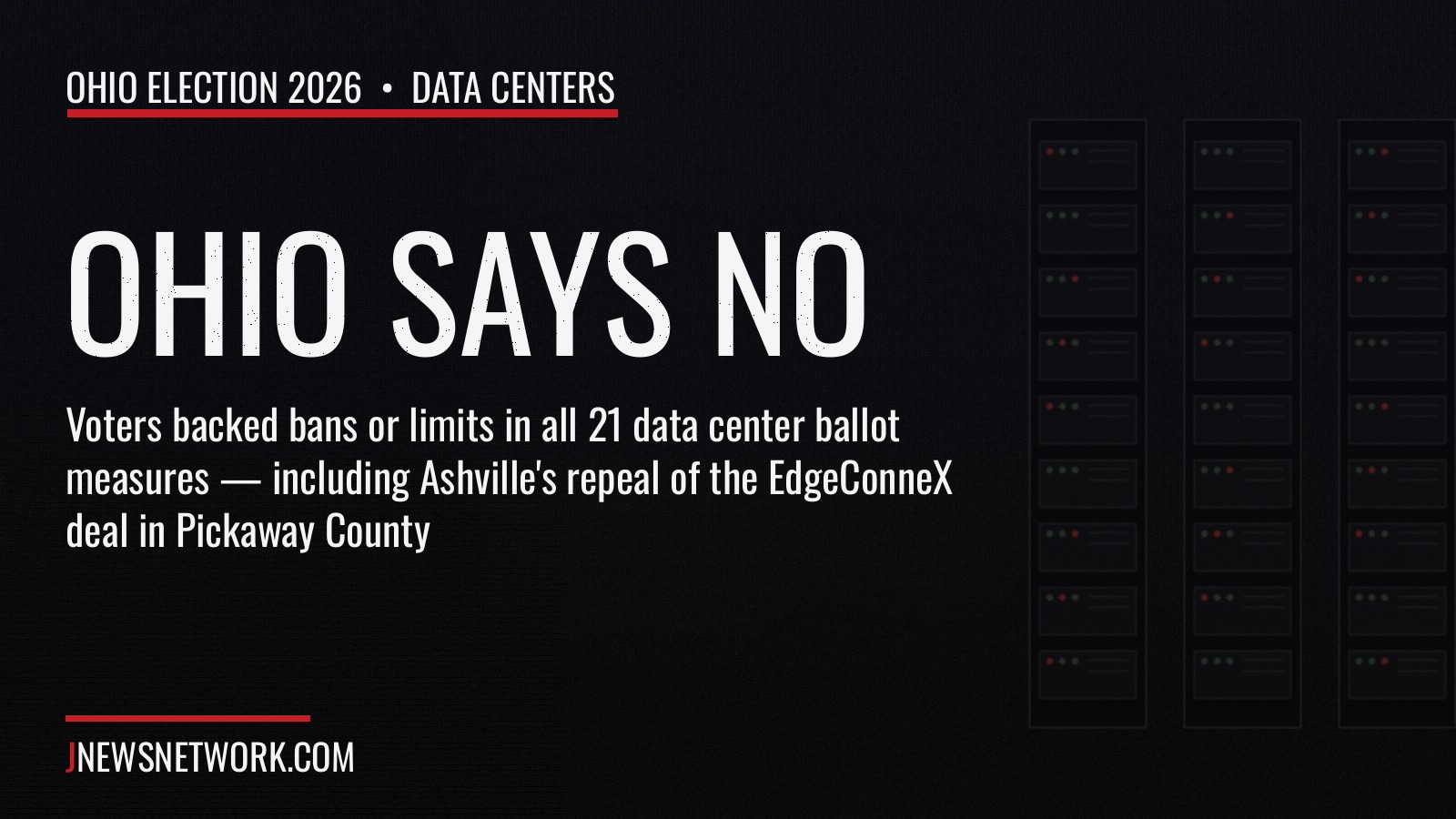
Ohio voters delivered the broadest rebuke of the data center boom in the nation on Tuesday, approving a ban, a limit or a voter-approval requirement in every one of the 21 local measures on the Nov. 3 ballot, according to unofficial results posted by county boards of elections.
Ohio decided more data center questions than any other state — 21 measures in 18 communities, out of 41 measures on ballots in 10 states, according to Ballotpedia’s count of the election. Eleven communities voted to ban large data centers. The others adopted restrictions or conditions, or required that voters approve large projects themselves. All but one of the measures reached the ballot through petitions circulated by residents, not referrals from local councils.
In Pickaway County, voters repealed a deal
The closest vote to home came in Ashville, where voters repealed the village’s development and supply agreement with EdgeConneX by better than 4 to 1. The referendum on Resolution 06-2026 failed with 1,469 votes against and 331 in favor — 81.6 percent voting no — in unofficial Pickaway County Board of Elections results with all four precincts reporting. Under Ohio referendum law, the “no” vote repealed the resolution.
Council adopted the resolution in April by a 5-to-1 vote, approving a term summary for two EdgeConneX data center buildings and a natural gas power plant on about 195 acres. The resolution declared itself an emergency, suspended the village’s data center moratorium for the project and declared a zoning permit issued the day before Christmas 2025 sufficient for the development.
Residents answered with a referendum petition. The Pickaway County Board of Elections verified 669 signatures on it, 171 more than required. When the village fiscal officer refused to certify the petition, the Supreme Court of Ohio ruled on Aug. 7 that the resolution’s emergency language did not state sufficient reasons and ordered the petition certified. The board of elections placed the referendum on the ballot on Aug. 24.
Central Ohio votes
In Licking County, Pataskala voters approved a charter amendment banning data centers that use more than 25 megawatts, by 5,418 votes to 1,941 — 73.6 percent — in unofficial county results. Pataskala’s council had already turned away a proposal from Aligned Data Centers in August. Granville voters approved a similar ban, 2,015 to 429, or 82.5 percent.
In Delaware County, Sunbury voters banned data centers above 25 megawatts, 2,809 to 763, or 78.6 percent. In Franklin County, Grove City voters approved the Community Consent charter amendment, 11,317 to 9,411, or 54.6 percent. The amendment requires voter approval for developments that occupy more than 50 contiguous acres, use more than 20 megawatts of power a month or use 500,000 gallons of water a day. Grove City had adopted a 12-month moratorium on data centers on June 1.
In Butler County, Trenton’s Issue 17, a ban on data centers using more than 25 megawatts of electricity, passed 3,541 to 903, or 79.7 percent. An Amazon Web Services campus of 18 data center buildings is planned on land just outside the city, and that fight is not finished: the St. Clair Township Zoning Commission voted Oct. 13 to ban data centers in the township’s zoning, and Butler County holds a hearing on that resolution on Nov. 10.
Across the state
Bans also passed in Hubbard, Urbana, Defiance, Piqua, Conneaut and Upper Sandusky, where the ban drew 76.9 percent. Oregon voters capped data centers at 25 megawatts with 60 percent of the vote. Restrictions or conditions passed in Perry, where more than 87 percent of voters backed financial guarantees from developers seeking tax breaks; in Wilmington, where voters rejected all four rezoning questions for a data center project by roughly 80 percent; in Adams County’s Monroe Township and Sprigg Township, which adopted zoning regulations for unincorporated areas; and in Monroeville.
The votes capped two years of packed council meetings across the state, where residents raised rising electric bills, water use, noise and light, lost farmland, and the non-disclosure agreements developers have required of communities that want their projects. Ohio has nearly 250 data centers in 66 of its 88 counties, according to Data Center Map, with 27 under construction and 57 more planned as of Nov. 4.
The industry urged communities not to close the door. Dan Diorio, executive vice president of state policy and government affairs for the Data Center Coalition, said in a statement that the coalition is committed to engaging with communities, and warned that communities that signal they are “closed for business” could miss out on the jobs and investment data centers bring. An Ohio Chamber of Commerce study credits data centers with more than 95,000 jobs in Ohio, though the Ohio Consumers’ Counsel has noted that not all of those jobs are permanent.
The fight moves to the Statehouse
The results are already pushing the question to state government. Dan Conway, chairman of the Public Utilities Commission of Ohio, said: “I tend to think this is an area that it would be better regulated by the states in a uniform, predictable way that applies statewide rather than a patchwork of different local ordinances.” Conway pointed to the commission’s ruling on AEP Ohio’s data center contract terms, which approved a modified version of the utility’s proposal requiring the companies to post financial security, pay exit fees and meet minimum billing demands.
Governor-elect Amy Acton campaigned on a conditional pause on new data center construction until guardrails are in place, including ending non-disclosure agreements, requiring data centers to cover their utility costs in full and maintaining state environmental standards. She takes office Jan. 11.
Conserve Ohio, a volunteer group opposing hyperscale data centers, is collecting signatures to put a constitutional amendment on the 2027 ballot banning data centers that use more than 25 megawatts a month. Founding member Nick Owens said the group has collected more than 150,000 signatures in all 88 counties; it needs more than 400,000 to reach the ballot. A similar effort missed the deadline for this year’s ballot.
Other communities are writing rules instead of bans. Twenty-seven Ohio communities are working with Clean Fuels Ohio and the Ohio Township Association on a model data center ordinance, an effort that began after a large solar company proposed a data center in Perry County earlier this year.
The debate in Ross County
The debate is live in Ross County as well. Chillicothe City Council rescinded its 60-day data center moratorium in September, after a February letter from the city’s chief building official surfaced showing the city had already certified that a data center is a permitted use at the former paper mill site, where SOAR AI is developing an AI data center campus. The city is now writing new zoning rules for data centers, data halls, battery storage facilities and cryptocurrency operations, and will take public input on Nov. 16 at the Armory building in Yoctangee Park. On Tuesday, Nov. 10, at 8 p.m., U.S. Rep. Dave Taylor, whose district includes Ross County, will hold a telephone town hall on artificial intelligence and data centers.
All of Tuesday’s results are unofficial. County boards of elections must certify their results within 21 days of the election.