

PIKETON, Ohio — Ohio EPA has told SB Energy that the water permit applications for both its Artemis power plant and its six-building Bobo Road data center project are incomplete, in rulings issued on consecutive days, and that the state will not review either application any further until the missing material is filed.
In a letter dated Oct. 30, 2026, Ohio EPA’s Division of Surface Water notified Portsmouth Gas DevCo, LLC — an SB Energy company — that the Section 401 water quality certification application it received on Oct. 22 for the Artemis Power Generation Facility in Pike County “did not contain all the required components” and is therefore incomplete under Section 6111.30(B) of the Ohio Revised Code. “Ohio EPA will not proceed with any further review until the following deficient items have been adequately addressed,” the letter states. J News Network reviewed the letter and the related filings in Ohio EPA’s eDocs public records portal for The Fallout Files.
The Artemis facility is the natural-gas generating plant proposed as part of the PORTS-Pike technology campus taking shape around the former Portsmouth Gaseous Diffusion Plant, the project J News Network detailed on Oct. 27 in “Beyond the PORTS Fence.” The certification at issue is the state’s Section 401 sign-off — required before the U.S. Army Corps of Engineers can issue the federal Section 404 permit for work affecting streams and wetlands at the plant site, listed in the letter at latitude 38.993372, longitude -82.996589.
According to the letter, signed by Matthew Lamoreaux, application coordinator in Ohio EPA’s 401/Wetlands/Mitigation Section, the missing material includes the Corps of Engineers’ jurisdictional determination for the site, the project’s waters delineation report, and a copy of the federal permit application itself, which federal rules require be filed with the state as well. No Corps public notice number has been assigned to the project, the letter notes. Ohio EPA also requires completed wetland assessment (ORAM) forms for two identified wetlands — Wetland 17 and Wetland 19 — stream habitat data (HHEI/QHEI forms) for five identified streams, and site photographs for four of those streams. The agency further directed the company to make its impact figures consistent across the Corps public notice, the state’s impact tables and the mitigation plan, and to list even the wetlands and streams inside the survey area that the project would not impact. The letter, addressed to Portsmouth Gas DevCo’s Karl Brutsaert in Redwood City, California, and copied to the Corps’ Huntington District, the company’s consultant Verdantas and SB Energy, sets no deadline for resubmission; it states the missing items must be uploaded through Ohio EPA’s eBusiness Center and the application resubmitted.
An incomplete determination is an administrative ruling, not a denial: it stops the state’s review clock until the application is complete. But it means that, as of Oct. 30, the Artemis plant’s state water review has not begun on the merits.
Bobo: the same ruling, one day earlier
The Artemis letter was the second such ruling in two days. In a letter dated Oct. 29, 2026, Ohio EPA notified Portsmouth DevCo, LLC — the SB Energy company behind the Bobo Technology Project, the six-data-center-building project along Bobo Road that J News Network detailed in the Oct. 27 story — that the Section 401 application it received on Oct. 21 is likewise incomplete under Section 6111.30(B), and that the agency “will not proceed with any further review” until the deficiencies are cured. The Bobo project is the subject of a U.S. Army Corps of Engineers public notice, LRH-2026-00976-SCR, which lists 155,840 linear feet of stream impacts and 1.725 acres of wetland impacts.
The Bobo deficiencies, listed in a letter signed by James Morris, application coordinator in the 401/Wetlands/Mitigation Section, overlap the Artemis ruling — an incomplete application form with impact tables to be entered and reconciled against the Corps public notice and the mitigation plan, and no copy of the federal permit application the 2023 federal rule requires be filed with the state. But the Bobo letter goes further on the company’s environmental paperwork. Ohio EPA states that the wetland assessment (ORAM) form for wetland 5C was not provided, and that several submitted ORAM forms designated wetlands as Category 3 “even though the numeric score did not fall in the Category 3 range nor did any of the narrative rating sections of the form indicate the wetlands were Category 3” — the company is directed to correct and resubmit them. Ohio EPA also rejected the structure of the project’s mitigation plan, which proposed purchasing in-lieu fee credits in an adjacent watershed; the letter sets out the state’s mitigation hierarchy — bank credits within the watershed first, then in-lieu fee credits within the watershed, then permittee-responsible mitigation within the watershed, with adjacent-watershed options last — and requires a plan that follows it, noting that a pending request for additional in-watershed credits “cannot be considered in the present mitigation plan.” The company’s threatened and endangered species documentation is likewise listed as incomplete: only a federal IPaC report was submitted, and Ohio EPA requires the requests for the applicable U.S. Fish and Wildlife Service determination keys and/or the final coordination letter. Any resubmitted pages must carry the project name, Ohio EPA ID number, revision date and revision number, with changes marked, the letter states.

The Baku substation, by contrast, arrives complete


The same state records system this week posted the full Section 401 application package for the other end of the campus power buildout: American Electric Power’s proposed Baku 765 kV Station, the substation near Piketon where the 51-mile Baku-Gavin transmission line — the subject of an Ohio Power Siting Board public hearing in Jackson on Oct. 27 — would terminate. AEP’s application describes a new 68-acre transmission substation at 1450 Wakefield Mound Road, on land the application says is “currently in negotiations to be purchased by the customer,” interconnecting the Baku-Gavin line, a Baku 765 kV Extension, and a new Baku-Artemis 765 kV line running to an Artemis 345/765 kV station. The stated construction window is Dec. 1, 2026 through May 1, 2031.
The package — an application form, a 259-page environmental survey report by WSP dated August 2026, a 51-sheet site civil plan at 60 percent design, and federal and state determinations — puts numbers on the substation’s footprint. AEP’s mitigation credit request to The Nature Conservancy’s Ohio Stream and Wetland In-Lieu Fee Program states the project would grade an area of up to 167 acres to create a flat pad for the station, and lists the proposed impacts: 5,316 linear feet of streams (923 feet ephemeral, 4,393 feet intermittent, none perennial), 0.125 acre of federally jurisdictional wetlands and 0.079 acre of state-jurisdiction isolated wetlands. To offset those impacts, AEP has requested 7,768 stream mitigation credits and 0.5 wetland credits in the Lower Scioto watershed. The civil plan (Woolpert, marked “60% IFR — Not for Construction”) calculates 1,475,342 cubic yards of excavation and 1,291,393 cubic yards of fill, removal of trees and shrubs across 70 acres, demolition of 10,500 square feet of buildings, and a rise in impervious surface on the 153.83-acre project area from 0.34 acre to 103.43 acres. The plan’s client block names SB Energy, and its site note states that property acquisition, lot split and transfer to AEP are still pending.
The Corps of Engineers’ Huntington District issued its approved jurisdictional determination for the Baku site on Oct. 20, 2026 (file LRH-2026-00851-SCR), evaluating the roughly 167-acre review area under the pre-2015 regulatory regime as narrowed by the U.S. Supreme Court’s decision in Sackett v. EPA. The Corps found 5,335 linear feet of five streams, 0.125 acre of three wetlands and a 0.02-acre pond to be federal waters. It found that 3,366 linear feet of eight other streams, 1,909 linear feet of nine drainage features and two wetlands totaling 0.079 acre are not federal waters — leaving the two wetlands to Ohio’s isolated-wetlands program. Ohio EPA, in a Sept. 15, 2026 verification, assigned all six delineated Baku wetlands to Category 2 under the state’s wetland assessment method.
The two filings land in the same week Ohio EPA takes the PORTS-area wetland permits to the public: a public hearing is scheduled for Wednesday, Nov. 4, with written comments due Nov. 12.
Neither Ohio EPA’s letter nor the Baku package contains any allegation of a violation by either company, and nothing in the records indicates any work at either site has been found out of compliance.
The documents


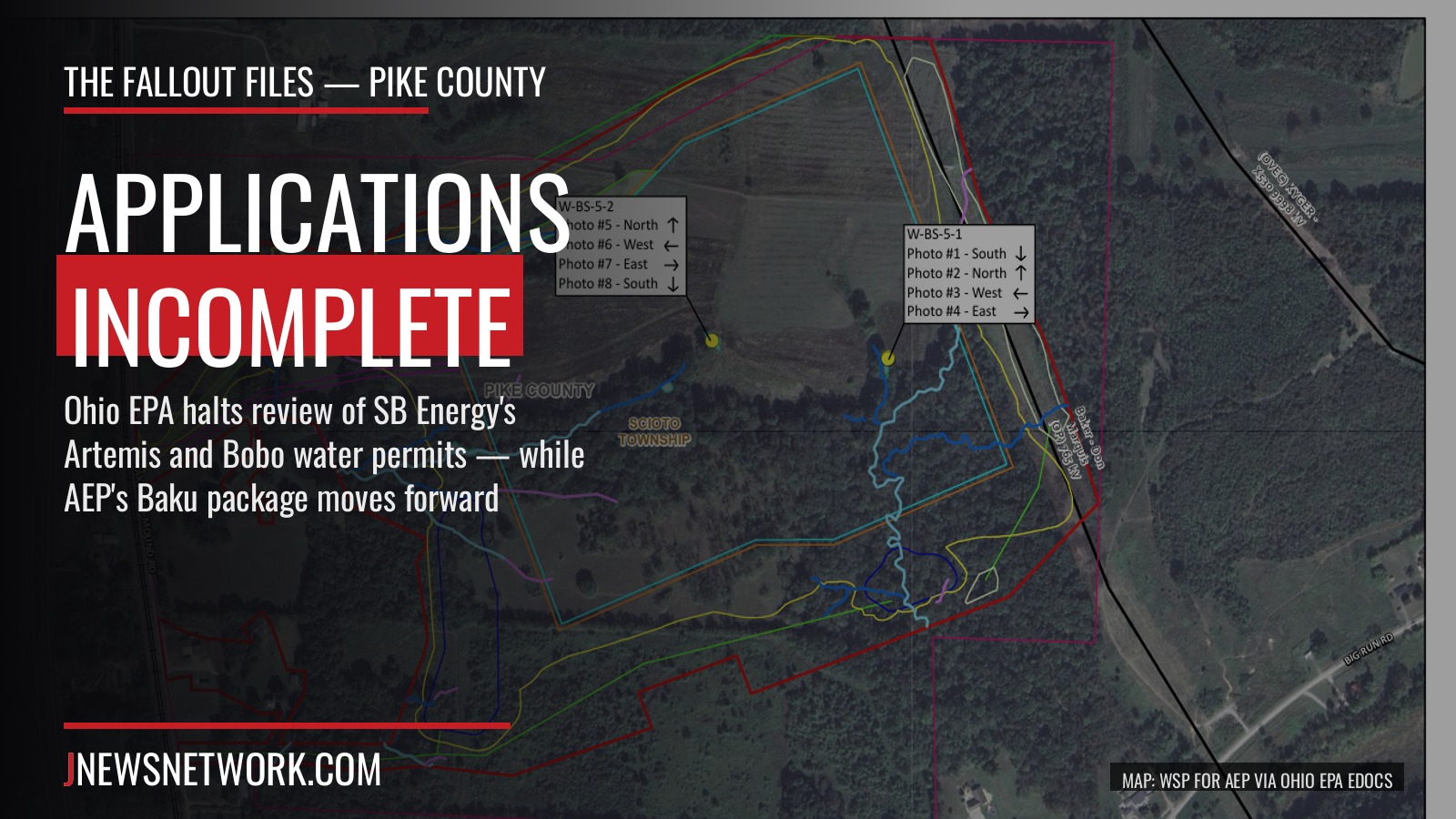
Also filed with the Baku package: the in-lieu fee credit request (PDF) and the photo point map (PDF), pictured above.
This story is based on Ohio EPA eDocs records: Ohio EPA’s Oct. 30, 2026 incomplete-application letter for the Artemis Power Generation Facility, Ohio EPA ID 263101A1 (docids 4305324 and 4305516, identical letters); and Ohio EPA’s Oct. 29, 2026 incomplete-application letter for the Bobo Technology Project, Ohio EPA ID 263102A1 (docids 4301319 and 4301439, identical letters); and AEP’s Baku 765 kV Station Section 401 application package (docids 4305692 through 4305702), including the WSP Environmental Survey Report (August 2026), the U.S. Army Corps of Engineers approved jurisdictional determination LRH-2026-00851-SCR (Oct. 20, 2026), Ohio EPA’s ORAM verification (Sept. 15, 2026), the site civil plan and The Nature Conservancy in-lieu fee credit request.