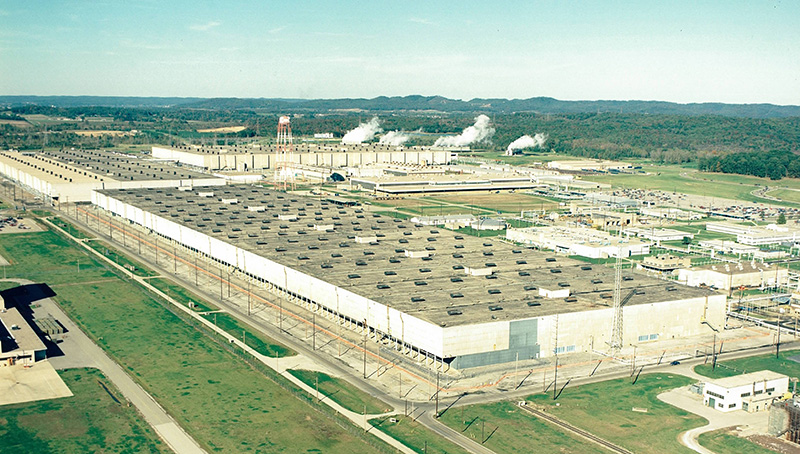
PIKETON, Ohio — An estimated 1,000 gallons of wastewater was released during a July 8 sanitary sewer overflow at the former Portsmouth Gaseous Diffusion facility in Piketon, according to a recently released report submitted to the Ohio Environmental Protection Agency.
The incident occurred after a grout seal failed on a sewer line that had previously been isolated as part of demolition and decommissioning work.
According to emails between Mission Conversion Services Alliance, Southern Ohio Cleanup Company and Ohio EPA, the leak entered an already excavated area associated with the site’s X-231B work area.
The area collects water that is pumped to a 2-million-gallon storage tank before being treated at the X-622-1 D-train wastewater treatment system, according to information provided to Ohio EPA.
The Aug. 3 Ohio EPA sanitary sewer overflow report identifies the incident as an SSO and estimates the release at 1,000 gallons. The report lists the overflow as lasting approximately 12 hours and occurring during dry weather.
Failed sewer isolation
The sewer line involved in the incident had been isolated during work associated with X-326 demolition activities.
In a July 17 email to Ohio EPA, MCSA Environmental, Safety and Health Manager Stephen Skeens said the section of sewer had been plugged and abandoned in place by a previous contractor, Southern Ohio Cleanup Company, as part of the work.
The isolation point was located at manhole B-6.
According to the information provided to Ohio EPA, a single plug had been inserted at the manhole and grouted in. The grout seal later failed.
MCSA said the failure was likely associated with heavy equipment operating in the area, including excavators, bulldozers and jackhammers.
Southern Ohio Cleanup Company later installed a plug on the open end of the sewer line.
Sewage backed up in manholes
The July 15 correspondence from Ohio EPA states that sewage had entered the excavation area after a sewer leak was reported on July 8.
SOCCo initially estimated the leak at approximately 50 gallons per minute but said it could not determine the exact quantity or duration.
The company also reported that an issue involving the X-614A sewage lift station allowed sewage to back up several feet in manholes.
MCSA told Ohio EPA that the X-614A lift station was operational manually, but its automatic controls were out of service. Personnel were checking the station periodically around the clock and manually pumping it down as necessary.
MCSA said the failed sewer isolation point was the cause of the issue.
Ohio EPA determined report was required
The nature of the material entering the excavation was questioned during the investigation.
MCSA told Ohio EPA that no visible solids or notable discoloration had been observed in the leaked material.
In a July 29 email, Ohio EPA Environmental Specialist II Brandon Atwood said the grout failure at manhole B-6 meant it was possible that some of the water entering the excavation was sanitary wastewater from the manhole.
Atwood said that, based on the information provided, the incident should be reported as a sanitary sewer overflow.
MCSA responded that it would enter the report.
The Aug. 3 filing identifies the event as an SSO and lists the cause as a “failed grout seal installed by previous contractor.”
No impacts observed
The formal report states that no odors or solids were observed.
It also states that no environmental impacts were observed because the overflow was contained in an excavation area connected to a pump-and-treat system.
This wastewater comes from one of the most radioactively contaminated locations in the nation.
MCSA said the overflow was stopped by lowering the water level in the manhole below the failed grout seal.
The company also said it increased manual pumping of the X-614A lift station to maintain the appropriate level.
As corrective actions, the report lists repairing the broken sewer line as a short-term action and sewer separation as a long-term corrective action.
The report also states that the exact quantity and duration of the overflow could not be determined and that notification of the SSO was delayed while MCSA evaluated whether an overflow had occurred.
The filing says MCSA will continue working with SOCCo on long-term corrective actions intended to prevent the incident from happening again.
Last year, a similar incident happened at the Piketon site. Over 50,000 gallons of wastewater were released at that time. Details on that spill can be found here: 50,000 Gallons of Contaminated Water Released at Piketon Atomic Plant / NUCLEAR NEWS | Ohio Atomic Press