

WAVERLY, Ohio — They came to talk about the ground under their houses.
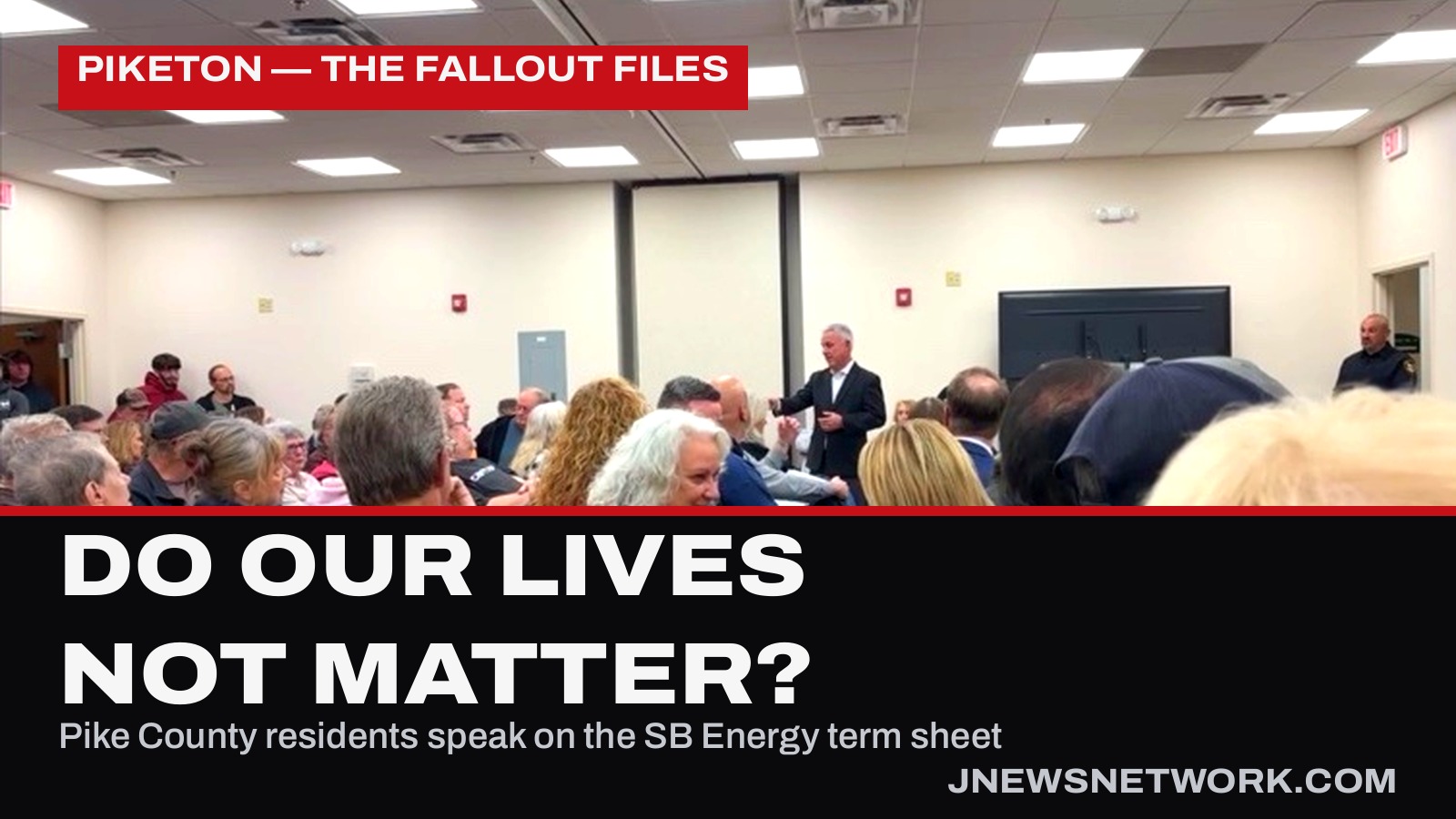
On Tuesday night, Nov. 24, Pike County residents packed the conference room at the Pike County Government Center in Waverly for a special meeting of the Board of County Commissioners: a public comment session on the term sheet for the PORTS-Pike Technology Campus, the data center project SB Energy proposes to build at and around the former Portsmouth Gaseous Diffusion Plant in Piketon. The board approved the non-binding term sheet on Nov. 18, by Resolution No. 1011-26. The board said it expected no formal action that night, and speakers were held to three minutes each.
For more than three and a half hours, the residents talked — about land tested and found contaminated, about family lost to cancer, about letters from land buyers, about water, noise and homes. The county’s lawyers and consultants presented the project first, and answered questions as the night went on. This is what was said in that room, in the speakers’ own words.
J News Network reviewed a full recording of the meeting made by Vina Colley, the Piketon-area activist who has fought the plant’s contamination legacy for more than forty years. Every quote in this story was checked against that recording.

The county’s case
John Oberle, a partner with Ice Miller LLP, the firm representing Pike County on the SoftBank–OpenAI project, opened the county’s presentation by telling the room where things stand. “Nothing has been decided,” he said. “We want comments, we want openness.” Negotiations with the company began in July, he said. No final agreement has been signed; the term sheet binds no one, and the night was for the public’s comments on it.

Oberle ran through the outreach the county says came first: “Over 28,000 postcards went to every home in the community,” he said, and there had been “25 open houses.” Then the scale of what is proposed: power plants with “10 gigawatts of power,” “up to 17 data centers,” and “25 to 30,000 construction workers in this community.”
He did not pretend it would be easy. “It’s going to be some disruption,” he said. “There’s going to be short-term pain for long-term gain in Pike County.”
A voice from the room answered him before he finished the thought.
Oberle pressed on. “There’s been no decisions made,” he said.
The money, as he presented it: up to $300 million in upfront dollars negotiated from the company — “I think this package is going to be the biggest package in Ohio’s history” — and, in exchange for a 100% tax abatement on the buildings, “up to $1.5 billion in payments in lieu of taxes,” with $120 million of it arriving within three years, before construction is even complete. A guaranteed minimum of $150 million a year in sales tax on top of that, he said, and up to $6 million from the company to cover the county’s own costs, so residents’ tax dollars would not pay the lawyers and engineers. The Pike 2040 Foundation, the 15-year community plan in the package, he described as “a draft for your consideration.”
Tom Zaino, the former Ohio tax commissioner working with the county’s team, walked the room through the arithmetic. His firm valued the buildings at “at least $714 per square foot,” with an outside range up to $1,000. The payment in lieu of taxes, he said, is figured on a value of $771 per square foot, which works out to “$10.19 per square foot” — against $1.11 per square foot in New Albany, the state’s data center capital. The upfront money in the term sheet, he said, comes in stages: “$10 million, then it goes to $40 million, then to $50 million, and then back down to $20 million” — $120 million paid before the buildings exist, money the county would otherwise wait four years to see a dime of in property taxes.
Some of that is in the document itself. The term sheet describes up to 17 buildings, about 2,500 permanent jobs at full build-out, the $1.5 billion in payments over 15 years in exchange for a 15-year, 100% real property tax exemption on each building, and a total package of $3.3 billion to $4.06 billion — at full build-out, with payments owed only for buildings actually built. It describes the $300 million as upfront capital investment tied to a port-authority tax exemption. It lists the Pike 2040 Foundation as to be determined — in the document’s own words, it “has not been agreed to.” And its footer says the summary “is provided for informational purposes only and is not binding,” and that any final development agreement must be negotiated and considered separately, at a future public meeting.
“Do our lives not matter?”
The first resident called to speak said she has lived there since 1986, less than a mile from the plant, between the two roads she said are about to be torn up. She wanted to know how the county would protect the people who live that close.
She said she had her land tested in 2019, and the test came back with four cancer-causing agents. She said she is not far from the school that tested positive for neptunium and plutonium. She said the letter that came with her test results told them not to dig, not to stir the dust, not to eat from the garden. Her husband, she said, died in 2014 of a rare form of cancer.
“Now, do our lives not matter?” she asked. “That’s what I’m asking. Do our lives not matter?”
“Yes, ma’am, they do,” came the answer from the front of the room. What they would do, Oberle said, is make sure the laws are followed — construction laws, environmental laws — and set up working groups and communication. She asked again: “So how are you going to prevent it from making us sick?”

The room answers
She was not the only one asking how the words matched the ground. When a resident pointed out that work had already started, Oberle answered: “No deal has been made.” The company, he said, can move dirt at its own risk, “but they can’t start construction until there’s a deal.” He also acknowledged the room’s central fear: the concern that contaminants that migrated off the site in the past could be stirred up by construction and become airborne.
Then a resident who said she was a senior citizen, handicapped, and did not know whether she would lose her home, pressed the county’s team on whether a decision had already been made. Oberle answered her: no decision has been made, he said, and there has not been one vote on moving this project forward.
The board’s Nov. 18 action is a matter of record: the board approved the non-binding term sheet that night, by Resolution No. 1011-26. No final agreement has been signed.
The room erupted. The woman answered that the board had proposed these terms on the residents’ behalf, without their say-so. Another resident followed, saying the project puts people’s health in jeopardy: “It’s taking people’s homes. It’s destroying this area. It’s wrong.” And the board, he said, should be ashamed of itself.

Then a man who identified himself as a lawyer took the term sheet apart. A term sheet, he said, is not something you come preach to the community about — it is a negotiation already made with the corporations, and the room should have gotten a vote on it. “It’s wrong,” he said. “Shame on you. Shame on all of you.”
Not everyone opposed
Not everyone in the room was against the project. A union business manager who said he lives about a mile from the site said his local has “over 400 members that are very excited about this opportunity to be able to work close to home,” instead of driving “two, three, four, five, six hours away to work.” There are people the project will hurt, he said, “but it’s going to be beneficial to a lot of people as well.”
A woman who said she owns property on Dutch Run Road, where the project’s own maps put data centers at her back door, was measured. She said she was not there to oppose the project and recognized the opportunities it brings the county. “However, I also believe the property owners who will be directly impacted deserve reasonable and enforceable protection,” she said. She asked for specific, measurable, enforceable noise limits written into the final agreement — not a promise that the company would make an effort — and for the final agreement to be public in time for review and comment before the commissioners vote. “Economic development and protecting existing property owners should [go] hand in hand,” she said. “One should not come at the expense of the other.”
The letters
The sharpest collision of the night came over the mail. A landowner stood up and said it plainly: “You already made this deal. You said nothing’s been done, but why is everybody getting letters in the mail saying that they have to speak to people about selling their land or signing rights away?”
Another resident asked what property the company is still buying. The answer from the county’s team was that they do not know. “We don’t know what all properties SoftBank is — what they’re optioning, what they’re trying to buy,” the room was told. “That’s not stuff that they disclosed to us.”

And when a resident raised what he called the biggest surprise he had learned the day before — that SoftBank is paying the county’s lawyers — one of the commissioners answered it head-on. “We did not want to burden the citizens of Pike County with legal expenses,” he said. “We went to SoftBank and said, you give us money, we will pay the attorneys, we will hire the attorneys, we will pay them.” The auditor cuts the checks, he said. “SoftBank pays us, we pay them. They work for us.”
Vina Colley’s record
Late in the comment line came the woman who recorded the meeting. “My name is Vina Colley,” she said. “I live 11 miles from the plant.” President of PRESS — Portsmouth Piketon Residents for Environmental Safety and Security — and co-chair of National Nuclear Workers for Justice, she told the board her organization was filing detailed technical and legal written comments that night, “so that every law, environmental rule and scientific fact goes straight into the official record.”

Then she said, to the commissioners’ faces, what the room had been saying all night: “You all know the term sheet you voted on last week is not a final contract. Yet that means you still have the power to protect the people before you sign anything binding.”
“Here is the plain truth,” she said. “This site is different from 99% of any other data center site. For 75 years this plant has poisoned the air, the water, and the soil.” She accused the project’s promoters of talking about how little water the computer buildings will use while hiding the millions of gallons a day the 9.2-gigawatt gas plant will burn through — PRESS’s claim, made in her statement and in the group’s written filing, and one no state agency finding in the record adopts. Before one dollar is spent on the project’s promised programs, she said, two things have to be funded and put in writing.
First: “Before one shovel of dirt is turned — which has already been turned — [bring in] an independent third party that our community agrees on to come into the plant site and into our surrounding neighborhoods to put deep core samples.” In all the years the Department of Energy has run that plant, she said, no independent group has ever been allowed on site to test. Put the test results on the public record, she said — “for people to know what they are living next to, and have proof if they get sick.”
Second: a public compensation fund, covering past deaths and illnesses and into the future, “set up like the Energy Employees’ Compensation Act for the workers, which we fought for and we got it. And the public should be on RECA, the Radiation Exposure Compensation Act. Not four zip codes, but 24 zip codes” — seven counties, she said, and the same 22 cancers and illnesses the worker programs recognize. PRESS’s written filing, a 12-page document, gives the board 30 days to answer.
What the paper record says
Strip the night down to documents and this is what is actually settled. Resolution No. 1011-26, adopted Nov. 18 at a special meeting and signed by all three commissioners, approves the term sheet and says in its own words that the term sheet “shall remain non-binding on the County and the Company.” The same resolution says the approval shall not be construed as obligating the county to approve the project or grant any incentive, and that each final agreement comes back to the board for separate consideration. A final development agreement does not exist. The permits are not in hand. Ohio EPA’s Nov. 20 letter on the main campus water certification logged 481 comments and raised concerns about the TCE plume and the Scioto Valley aquifer, with the applicant’s response due in about 15 days — a pending application, not a certification. The gas plant’s own water certification was ruled incomplete by Ohio EPA on Oct. 30 — not denied, and not approved. The Ohio Environmental Council has already asked Ohio EPA to deny the main certification, arguing the application never evaluates the 9.2-gigawatt energy center alongside the campus it would power. The gas plant faces its own Ohio Power Siting Board public hearing on Dec. 10 at Piketon High School, Case No. 26-0746-EL-BGN.
The document: Resolution No. 1011-26, adopted Nov. 18, 2026, is published below in full. Read the full resolution (PDF).


And near the end of the night, past the three-hour mark, a resident asked whether the data center was definitely going in or whether votes were still to come. The answer from the front of the room: site work has started; building permits have not been filed; and “the county has not acted on it to approve it yet.”
What comes next is on the calendar: the Dec. 10 siting board hearing, the 30 days PRESS’s filing gives the board to answer, and a final development agreement that, under the term sheet’s own terms, must be negotiated and considered separately at a future public meeting.
Recording of the Nov. 24 meeting by Vina Colley. Every quote in this story was checked against that recording.