


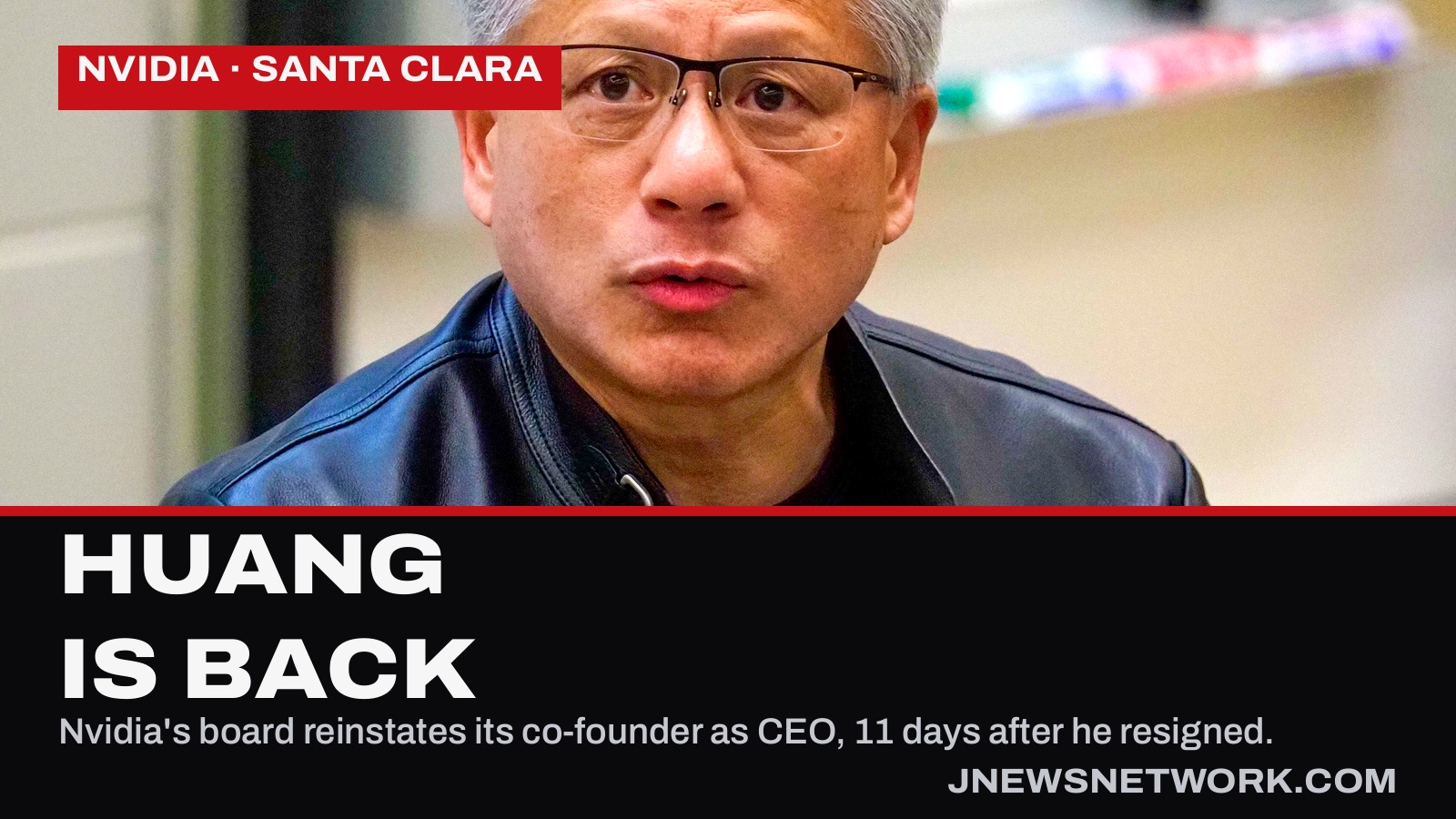
SANTA CLARA, Calif. — Nvidia’s board of directors voted unanimously to reinstate Jensen Huang as the company’s president and chief executive officer, effective immediately, the company announced Monday — 11 days after Huang resigned the posts, and a reversal that returns the executive whose company stands behind the $105 billion credit backstop for the planned data center campus at the Portsmouth Gaseous Diffusion Plant site in Pike County, Ohio.
The board said it reached the decision after “a series of discussions and meetings with Mr. Huang, after which the Board was satisfied with respect to Mr. Huang’s candor and ability to lead NVIDIA,” according to the company’s announcement. The board also said it “received input from senior levels of the United States government, and based on that input, the Board is confident that Mr. Huang’s reinstatement poses no national security risk.”
“The Board believes Jensen is the right person to lead NVIDIA, and that his reinstatement is in the best interests of our stockholders, employees, partners and customers,” said Harvey C. Jones, chair of the board. Jones thanked Colette Kress “for her outstanding service as interim CEO, in addition to her continuing responsibilities as NVIDIA’s Chief Financial Officer,” and said he will remain as board chair.
“I am honored to return to NVIDIA and lead one of the most consequential technology companies in the world at the beginning of a new industrial revolution,” Huang said in the announcement. “I take this responsibility with the greatest humility and renewed commitment.”
What it means for Pike County
Huang’s resignation on Nov. 12 put a question mark over the largest economic development commitment in southern Ohio: $105 billion of Nvidia credit support standing behind the data center campus planned for the PORTS site near Piketon. As J News Network reported Nov. 18, Kress told investors on the company’s earnings call that the credit support survived the change of chief executives intact, naming the Piketon project and putting its first capacity on a calendar-2028 timeline. Huang’s return puts the co-founder who built Nvidia — and under whom the Pike County commitment was made — back in charge of it.

Why he left, and what is still open
Huang resigned following revelations of extramarital affairs, including one with a woman U.S. officials are investigating as an alleged Chinese spy, according to reporting by Reuters and The Wall Street Journal. Nvidia’s announcement Monday did not address the affairs. It said a committee of independent directors, assisted by independent counsel, is investigating “recent reporting that Mr. Huang has been the target of a foreign intelligence effort,” and that “the committee’s investigation will proceed to conclusion,” with Huang’s full support and cooperation.
The board also said it has formed a National Security and Export Control Committee of independent directors to oversee trade compliance and national security risks, is searching for a new chief compliance officer, and “will continue to cooperate with ongoing government investigations and inquiries.”
The reinstatement is a reversal: as recently as last week, Nvidia’s board was reported not to be considering bringing Huang back. President Donald Trump, who had publicly urged the board to reinstate him, praised the decision in a Truth Social post Monday, calling it “the correct and proper decision” and Huang a “Great Patriot and National Treasure,” according to CNN and The Wall Street Journal. Nvidia shares, which had lost roughly a third of their value since Huang’s resignation, jumped about 30 percent in early trading Monday, according to market reporting by Investopedia and Barron’s.