


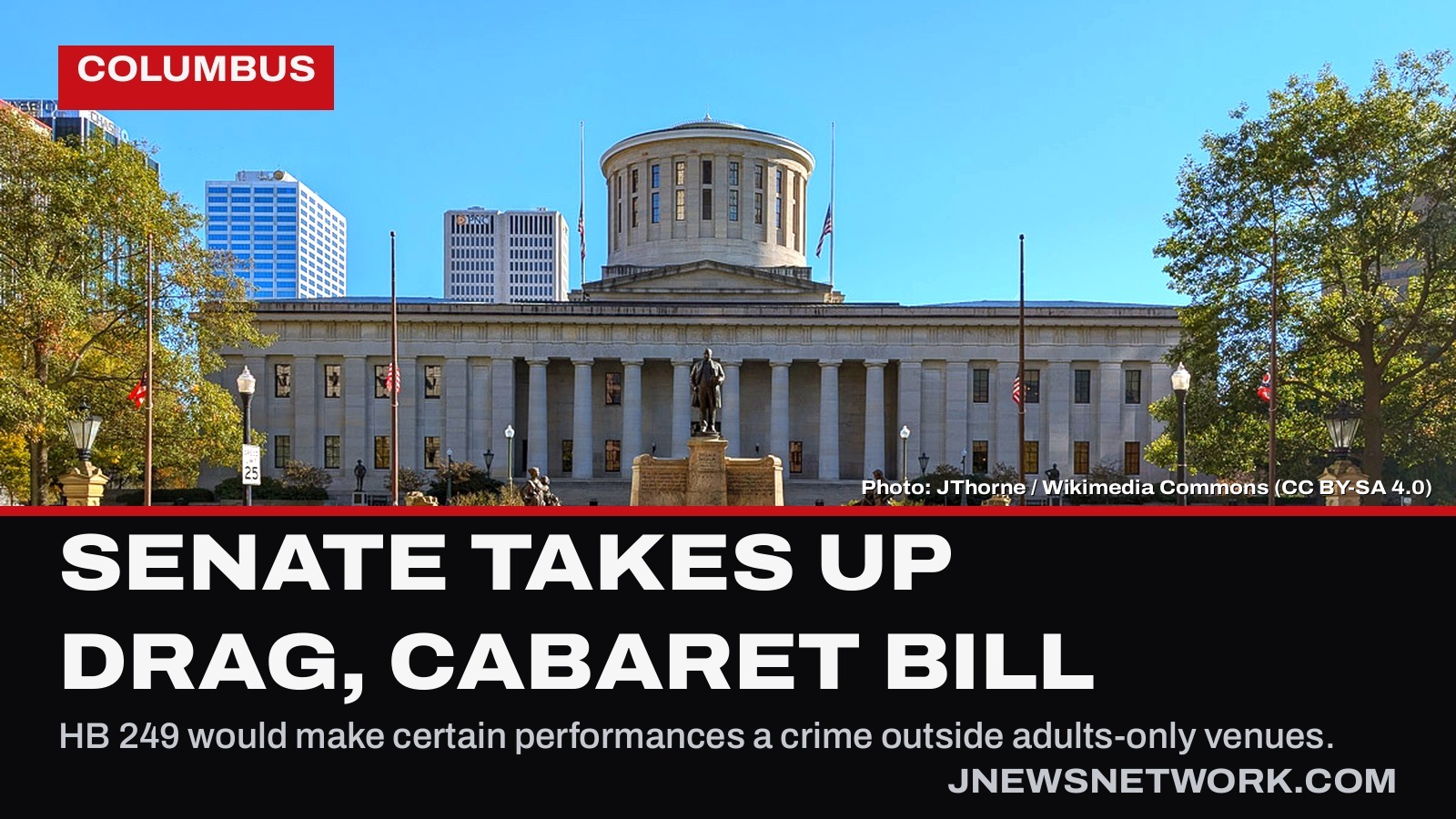
COLUMBUS, Ohio — A bill that would make it a crime to stage certain drag and cabaret-style performances outside adults-only venues received its first Ohio Senate hearings this week, as lawmakers took up the measure in the post-election session.
The Senate Judiciary Committee heard sponsor testimony Tuesday and testimony from supporters Wednesday on House Bill 249, the Indecent Exposure Modernization Act. The bill, sponsored by Reps. Angie King and Josh Williams, both Republicans, passed the House 63-32 on March 25 and had sat in the Senate committee since April before this week's hearings.
The committee adopted a substitute version of the bill at Tuesday's hearing, according to the committee's minutes. The substitute's text had not been posted to the legislature's bill page as of Thursday, and the penalties and definitions below are from the House-passed version, as analyzed by the Legislative Service Commission.
What the bill would do
The bill would create a new criminal offense, "unlawful adult cabaret performance," for recklessly staging an "adult cabaret performance" anywhere other than an adult cabaret — a nightclub, bar or similar establishment that regularly features nudity or sexual performances — according to the commission's analysis.
Under the bill text, an "adult cabaret performance" is a performance in a place where minors may be present that is "harmful to juveniles" or "obscene," whether or not anyone is paid, and that features topless dancers, go-go dancers, exotic dancers, strippers or "performers or entertainers who exhibit a gender identity that is different from the performer's or entertainer's biological sex using clothing, makeup, prosthetic or imitation genitals or breasts, or other physical markers."
In the House-passed version, the offense would be a first-degree misdemeanor if committed in the presence of a juvenile, a fifth-degree felony if the performance is obscene, and a fourth-degree felony if the performance is obscene and a child under 13 is present, the commission's analysis says. The bill would not apply to a bona fide film, theatrical or other artistic performance that is not obscene or harmful to juveniles, or to a performance in a private residence where no minors are present.
The bill would also rewrite Ohio's public indecency law, replacing the term "private parts" with "private area" — defined in existing law as the genitals, pubic area, buttocks, or female breast below the top of the areola, whether nude or covered by an undergarment — and would add an exception for breastfeeding, according to the analysis. It would amend sections 2907.09, 2907.39 and 4301.25 of the Revised Code.
Sponsors call it child protection; critics call it a drag ban
"House Bill 249 has one purpose . . . to protect Ohio children," King told the committee in her sponsor testimony Tuesday.
King testified that "this bill makes no restrictions or claims on adult activity. There is no viewpoint or sexual orientation discrimination as this bill applies to ALL adult cabaret performances." She told the committee the bill grew out of a performance at a family event in a city park in her own community, where, she said, adults danced for children who handed them dollar bills.
Wednesday's hearing drew testimony from supporters including officials and advocates from Celina, Greenville and the Center for Christian Virtue, along with at least one opponent, according to the committee's witness list.
The ACLU of Ohio, which flagged the hearings this week and is urging senators to vote no, says the bill "seeks to limit drag performances to strip clubs and similar locations, making it a crime to perform in drag in other places where a minor may be present", and that it relies on "notoriously vague legal standards" for what counts as obscene or harmful to juveniles. The group's legislative director, Gary Daniels, has called the act's provisions "vague, overbroad, and nonsensical" in testimony against the bill.
What happens next
The committee took no vote on the bill itself at either hearing, and the measure remains in the Senate Judiciary Committee, chaired by Sen. Theresa Gavarone, according to the official bill status and the Senate's committee schedule. To become law, the bill must still be voted out of committee, pass the full Senate — with any Senate changes going back to the House for agreement — and be signed by the governor, all before the two-year General Assembly ends at the end of the year. If it does not pass by then, it dies and would have to be reintroduced in January.