

WASHINGTON — Three Vietnam veterans sued to keep President Donald Trump’s 250-foot arch away from Arlington National Cemetery. On Thursday night, a federal judge stopped the project cold — hours after Trump’s own planning panel voted to build it.
U.S. District Judge Tanya S. Chutkan ordered the government to keep every shovel out of the ground at Memorial Circle for 14 days. No construction. No excavation. No demolition, no digging, no road closures for the arch — nothing.
Earlier that same night, the National Capital Planning Commission voted 8-4 to approve the arch after more than 120 people testified over eight hours. Most of them said no.

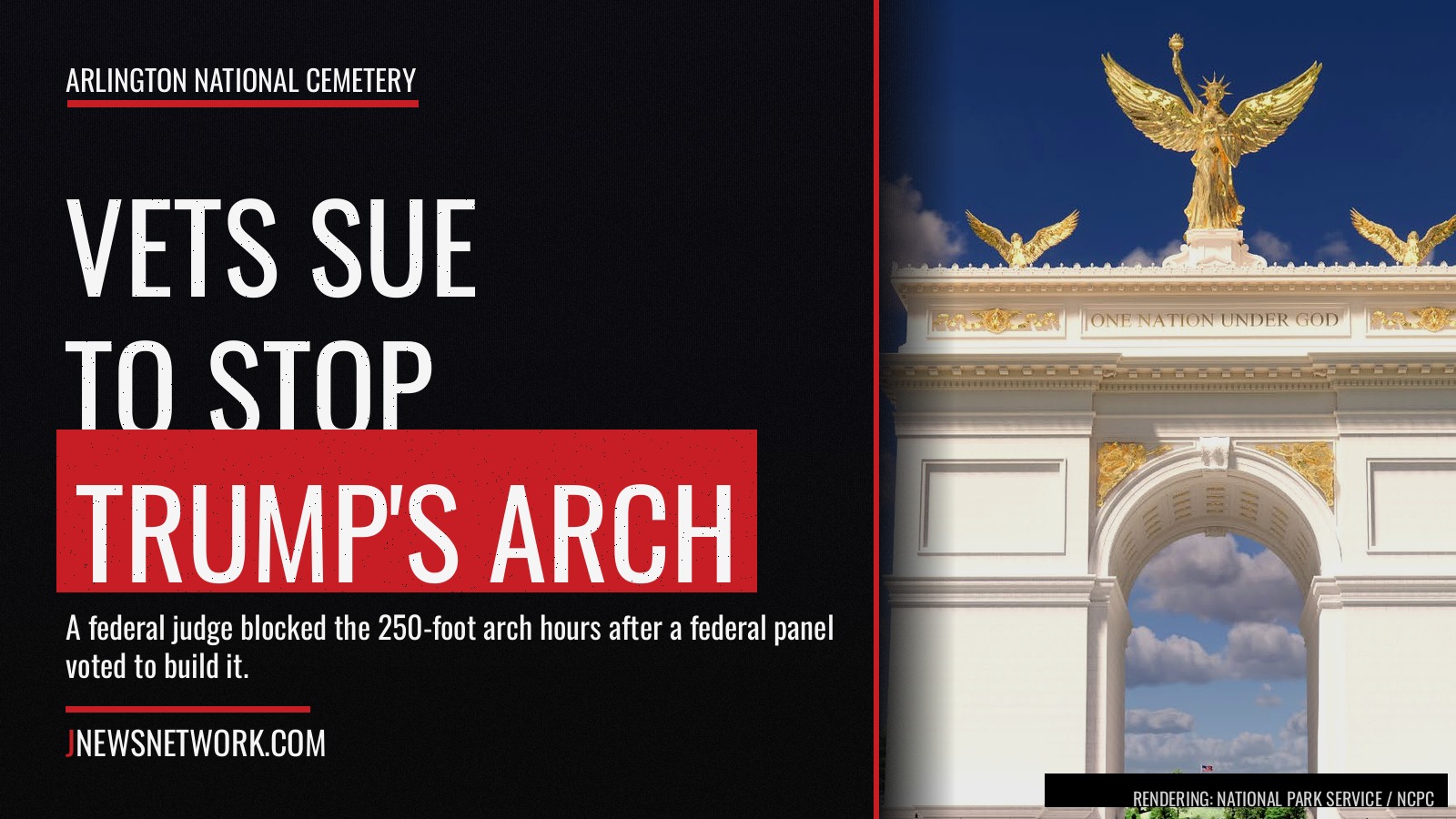
The arch would stand in Memorial Circle, the traffic circle at the Virginia end of Arlington Memorial Bridge, facing the cemetery. The structure itself is 166 feet tall; three gilded statues on top carry it to 250 feet — more than twice the height of the Lincoln Memorial. The administration’s renderings show a white arch topped with a golden winged figure and the words “One Nation Under God,” planned as a centerpiece of the nation’s 250th anniversary.

Trump has been showing off a model of the arch in the Oval Office, and the plan moved fast. The U.S. Commission of Fine Arts approved the design in May. The planning commission gave preliminary approval in July. The administration told the court construction could start the very day of the final vote — and a filing the night before the vote laid out plans to stage construction equipment off-site so work could begin the moment approval landed.
The veterans filed first. Michael Lemmon, Shaun Byrnes and Jon Gundersen — all Vietnam veterans — sued the president in February, joined by architectural historian Calder Loth (Lemmon v. Trump, No. 26-cv-544, U.S. District Court for the District of Columbia). Their case comes down to one sentence: Congress never approved this. Federal law — the Commemorative Works Act and a statute on the books since 1912 — says no structure may be built on federal park land in the capital “without express authority of Congress.” Congress never voted on the arch.
Lemmon flew helicopters in Vietnam. He went in September 1967, a 21-year-old Army warrant officer, and flew combat for 13 months. He later built a career at the State Department. On Thursday, he stood at a microphone in Washington and said this:
“I have a duty as a Vietnam vet, as a survivor, to my buddies buried there, to honor their sacrifice and protect their memory from this vainglorious monument.”
Vietnam veteran Michael Lemmon, the lead plaintiff in the lawsuit, speaks against the arch in Washington on Nov. 5. (Video: Public Citizen)
“This is not just another park,” Lemmon said. “This is something more profoundly important and incomparably different. We have to remember that. Respect it. Honor it. Protect it.”
More than 400,000 service members, veterans and family members are buried at Arlington. The veterans, represented by the Public Citizen Litigation Group, say the arch would break the sightline between the Lincoln Memorial and the cemetery and tower over ground that is supposed to stay quiet.

The emergency order itself came in a second lawsuit, filed Oct. 31 by the District of Columbia and the Commonwealth of Virginia, whose attorneys general say the project violates federal monument, environmental and historic-preservation law. Chutkan combined the cases and found D.C. and Virginia are likely to succeed on the core point — that the arch requires specific authorization from Congress. Arlington County, where the cemetery sits, has also sued to block the project. The veterans’ own request for an injunction is still pending; the judge held it in abeyance while she ruled on the emergency order.
The administration says it does not need Congress. Justice Department lawyers argue a 1925 law authorizing construction at Arlington Memorial Bridge already covers the arch. They told the court the arch is a “high-priority project,” and that making the government wait would seriously infringe on the work of the federal government. In recent filings, affidavits from Defense Secretary Pete Hegseth and Homeland Security Secretary Markwayne Mullin said the structure could serve a national-security purpose, including drone defenses. The government’s lawyers also argued the veterans’ objection amounts to being offended by the arch — and that being offended is not the kind of legal injury that gives anyone standing to sue.
At a hearing last week, Chutkan put the question to the government’s lawyer directly: “What’s the harm to the government to wait three or four months? What’s the rush to put this arch up?” She asked whether the president’s main desire is to “bedazzle the city.”
Not every veteran is against it. Kevin Lilly, an Interior Department official serving on the planning commission, said he voted as a veteran with loved ones buried at Arlington — and that the arch would be a tribute to the people buried there, not a distraction from them.

Now the clock runs. The judge ordered the government to certify by Monday, Nov. 9, that every employee and contractor has stopped work. The restraining order lasts 14 days. Still ahead: rulings on the veterans’ injunction request and on the motions that will decide the case itself.
The question underneath all of it is the one the veterans asked in February: can a president build a 250-foot monument on public land when Congress never said yes?