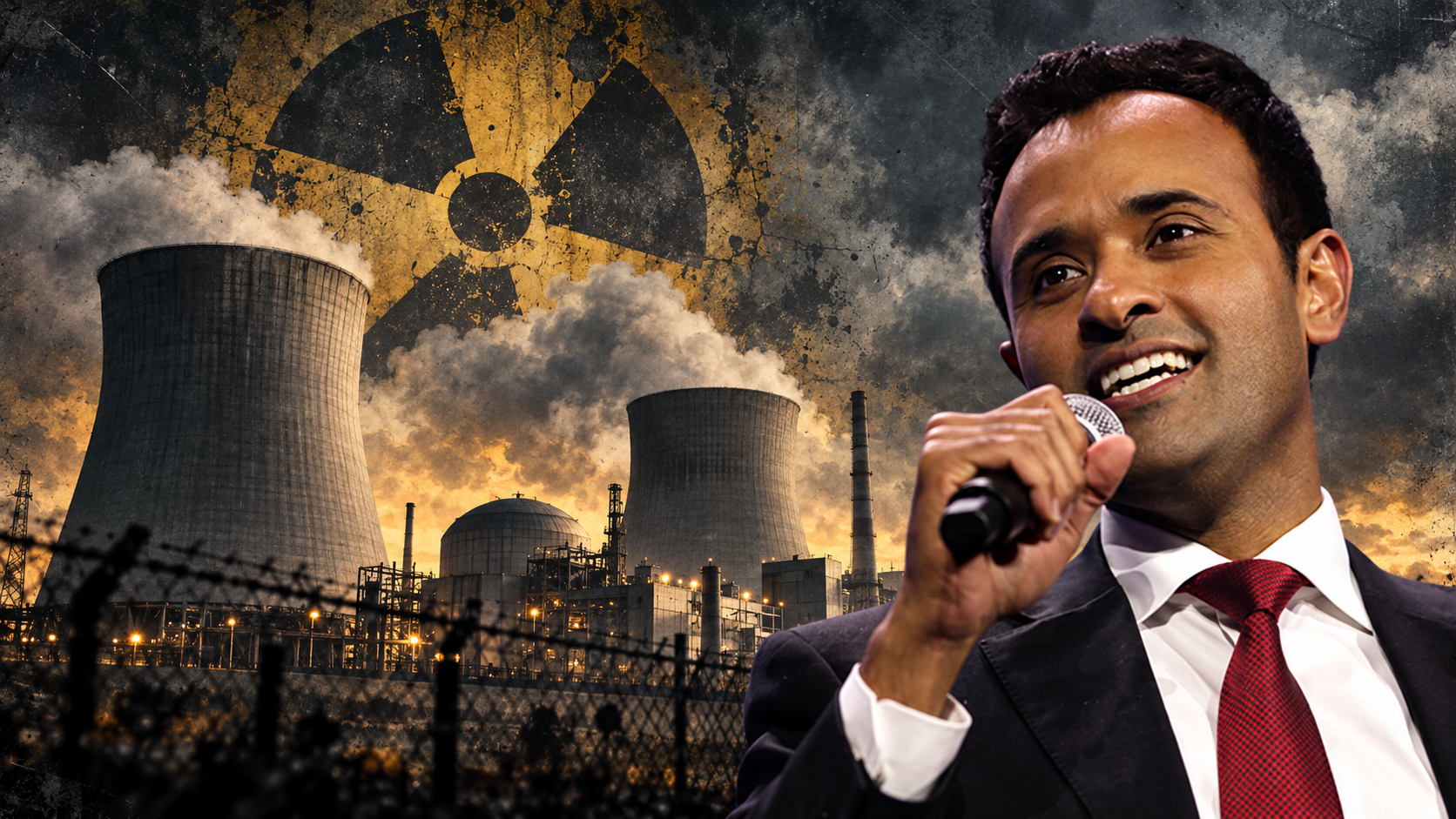
A nuclear startup co-founded by Republican gubernatorial candidate Vivek Ramaswamy has raised $400 million at a valuation of roughly $1.9 billion, according to Bloomberg reporting this week — putting a candidate for Ohio’s highest office at the financial center of a nuclear company whose future depends on the decisions a governor makes.
Atlas Atomics, still in stealth mode, is developing an improved heavy-water reactor design that would not rely on enriched uranium. General Catalyst led the Series A round; Andreessen Horowitz participated. The company is run by co-founder Kevin Gan, a former Millennium hedge fund investor, and Balendra Sutharshan, a former chief operating officer of Oak Ridge National Laboratory, as chief nuclear officer. Ramaswamy’s ownership percentage has not been disclosed.
Ramaswamy faces Democrat Amy Acton in next month’s gubernatorial election. He has made nuclear expansion a core plank of his campaign, publishing a video last year describing nuclear energy as the driver of “America’s next revolution.” Musk gave $5 million to the pro-Ramaswamy super PAC Victors Not Victims in the second quarter.
The question for Ohio is not whether nuclear power has a role in the state’s energy future. It is whether Ohioans are about to elect a governor — or a salesman.

A $1.9 billion valuation for a reactor that doesn’t exist yet
Start with what Atlas Atomics has actually built: nothing the public can evaluate. The company remains in stealth mode. No reactor design has been published. No development timeline has been shared. No engagement with the Nuclear Regulatory Commission has been disclosed. What investors bought this week, at a $1.9 billion valuation, is a team, a concept, and a political tailwind — President Trump has signed an executive order aiming to quadruple U.S. nuclear capacity by 2050, and investors have poured $4.6 billion into American nuclear startups this year.
That is the market’s business. Ohio’s business is different: the man who co-founded the company is asking voters to hand him the regulatory apparatus that will decide where, how, and under what conditions nuclear facilities get built in this state.
An Ohio governor appoints the members of the Public Utilities Commission of Ohio, appoints the director of the Ohio Environmental Protection Agency, and sits atop the state machinery — including the Ohio Power Siting Board process — that determines whether major energy facilities get built and where. A governor who holds a personal financial stake in a nuclear startup valued at nearly $2 billion would hold those levers while his own net worth rides on the industry’s expansion. Ramaswamy has not disclosed the size of his Atlas stake, nor said whether he would divest it if elected.
The technology has a footprint nobody is discussing
Atlas is betting on heavy-water reactor technology — the design family behind Canada’s CANDU reactors. The pitch is economic: no enriched uranium means cheaper fuel and less dependence on the enrichment supply chain. What the pitch leaves out is the environmental trade.

Heavy-water reactors are the only commercial reactor design that routinely produces large quantities of tritium, a radioactive isotope of hydrogen created when radiation strikes the heavy water itself. Most of it is captured. About one percent routinely escapes into the environment around operating plants — a higher routine release profile than conventional light-water reactors of comparable size. Tritium cannot be seen, smelled, or tasted. In 1992, an accident at Canada’s Pickering station released tritium into Lake Ontario. Greenpeace published a full critique of CANDU tritium emissions in 2007; the controversy over the isotope’s health effects has never been resolved to the satisfaction of the communities living near these plants.
None of this means heavy-water reactors cannot be operated safely. It means Ohioans deserve to hear about the trade-offs from someone other than the man selling the reactors. So far, the entire public conversation about Atlas Atomics consists of a fundraising announcement.
They’re already shopping for states
Atlas Atomics has already moved beyond introductory discussions with at least one state. On June 2, Atlas CEO Kevin Gan and Utah Office of Energy Development Director Emy Lesofski signed a memorandum of understanding to explore the siting, development, and potential operation of an Atlas heavy-water reactor facility at a proposed Utah nuclear campus. The agreement identifies a roughly 20-megawatt test reactor and a roughly 350-megawatt commercial reactor and calls for evaluating sites, regulatory and environmental requirements, isotope production, spent-fuel recycling and potential state, local and federal financial support. The agreement is nonbinding.
Follow the money around the candidate and the pattern sharpens. Ramaswamy’s April financial disclosure filed with the Ohio Ethics Commission lists holdings in NVIDIA, Microsoft, Amazon, and Apple — the chipmaker and the hyperscalers building the AI data centers devouring electricity — plus a semiconductor fund from Strive, the investment firm he founded. Musk’s $5 million landed in the pro-Ramaswamy super PAC, V-PAC, in the second quarter. The same Silicon Valley firms now capitalizing Atlas Atomics — General Catalyst, Andreessen Horowitz — swim in the waters where Ramaswamy made his fortune. The nuclear startup, the data center boom, the campaign, and the investment portfolio are not separate stories. They are one story about who profits when Ohio’s energy future gets decided.
Ohio has paid for nuclear boosterism before
This state does not need to imagine what happens when nuclear ambition outruns oversight. In 2002, workers at the Davis-Besse plant near Oak Harbor discovered that boric acid had eaten a football-sized cavity through the reactor vessel head, leaving a stainless steel liner less than half an inch thick as the only barrier against a loss-of-coolant accident. Federal investigators later called it one of the closest near-misses in American nuclear history — a direct product of a culture that prioritized production over inspection.
Down in Piketon, the Portsmouth Gaseous Diffusion Plant left a legacy of deliberate radioactive gas vents — the “midnight rockets” — and a surrounding community still living with the consequences decades later. These are not arguments against nuclear energy. They are arguments against letting the people who profit from nuclear energy also write the rules for it.
The questions Ramaswamy won’t answer
A neutral press would treat this as a business story: startup raises money, valuation impresses. But the business story is inseparable from the political one, and the political one has unanswered questions that go to the heart of whether Ohio’s next governor can be trusted to regulate an industry he co-owns:
How large is Ramaswamy’s personal stake in Atlas Atomics, and will he divest it if elected? Has the company had any contact with the Nuclear Regulatory Commission about licensing its design? Has Atlas had any discussions — formal or informal — with Ohio officials about siting a reactor or facility in the state? And if elected, would he recuse himself from every state decision affecting the nuclear industry?
The $1.9 billion valuation does not establish the value of Ramaswamy’s personal interest in Atlas Atomics; the size of that interest has not been publicly disclosed. But the financing gives new urgency to questions that can be answered before Election Day: what does Ramaswamy own, what would he retain as governor, and what safeguards would he put in place when state decisions intersect with the nuclear company he helped create?