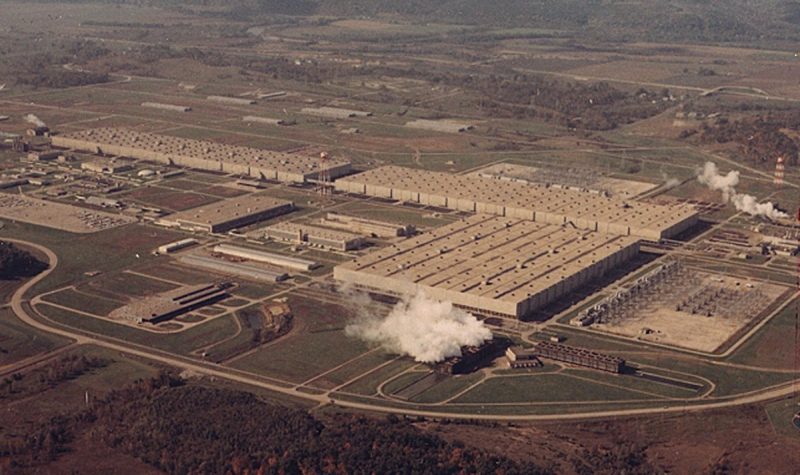
PIKETON, Ohio — The U.S. Department of Energy is seeking Ohio EPA approval to abandon 60 groundwater monitoring wells at the former Portsmouth Gaseous Diffusion Plant in Piketon as the site moves toward construction of a planned data center campus.
The request, dated Aug. 11, 2026, was submitted by the DOE Portsmouth/Paducah Project Office to Ohio EPA’s Southeast District Office.
According to the letter, the wells are located within the footprint of what DOE calls the Industrial Reuse Areas, where construction of the planned data center and associated infrastructure is expected to occur.
The wells are being targeted for abandonment as part of the work needed to prepare the property for redevelopment.
But the wells are not simply abandoned pieces of infrastructure.
DOE’s own letter states that 27 of the 60 wells currently are part of the site’s Integrated Groundwater Monitoring Plan and are actively sampled.
That means the proposed abandonment will eliminate monitoring locations that are currently being used to evaluate groundwater conditions at the former nuclear weapons production site.
Sixty wells targeted
DOE provided Ohio EPA with a list identifying the 60 wells proposed for abandonment.
The wells include monitoring locations associated with areas of the former plant identified by DOE as X-746, X-747F, X-749A and X-750, among others.
The list identifies wells serving a variety of purposes, including legacy monitoring, post-closure monitoring, plume-extent monitoring, RCRA-related monitoring, underground storage tank monitoring and other investigations.
Several of the X-749A wells are specifically identified as part of the site’s Integrated Groundwater Monitoring Plan.
DOE says the wells will not all be removed simultaneously.
Instead, abandonment will occur in phases, depending on the schedule for individual data center buildings and infrastructure projects.
Monitoring will continue — until construction reaches the area
DOE’s letter acknowledges that some of the wells provide active groundwater monitoring.
The agency says wells in the X-749A and X-740 areas will remain in place until work in those areas is about to begin.
According to DOE, this is intended to allow monitoring to continue until an area is either removed or otherwise affected by construction.
For X-749A, DOE says monitoring will continue until work involving the landfill begins.
For X-740, monitoring will continue until the excavation area is affected.
But once the construction schedule reaches those locations, most or all of the Integrated Groundwater Monitoring Plan wells in those areas will be removed.
That raises an important environmental question: what happens to groundwater monitoring once those wells are gone?
DOE’s letter acknowledges that additional monitoring may eventually be necessary.
DOE says new wells may be needed
The agency says that after several planned and ongoing remediation projects are completed, a new regulatory mechanism may be needed to evaluate groundwater conditions in areas associated with previous demolition and soil excavation projects.
DOE says it will then work with Ohio EPA to consider a comprehensive revision of the Integrated Groundwater Monitoring Plan.
That revision, DOE says, may include installation of several new groundwater monitoring wells, along with new sampling, analysis and reporting requirements.
The wording is significant.
The letter does not say that replacement wells will immediately be installed for every well being abandoned.
Instead, DOE says potential replacement-well needs will be identified through future environmental restoration progress reports, annual groundwater monitoring reports or other means.

How the wells will be destroyed
The proposed abandonment process involves physically removing the wells and sealing the underground boreholes.
DOE says its contractors will follow applicable site procedures and Ohio EPA’s technical guidance for sealing decommissioned monitoring wells.
The wells will be over-drilled, with the resulting boreholes grouted all the way to the surface.
Concrete pads, protective casings and bollards, where present, will be removed.
Well construction materials such as risers and protective casing will be removed and reduced in size as necessary for waste management.
DOE says waste debris and residual soil may temporarily be placed on plastic sheeting near the work area.
If materials must be reduced in size to meet acceptance requirements for the site’s On-Site Waste Disposal Facility, the work is expected to occur near the well-abandonment area.
DOE says resulting materials destined for on-site disposal will be classified for disposal in the facility as Type 2 waste, or alternatively shipped off-site for disposal.
The wells are being removed before major redevelopment work
DOE describes the well abandonment as an initial step in establishing the site area for construction of the planned data center and its supporting infrastructure.
The agency says the wells will be abandoned before excavation of remaining groundwater plumes, landfills and deferred units, as well as before work involving utilities and demolition of buildings and structures within the Industrial Reuse Areas.
That means the well removals are directly tied to the broader redevelopment of portions of the former atomic plant.
The property, once home to uranium-enrichment operations, is now undergoing extensive environmental remediation and demolition as portions of the site are prepared for new industrial uses.
The environmental questions remain
The DOE letter does not claim that abandoning the wells will eliminate the need for groundwater monitoring.
In fact, the document acknowledges the opposite.
DOE anticipates that future monitoring requirements may need to be established after remediation and construction activities change the site.
The issue is therefore not simply whether 60 wells can be physically sealed.
The larger question is how groundwater contamination will be tracked as the landscape of the former atomic plant is dramatically altered.
The DOE letter specifically references remaining groundwater plumes, landfills, and deferred units that will undergo future work.
At the same time, some of the wells proposed for abandonment are currently part of the site’s established groundwater monitoring system.
DOE is asking Ohio EPA to concur with the abandonment request so field work can begin.
If Ohio EPA grants that concurrence, the wells will be removed in phases as construction projects require the land.
The agency says all well abandonment activities will be documented in DOE’s quarterly progress reports, while removals involving the Integrated Groundwater Monitoring Plan will also be documented in environmental restoration technical progress reports.
For a site with a decades-long history of uranium enrichment and environmental contamination, those records will be important to understanding whether groundwater monitoring is simply being relocated as part of remediation — or whether monitoring gaps could emerge as redevelopment accelerates.
The wells may be coming out of the ground. The contamination they were installed to monitor does not necessarily go with them.